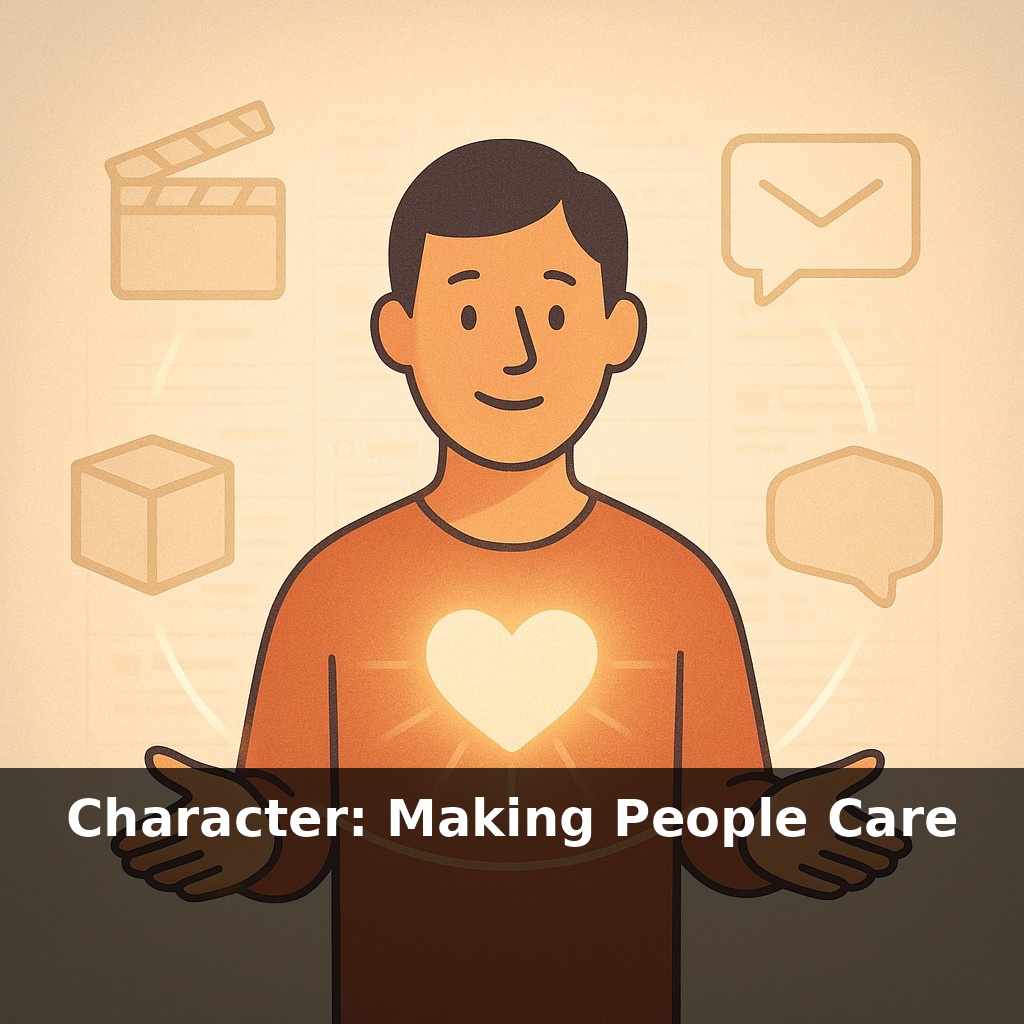
A single well-told story about one person can raise more money for charity than a whole slideshow of facts. In this episode, we’ll step into three tiny scenes—a movie, a brand, and a real customer—and ask: why do we care about some people on paper, and not others?
Most storytellers focus on what happens. Strong storytellers focus on who it happens to. The difference sounds small, but in the brain it’s enormous. When we meet a character—on screen, in a sales deck, or in a customer email—our social circuitry lights up as if we’re dealing with a real person. That’s when attention stops being polite and starts becoming personal.
In this episode, we’ll look at characters as decision-making shortcuts. A movie hero can carry an entire theme on their shoulders. A quirky brand mascot can make a complex product feel instantly familiar. A specific customer, quoted in a case study, can nudge someone from “sounds interesting” to “this is for me.”
Instead of asking, “Is my story emotional enough?” we’ll ask a sharper question: “Is there someone here my audience can actually care about?”
Think about the last time a character stuck in your head days after you closed the book or left the theater. It probably wasn’t because of special effects or flawless logic. More likely, something about what they wanted, what they could lose, and how they changed felt uncomfortably close to your own life. That’s the territory we’re exploring now: not “likable” or “relatable” in the vague sense, but the specific levers that make a person on the page feel like a person in the room—and how those levers quietly shape what your audience remembers, believes, and eventually does.
Let’s zoom in on the three levers you can actually control: motivation, vulnerability, and change. Think of them less as “literary terms” and more as knobs you can twist to make any person in your story feel sharper and closer.
Motivation is the “why now?” under the surface. Not a generic goal (“hit Q4 targets”), but the itch that won’t go away. A founder doesn’t just want users; she’s trying to prove the people who wrote her off were wrong. A nonprofit volunteer isn’t just “helping”; he’s paying forward the help he once got and never forgot. When you state that kind of personal “why,” audiences stop seeing a role and start seeing a person.
Vulnerability is where the risk leaks through. What could this character actually lose if things go badly—status, safety, self-respect, a relationship? Data can mention stakes in abstract terms; characters let us feel those stakes land on someone. A cybersecurity company can list breach statistics, or it can follow one IT director who knows that if this goes sideways, she’s explaining it to the board—and to her kids when the overtime doesn’t end.
Change is the payoff. Without it, a character is a cardboard cutout walking through events. Change doesn’t have to be dramatic; it just has to be visible. The prospect who starts cynical and ends cautiously hopeful. The user who moves from overwhelmed to quietly competent. The donor who goes from “someone should do something” to “I’m part of this.” When you track that movement, the audience unconsciously asks, “Could that be me?”
You can build this into anything: a 30-second ad that shows a harried parent before and after using a service; a case study that opens with a customer’s private doubt and closes with a specific win; a keynote that follows one employee wrestling with a new strategy instead of “the organization” in general.
Your job isn’t to invent perfect heroes—it’s to choose one concrete person, dial in what they want, expose what they stand to lose, and let us watch them shift.
A quick way to stress‑test a character is to drop them into tiny, ordinary moments and see if they still feel specific. Take a SaaS founder on demo day. Version A: “She was nervous but determined.” Version B: “She’d rehearsed the opening line so many times her tongue tripped over it, so she tossed the script and opened with the story she’d promised herself she’d never tell in public.” Same situation, but in the second, we glimpse a private rule she just broke. That’s motivation, risk, and shift all showing up in a single beat.
Or look at a customer quote in a deck. Instead of “We improved efficiency,” try: “I stopped dreading the 4 p.m. Slack ping from finance.” That tiny, concrete dread makes the stakes legible. Think of it like adjusting seasoning in a stew: you’re not changing the ingredients, just sharpening the flavor so one person’s inner world cuts through the noise.
Algorithmic feeds already act like weather systems: they amplify whatever “emotional pressure” is strongest. As synthetic personas and VR worlds spread, the characters that rise won’t just be the loudest, but the ones whose inner conflicts feel eerily close to ours. That creates leverage—and risk. Designers will need guardrails, like “nutritional labels” for AI‑driven characters: what they’re optimizing for, what data shapes them, and how intensely they aim to pull you in.
Your challenge this week: Take one existing piece of content (a pitch, landing page, lesson, or slide deck) and identify the “character slot” in it—where a person appears or could appear. Then, run this 10‑minute experiment: without changing the structure, rewrite just 3 sentences to sharpen (1) what that person wants, (2) what they might lose, and (3) how they end up slightly changed. Publish or present only this tweaked version and watch for differences in questions, replies, or conversions.
When you start treating every bio, brand blurb, or user quote as a tiny laboratory, you’ll notice something: the more precisely you sketch one person’s inner weather, the more other people quietly lean in. Keep experimenting. Nudge the dials, watch who responds, and let those reactions become your map for the next voice you bring onstage.
To go deeper, here are 3 next steps:
1. Re-listen to the section where the host breaks down how *specific choices under pressure* reveal character, then grab a scene from your current project and run it through the free “Character Reaction Checklist” in Shaelin Bishop’s YouTube video “5 Ways to Make Readers Care About Your Characters” to tweak how your character responds. 2. Pick one character you’re struggling with and complete the “Character Interview” and “Flaw/Need” pages from K.M. Weiland’s free “Crafting Unforgettable Characters” workbook (downloadable on her site), forcing yourself to answer every question in the most concrete, behavior-focused way possible. 3. Watch the “Lessons from the Screenplay” episode on *Parasite* or *Breaking Bad* (whichever is closer to your story’s tone) and, with your protagonist in mind, pause to map out—line by line—how the main character’s want, fear, and moral choice escalate, then mirror that same escalation pattern in the next three beats of your own story outline.