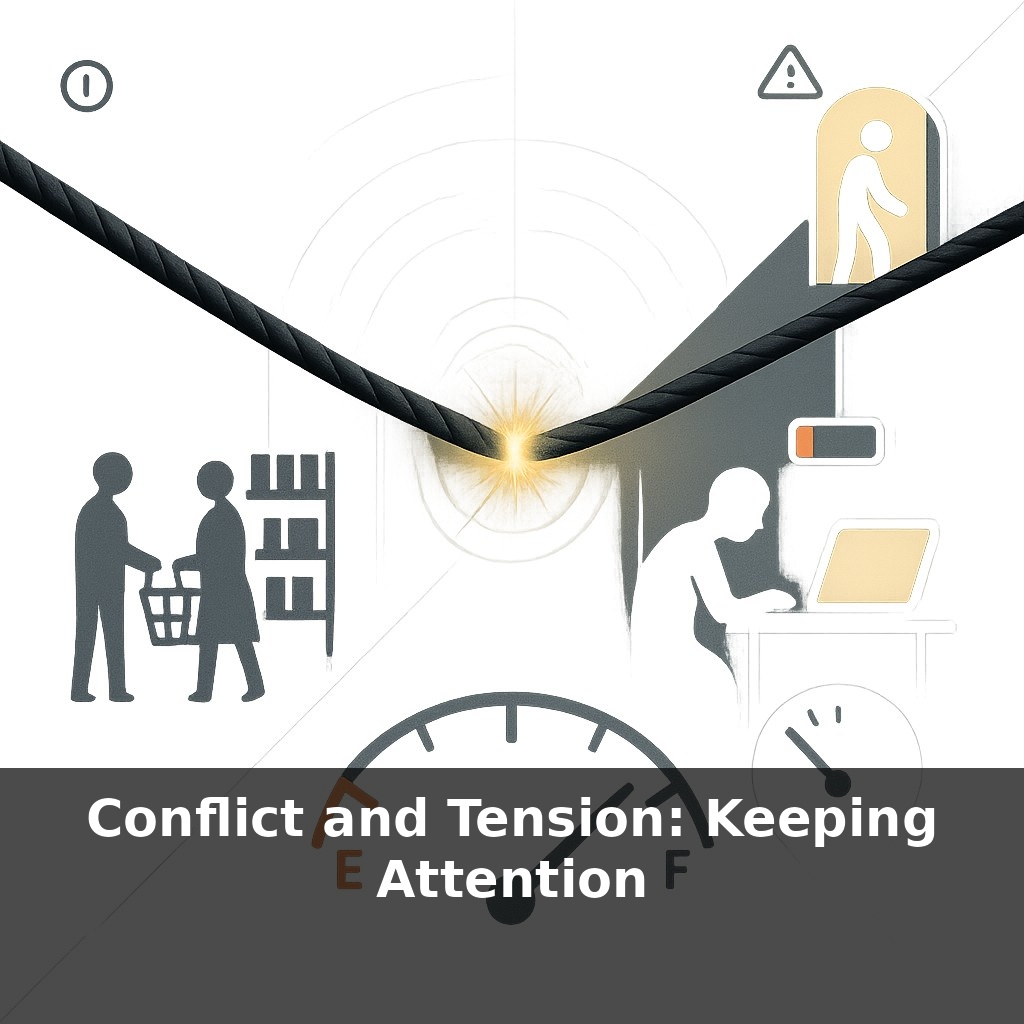
Most people click away from a video in under a minute, not because it’s boring, but because nothing is at stake. A couple argues in a grocery aisle. A startup’s cash hits near zero. A hero hesitates at the door. Same secret ingredient: rising conflict that makes you lean in.
Conflict isn’t just for action movies or courtroom dramas; it’s the quiet engine behind any story that holds attention. A founder refreshing their bank app before payroll clears. A parent watching the school nurse dial their number. A scientist staring at data that shouldn’t exist. None of these scenes need explosions—but they all contain a clear “uh‑oh” that keeps us watching.
What actually hooks us is not noise, but uncertainty: Will this work or not? Will they make it or fail? As that uncertainty intensifies, our brains lean forward, hunting for the next beat. This is why even a cooking video becomes addictive when the sauce might split or the cake might collapse. In this episode, we’ll look at how to design that sense of “uh‑oh” on purpose—how to set up problems, escalate them, and delay resolution just long enough that your audience can’t look away.
That “uh‑oh” moment doesn’t have to be dramatic; it just has to collide with something the audience cares about. In practice, strong tension grows from three ingredients: a clear goal, a meaningful obstacle, and a ticking sense of “not yet.” A founder racing a launch date against a competitor. A teacher trying to reach one student before the semester ends. A gamer stuck on the last boss with one life left. As stakes rise, we start predicting, taking sides, and mentally rehearsing outcomes—turning passive viewing into active participation. In the next section, we’ll turn this into concrete, repeatable story moves.
Here’s the practical layer: once you know what your character wants, what’s in the way, and why it can’t wait, you still have to *shape* the path between “uh‑oh” and “aha.” That path lives in the *beats*—the tiny turns that either tighten attention or let it leak out.
One useful lens: think in *questions*, not events. Every key moment should plant or sharpen a specific question in the audience’s mind.
- Instead of: “She presents to the board.” - Try: “She discovers one fatal flaw minutes before the board meeting—and has to choose whether to reveal it.”
The event is similar; the question is not. We go from “How will this meeting go?” (vague) to “Will she risk her reputation to tell the truth now?” (specific, loaded).
You can check your story by pausing at any point and asking: *What is the audience dying to know right now?* If you can’t answer in one clear sentence, the line of tension is fuzzy.
Layer on *reversals.* A reversal is a beat where expectations flip:
- The investor everyone fears becomes the surprising ally. - The “easy” workaround creates a bigger problem. - The rival admits they share the same deeper goal.
Reversals matter because they update the audience’s mental prediction model. Our brains reward us for adjusting to surprise that still feels *inevitable in hindsight.* Too random, and we feel cheated; too predictable, and attention drifts.
Timing is another lever. Notice three useful placements:
1. **Early jolt:** Introduce a small but concrete snag quickly, so we’re tracking a live thread. 2. **Midpoint squeeze:** Add a complication that forces a change of plan, not just more effort on the same path. 3. **Late-choice fork:** Present a decision where any option has real cost—no clean win.
In a product demo, that might look like:
- Early: the old workaround breaks mid‑presentation. - Mid: the new solution seems to fail in a high‑stakes scenario. - Late: the team must decide whether to ship with a known flaw or miss the season’s buying window.
Think of these placements less as a formula and more as waypoints. Between them, you can let the pressure breathe: small wins, moments of doubt, glimpses of hope. Those fluctuations keep engagement sustainable rather than exhausting.
Think of your story beats like steps in a recipe: each one should either add heat, add flavor, or change the texture of what’s happening. In practice, you can do that with three simple moves:
1. **Narrow the options.** Each turn should quietly remove an easy way out. The marketing team doesn’t just have a weak headline; legal bans their strongest claim. Fewer paths remain, so each choice feels sharper.
2. **Shift who holds power.** A junior engineer spots a flaw the CTO missed. A quiet customer on a sales call asks the one question nobody can answer. When power tilts, attention spikes.
3. **Expose a hidden cost.** The shortcut saves time but burns trust with a partner. The donation surge crashes the nonprofit’s outdated systems. Wins that come with side‑effects keep us leaning in.
Notice how these moves stack: first the easy doors close, then the wrong person gains leverage, then each “fix” leaves a bruise. Used sparingly, they turn even quiet stories into ones people replay and share.
As attention tools sharpen, you might not just *watch* a story—you’ll stand inside branching moments. A VR sales pitch could let you pick the risky strategy and feel the room react, like adjusting a recipe mid-cooking and tasting the result. Platforms may offer “intensity sliders” for narrative pressure, the way you now set brightness or volume. The frontier isn’t only “more gripping”; it’s stories that adapt to your limits, not just your clicks.
Treat each new project as a lab: test how small shifts in risk, stakes, or timing change where people lean forward or drift. Let metrics be your telescope, revealing which turns actually pull focus. Over time, you’re not just telling stories—you’re quietly training your own instincts to spot the precise moments where attention wants to live.
Start with this tiny habit: When you catch yourself zoning out during a story in the podcast, quietly say to yourself, “What’s the tension here—what could go wrong?” and answer it in one short sentence. The next time a character is introduced, pause and whisper, “What do they want, and what’s in their way?” in 10 words or less. When the host shifts topics or scenes, quickly ask, “Did the stakes just go up, down, or sideways?” and name just one reason why.