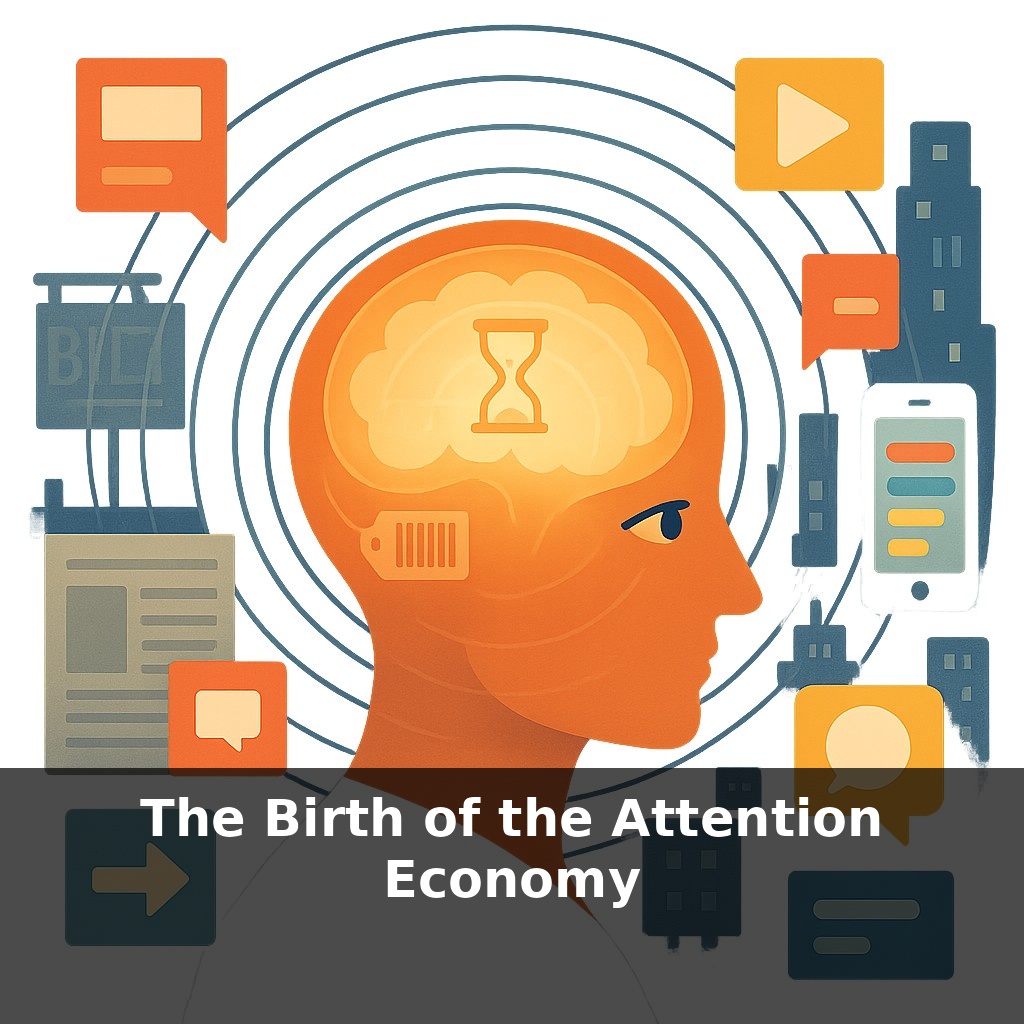
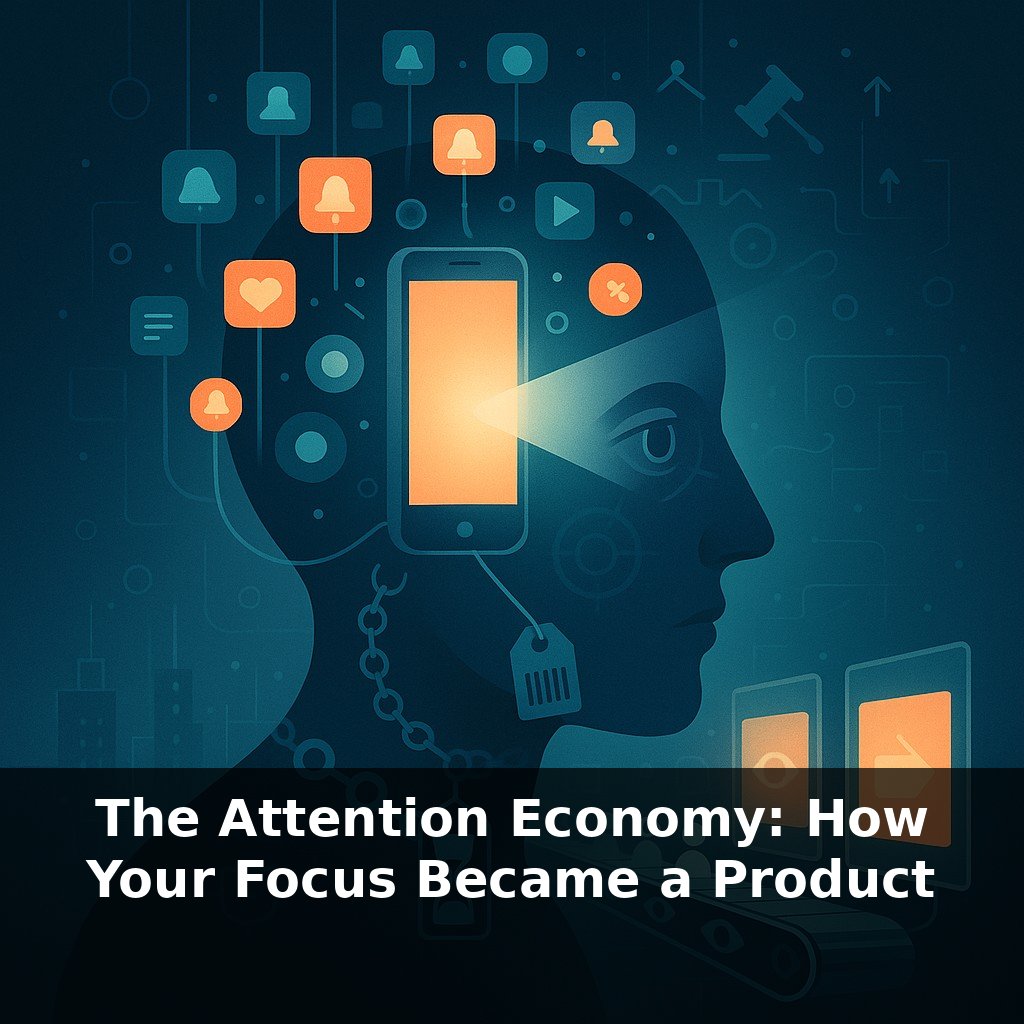
You’ll hear thousands of ads today, and you’ll remember almost none of them—yet they’re quietly shaping what you buy, how you vote, even when you sleep. In this episode, we’ll trace how your attention went from a side effect of media to the most valuable product in the room.
By the late 1800s, something subtle but radical was happening: companies stopped just making products and started competing to occupy mental space. Newspapers thickened with ads. City streets lit up with signs. Brands didn’t just want you to buy soap; they wanted you to *remember* a specific soap when you stood at the store shelf. Over time, that quiet competition hardened into a battle for measurable slices of your day. By the time economist Herbert Simon warned in 1971 that “a wealth of information creates a poverty of attention,” the groundwork was already laid. The 21st century simply finished the job: every scroll, tap, pause, and replay became traceable. Instead of guessing what caught your eye, platforms could count it, price it, and sell it. In this episode, we’ll follow that shift from rough guesswork to real-time auction.
By the early 2000s, a crucial twist appeared: attention stopped being inferred from rough signals and started being *measured* in microscopic detail. Clicks, scroll depth, watch time, cursor movement—each became a proxy for interest. Platforms didn’t just see that an ad was shown; they saw how long it stayed in view, whether you hesitated, whether you came back later. That granularity invited new tactics: notifications timed for when you’re most likely to respond, feeds tuned to keep you just a bit longer, and designs tested against your split-second reactions like a high-speed financial market.
Walk through three moments in time and you can see the machinery of the attention economy snapping into place.
First, the late 19th century: big industrial firms suddenly had the ability to flood markets with goods. Supply exploded faster than people’s wants. That pushed companies toward branding and mass advertising. Soap wasn’t just soap; it was Pears, Ivory, Sunlight. Newspapers and billboards proved you could rent a slice of public awareness, but no one really knew what they were getting beyond circulation numbers and rough guesses.
Second, mid‑20th century broadcasting: radio and TV bundled attention into standardized blocks—thirty seconds during a popular show, priced by ratings. Nielsen panels stood in for an entire country. It was crude but powerful: if millions tuned in, advertisers assumed their messages rode along. Attention was still treated like a byproduct of entertainment; the programs existed to attract audiences, but the tracking ended at the living room wall.
The real pivot came when the internet turned that wall into glass.
Search engines like Google discovered they could sell ads *aligned with intent*: a query for “running shoes” could trigger a specific sponsor message. That was a leap from spraying messages at demographics to targeting moments of expressed need. Then came behavioral targeting—following patterns across sites to infer interests. Where TV buyers looked at age and gender, digital marketers started buying against categories like “new parent,” “car intender,” or “likely to move soon,” built from click trails.
Social platforms added another layer: design features built explicitly to prolong and segment use. Snap’s streaks, for example, didn’t just boost daily users; they sliced engagement into predictable, repeatable visits. Netflix’s framing of sleep as a rival wasn’t a joke so much as an admission that the boundary of the “market” was now every minute you were awake.
This shift reshaped business models. Many platforms abandoned direct payment from users and leaned almost entirely on advertising or data‑driven deals. “Free” products could scale faster, which attracted more people, which made the underlying attention more valuable. Venture capital poured into any service that could plausibly claim future dominance of daily habits, long before profits appeared.
And the competition escalated. When two companies both rely on the same finite hours of your day, one’s gain is the other’s loss. It’s less like a growing pie and more like musical chairs with better analytics.
Open your phone’s app store and scroll through the top free apps: maps, messaging, games, streaming, social tools. On the surface, they solve different problems; underneath, many run on the same fuel. A budgeting app might nudge you with “helpful” alerts near payday. A travel app tracks when you usually browse flights, then highlights “limited-time deals” right as your curiosity spikes. A language-learning app sends a “Don’t break your progress!” prompt just before your usual practice window closes.
Think of it less as random nudging and more as calendar management performed on your behalf—by companies. Each service quietly stakes out micro-slots in your day and defends them. Even productivity tools join the race: task managers gamify streaks, email clients surface “nudges” so you re-engage, calendar apps suggest “focus time” that still lives inside their ecosystem.
In this landscape, the question isn’t simply which tools you use, but which ones get to place recurring appointments on your mental schedule—and how many you’re willing to accept.
Regulation is starting to treat attention more like environmental impact than mere “engagement.” Some researchers propose “attention audits,” where platforms must reveal how much time their design choices extract, and from whom. Others explore “attention dividends”: tools that redirect a slice of ad spend into public goods, like independent news or digital literacy. As AR and wearables spread, the debate may shift from “Are you hooked?” to “Who’s allowed to set the terms of your focus?”
Soon, cars, glasses, even kitchen appliances may join this market, quietly competing to surface the next prompt, offer, or alert. The frontier isn’t just your screen; it’s your surroundings, your routines, your quiet moments. As more devices “wake up,” the open question is whether you’ll script that landscape—or let default settings do it for you.
Here’s your challenge this week: For three days, install and use a screen-time tracker (or your phone’s built‑in tool) to log exactly how many times you open any ad-funded apps like Instagram, TikTok, YouTube, or Facebook, then cut that number in half by the end of the week. Create one 60‑minute “no-attention-hijack” block each day where your phone is in another room and notifications are fully off, and use that time for a single, chosen deep-focus task (reading, learning, or creating). Finally, unsubscribe from at least five attention-grabbing email lists or notifications that are funded by ads, and replace just one of those time slots with a deliberate, ad‑free activity that you choose on purpose.