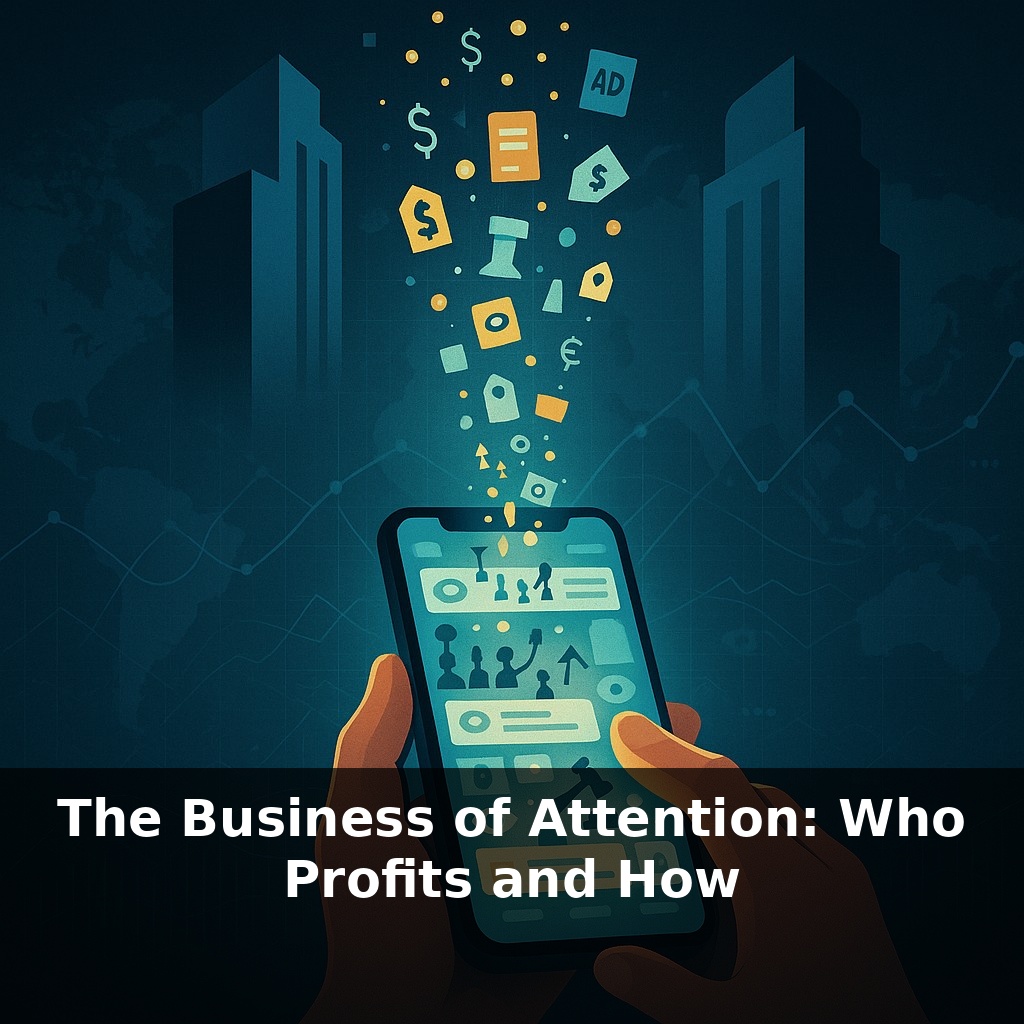
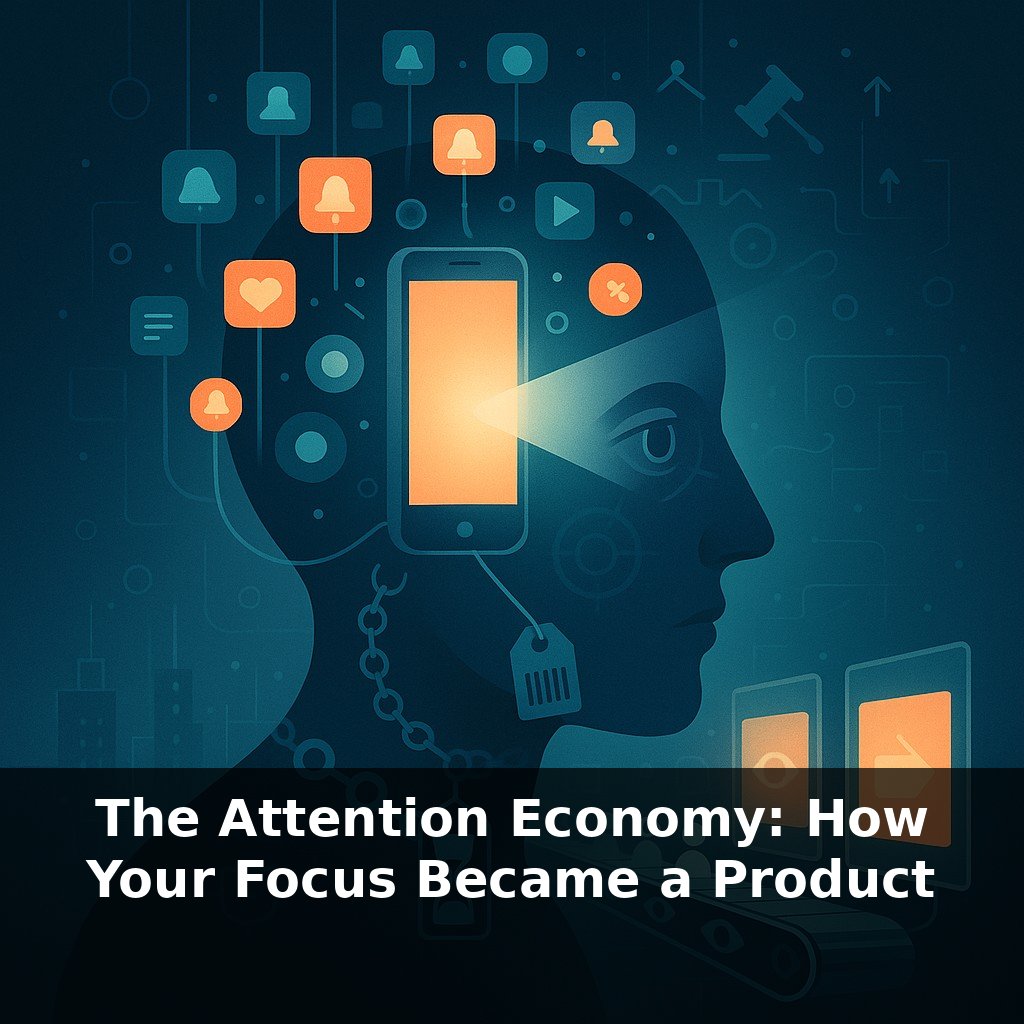
Right now, two companies quietly earn more ad money each year than many countries produce in goods and services. As you scroll, tap, and watch, a silent auction is unfolding around your attention—without you ever raising a paddle or seeing the price.
In this episode, we follow the money. Last time, we focused on *how* your focus gets captured; now we’ll ask a more uncomfortable question: *who cashes the checks* when you stay glued to a feed for “just one more” scroll?
Behind every notification, autoplay clip, and infinite timeline sits a business model that treats your screen time like prime downtown real estate at rush hour. Alphabet and Meta collect rent by the millisecond, subletting tiny slices of your field of view to advertisers who are charged only when you look, pause, or click. Smaller companies—game makers, news sites, solo creators—compete for a corner in that crowded street, then resell your gaze as ad slots, sponsorship reads, or “premium” experiences with fewer interruptions.
We’ll unravel how this layered marketplace turns your everyday habits into someone else’s primary revenue stream.
On the surface, it feels like you’re just choosing what to watch, read, or play. Underneath, software is doing accounting. Every pause on a video, every scroll through a feed, even how long you hover over a headline is logged, priced, and traded. Your habits become a kind of behavioral ledger, updated in real time. That’s why so many apps are “free”: your fee is paid in finely measured slices of your day. Alphabet and Meta simply run the busiest exchanges, while everyone from podcast hosts to puzzle-game studios tries to list their own tiny “shares” of your daily focus.
Scroll a little longer on Instagram or YouTube, and something very specific happens behind the scenes: a price gets assigned to that moment. Not a vague estimate—an actual number, often down to fractions of a cent. Brands aren’t paying for “vibes”; they’re paying for units they can measure: a thousand views, a single click, a successful sign‑up or purchase.
On Meta’s apps, for example, a thousand impressions might run around US$14 on average. That’s just the starting point. The cost jumps if you’re in a wealthy city, browsing luxury fashion, or shopping for flights. Your feed isn’t just personalized content; it’s personalized pricing. Two people can see the same type of ad, and one can cost the advertiser double, simply because their data suggest a higher chance of buying.
Now layer in the big players’ scale. Alphabet pulls in around US$237 billion a year from this system; Meta, about US$134 billion. That’s not “internet money”—that’s supermarket chains, car makers, political campaigns, and local dentists all routing budgets into the same pipes, because they can see exactly what those budgets “buy” in terms of clicks and conversions.
Everyone else has to decide: build their own pipes, or plug into those of the giants. A mobile game studio might show a rewarded video ad every few levels and earn a slice of what advertisers pay Google or a mediation network. A news site might cram in banner ads, add “sponsored stories,” and still struggle, because ad‑blocking strips out many of the higher‑paying placements. That 40 % of users running blockers doesn’t just mean fewer flashing boxes; it directly cuts the publisher’s take.
Others try to step outside this system. Netflix avoided ads for years, then launched an ad‑supported plan that quickly reached millions of monthly users. That move wasn’t just about extra profit; it was a hedge. If viewer growth slows, selling partial access to your audience—some paying with cash, some with time—creates a more flexible income mix.
Across podcasts, newsletters, and YouTube channels, you can see creators experimenting with similar hybrids: a free, ad‑heavy tier; a subscription with fewer interruptions; maybe data licensing on top. It resembles a financial portfolio: not all attention is equal, and diversifying how it’s monetized can make or break a business.
A clothing brand doesn’t just “hope” you see its latest campaign; it might divide spend across YouTube pre‑rolls, a Twitch streamer’s live shout‑out, and a TikTok creator’s dance challenge, then quietly compare which path moved the most hoodies. Each placement is a line item, and the most efficient channels get more budget next month. Creators feel this pressure: a podcaster might accept one mattress sponsor that pays per sale, a second that pays a flat fee, and a third that offers bonuses if listeners use a specific promo code. The host’s script, where they place the ad in the episode, even how enthusiastically they speak can shift those numbers. For a solo writer with a newsletter, choosing between a single high‑paying crypto ad and three smaller, safer sponsors can feel like deciding between a risky stock and a low‑yield bond—both can fund the work, but they shape who shows up, how long they stay, and what kind of trust survives the transaction.
Regulation and technology will redraw who profits. As privacy rules tighten, finely tuned targeting may give way to broader “contextual” placements, shifting power from data brokers back toward whoever owns the most trusted spaces. Generative AI will flood feeds with cheap, tailored content, like a factory churning out bespoke billboards, potentially driving prices down. Meanwhile, wearables and AR could turn every glance, gesture, and pause into a monetizable “slot,” raising new questions about consent and mental clutter.
As this trade in focus spreads to watches, cars, even classrooms, you’re no longer just “online”; you’re surrounded by meters quietly ticking up value. The open question is whether we accept being priced like billboard space, or start treating our own attention more like a scarce savings account—choosing when to spend, when to save, and when to walk away.
Before next week, ask yourself: 1) “If my attention is the ‘product,’ which 2–3 apps, shows, or newsletters are currently profiting from it the most—and do they deserve that much of my mental real estate?” 2) “Looking at just tomorrow, where could I deliberately ‘spend’ 30 minutes of attention on something that pays *me* back (learning, depth work, real connection) instead of padding someone else’s ad metrics?” 3) “If I treated my attention like a limited budget, what’s one specific ‘subscription’ I’d cancel this week (a creator, notification stream, or recommended feed) and what would I ‘invest’ those reclaimed minutes in instead?”