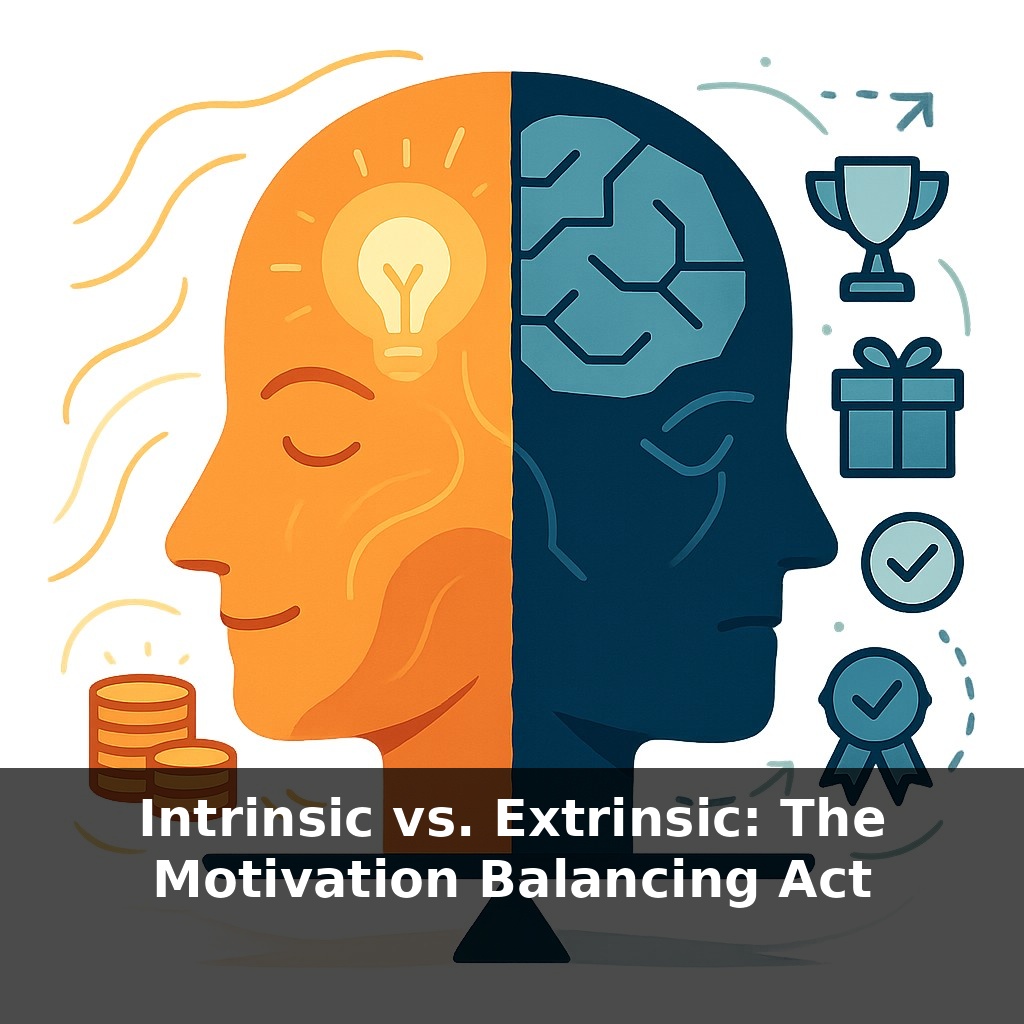
Your boss says, “Take a break, here’s a bonus,” and your brain quietly replies, “Now this is just about the money.” One insight from brain‑scan studies: expecting rewards in advance can actually drain the joy from tasks we already like. So why do some rewards light us up—and others dull us?
That subtle shift you feel—from “I want to do this” to “I have to do this”—doesn’t just live in your head; it reshapes your decisions, your performance, even your sense of who you are. At work, it’s the difference between losing track of time in a project and watching the clock for quitting hour. In school, it’s why a curious child turns into a grade‑maximizing strategist. And in relationships, it can turn a genuine favor into a mental ledger entry: “Now you owe me.” The tricky part is that the same bonus, grade, or thank‑you can either deepen your commitment or hollow it out, depending on how it lands psychologically. Today we’ll unpack how environments—deadlines, metrics, praise, pay—quietly tip the scales, and how to design them so that external incentives support, rather than hijack, what you actually care about.
So the puzzle isn’t “motivation: good or bad?” but “what kind, at what moment, and for whom?” A coder polishing open‑source software at midnight isn’t moved by the same mix of forces as a nurse finishing a double shift or a student cramming for an exam. Deadlines, bonuses, likes, grades, even a manager’s tone nudge the blend differently. Research on Self‑Determination Theory suggests that beneath all these nudges sit three quiet questions: Do I have a say here? Am I getting better at something that matters? And: Am I still connected to people I respect and care about? How you answer them changes everything.
Here’s the twist: the same external push can either act like fuel or friction because your mind is constantly asking, “What does this *mean* about me and this activity?” Not “How big is the reward?” but “What story does this reward tell?”
Three stories tend to show up.
First, the *control* story: “They don’t trust me to care about this unless they dangle something.” This is what turns a curious student into someone optimizing for grades, or a developer into a ticket‑closing machine. The task shrinks; the scoreboard swells. You still move, but in a narrow tunnel.
Second, the *competence* story: “This shows I’m getting good at something that matters.” Here, a performance bonus or public shout‑out doesn’t feel like a leash; it feels like a mirror. You’re not being steered—you’re being seen. The same metric that suffocates one person can sharpen another, depending on whether it feels like judgment or evidence of growth.
Third, the *connection* story: “This links me to people and purposes I care about.” A modest raise attached to a clear narrative—“We’re betting on you to help us build X over the next year”—often does more than a larger, opaque one. Meaning colors money.
Context shifts which story dominates. Early in a role, clear targets and tangible rewards can lower uncertainty and build confidence: “I know what success looks like.” For seasoned experts, those same targets can feel like training wheels welded on: “Do they really think I’m only here to hit this number?” The risk isn’t just boredom; it’s identity shrinkage.
This is where design choices matter. Change *when* you introduce incentives, and you change their meaning. Add a surprise recognition *after* someone has already demonstrated sustained effort, and it reads as validation. Tie every move to a pre‑announced prize, and it reads as management trying to buy your attention on the cheap.
The practical question, then, isn’t “Should we use rewards?” but “What interpretation are we accidentally inviting?” The levers are surprisingly small: who sets the targets, how much discretion lives in the task, whether feedback says “you complied” or “you progressed,” whether rewards arrive as commands or conversations about shared goals.
A product team is told there’s a gift card for whoever logs the most bug fixes this week. Overnight, nuanced problem‑solving turns into “spray and pray” ticket closing. The leaderboard climbs, but deeper issues go untouched. Contrast that with a team where the manager says, “Pick one gnarly bug that *you* think will matter most to customers. At Friday’s review, we’ll showcase the most elegant solution.” Same broad goal—better software—but one setup invites tunnel vision, the other invites judgment, creativity, and ownership.
In schools, a teacher can post gold stars for highest scores, or invite students to design their own mini‑projects, then highlight “most inventive question” or “boldest revision” instead. The latter quietly rewrites what counts as success.
Balancing motives is like configuring notification settings on your phone: too many pings and you’ll ignore what matters; too few and you’ll miss useful signals. The art is deciding which alerts deserve your attention.
The implications stretch beyond classrooms and offices. As AI systems learn your patterns, they’ll quietly tune digital “nudges”—like a streaming app shifting from autoplay to a gentle prompt—so your choices feel more authored, less herded. Hiring and promotion could move from “who hit targets” to “whose work unlocked new possibilities.” But there’s a knife‑edge: the same data that supports you could also script you, unless we bake transparency and opt‑outs into every incentive layer.
Treat this as ongoing detective work: your own behavior is the case file. Notice not just what you do, but the *tone* of your effort—curious, tense, playful, numb. Over time, you’ll spot patterns: certain people, tools, or spaces reliably expand you, others compress you. That awareness is the first lever in quietly redesigning your days.
Here's your challenge this week: Pick one task you’ve been doing mostly for external rewards—like hitting a sales target, posting for likes, or studying just for grades—and redesign it to be 50% intrinsically motivated for the next 5 days. Each time you start that task, deliberately swap one extrinsic driver (like “I need to impress my boss”) for one intrinsic driver (like “I want to get better at explaining complex ideas” or “I’m curious what I can learn from this”). Track, once a day, how your effort and enjoyment change on a 1–10 scale, and by day 5 decide which mix of intrinsic vs. extrinsic motivation actually helped you perform and feel better.