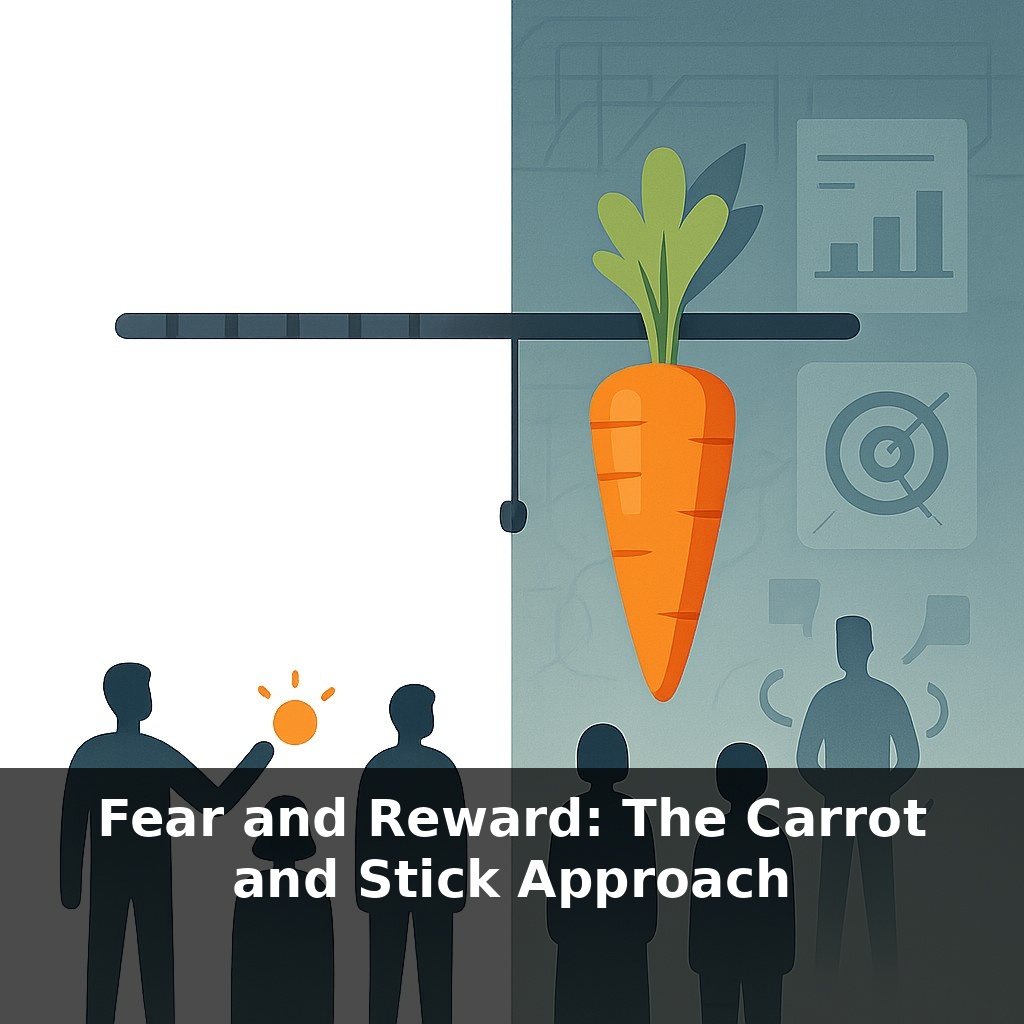
“Do this… or else.” “Hit this target and there’s a bonus.” From school grades to workplace quotas, we’re trained on threat and reward. Yet here’s the twist: in many complex jobs, bigger bonuses can actually make people perform worse. So why does the carrot and stick still rule us?
Across schools, offices, and even public health campaigns, we see a familiar pattern: behavior is “managed” through targets, trackers, and tidy dashboards. Hit your numbers, get the perk; miss them, feel the squeeze. But underneath those charts is a more fragile system—our sense of purpose, autonomy, and fairness. When every action is scored like a video game, people quickly learn to play the game rather than care about the work. They optimize what’s measured, not what matters. In creative or collaborative roles, this can hollow out initiative and trust: colleagues become competitors, customers turn into data points, and short-term spikes mask long-term damage. Yet the appeal is obvious—carrots and sticks are visible, controllable, easy to explain in a slide deck. The real question is whether they quietly tax the very motivation they’re meant to unleash.
Leaders often defend these systems by pointing to clear numbers: sales up, error rates down, tickets closed faster. On the surface, it looks like progress. But behavioral research hints at a more complicated ledger. When people feel controlled rather than consulted, they start preserving energy, doing just enough to stay out of trouble. Creativity becomes risky, speaking up becomes costly, and silence feels safer than suggesting a better way. Over time, organizations can drift into a strange paradox: more rules, more dashboards, yet less genuine responsibility. The missing piece is understanding which behaviors really need levers—and which need trust.
If you zoom in on where carrots and sticks actually work, a pattern appears. They shine in tightly bounded, repetitive tasks where “better” can be captured by a simple number: more boxes packed, fewer defects, faster call handling. That’s why you see hyper-detailed monitoring in places like fulfillment centers and gig platforms—if the job can be sliced into seconds and scans, it’s tempting to tie every slice to consequences.
But the same logic frays as soon as judgment, uncertainty, or ethics enter the picture. In fields like medicine, journalism, software engineering, or teaching, the crucial moves are often invisible to dashboards: the extra explanation that helps a struggling student, the unglamorous bug you fix before it explodes, the risky story you pursue because the public needs to know. When rewards fixate on a narrow metric—test scores, velocity points, output per hour—people start bending their effort around that constraint. They skip the parts of the work that don’t “count,” even when those parts are what make the work meaningful or socially valuable.
Psychologists call one consequence the overjustification effect: when a strong external incentive crowds into a space that used to be guided by curiosity, care, or duty, the story we tell ourselves about why we act quietly changes. “I’m doing this because it matters” turns into “I’m doing this because it pays.” Once that story flips, removing the incentive doesn’t simply reset behavior; it can leave a motivational hole.
You can see softer versions of this in everyday life. Loyalty programs nudge customers to chase points rather than genuine satisfaction. Public bonuses for whistleblowing can signal that speaking up is a transactional act, not a shared responsibility. Even well-meaning social campaigns that lean heavily on lotteries or discounts risk teaching people to move only when there’s a tangible prize.
A helpful way to think about it: motivation is like seasoning in cooking—external rewards are the salt that can bring out existing flavors, not a substitute for the ingredients themselves. When organizations forget this and try to “fix” every challenge with more salt, they may briefly intensify the taste, but they’re also masking a deeper problem: they never invested in the quality of the ingredients—craft, community, and a believable story about why the work matters at all.
Consider how this plays out in three very different settings. In software teams paid per feature shipped, developers may slice work into tiny, low‑risk changes that pad the numbers while gnarlier, high‑impact problems quietly age in the backlog. In sales, quotas tied to narrow targets can push reps toward deals that look great on paper but churn fast, eroding trust and long‑term revenue. In schools, bonus pay for test gains can tempt teachers to “teach to the test,” narrowing the curriculum as art, discussion, and experimentation slowly vanish from the timetable.
Some organizations are experimenting with a different mix: modest, predictable pay plus stronger voice in decisions; peer recognition instead of leader‑only awards; and goals framed around learning, not just outputs. Notice how these setups shift attention from “How do I win the game?” to “What does good work look like here?” When the scoreboard matters but doesn’t dominate, people often rediscover motives that were there all along—craft, contribution, and simple pride in doing the hard parts well, even when nobody is counting.
Gallup’s data hints at a quiet shift: when people feel treated like variables in a spreadsheet, many simply opt out mentally. As AI starts tuning incentives minute‑by‑minute, that risk grows sharper—like a navigation app constantly “recalculating,” nudging you down routes you never chose. The frontier challenge won’t be stronger levers, but transparent ones: systems that show their logic, invite pushback, and let groups renegotiate the deal rather than just react to it.
So the next frontier isn’t abolishing carrots and sticks, but learning to use them with restraint and consent. Think of policies less as levers pulled from above and more as drafts of a shared script: open to edits, tested in rehearsal, rewritten when the plot twists. As those scripts evolve, the real signal is simple: do people feel more human, not more managed?
Before next week, ask yourself: 1) “Where in my life am I mostly using the ‘stick’—fear of failure, guilt, or pressure—to get things done, and how is that actually showing up in my body (tight chest, headaches, trouble sleeping) and my behavior (procrastinating, snapping at people, overworking)?” 2) “If I replaced just one of those fear-based drivers with a ‘carrot’—clear rewards, genuine curiosity, or a sense of play—what would that look like in a real situation I’ll face this week (like a tough work task, a workout, or a conversation I’ve been avoiding)?” 3) “When I notice myself defaulting to fear again this week, what’s one specific question I can ask myself in that moment—such as ‘What’s the meaningful reward or value I’m moving toward right now?’—to gently shift my focus back to motivation instead of threat?”