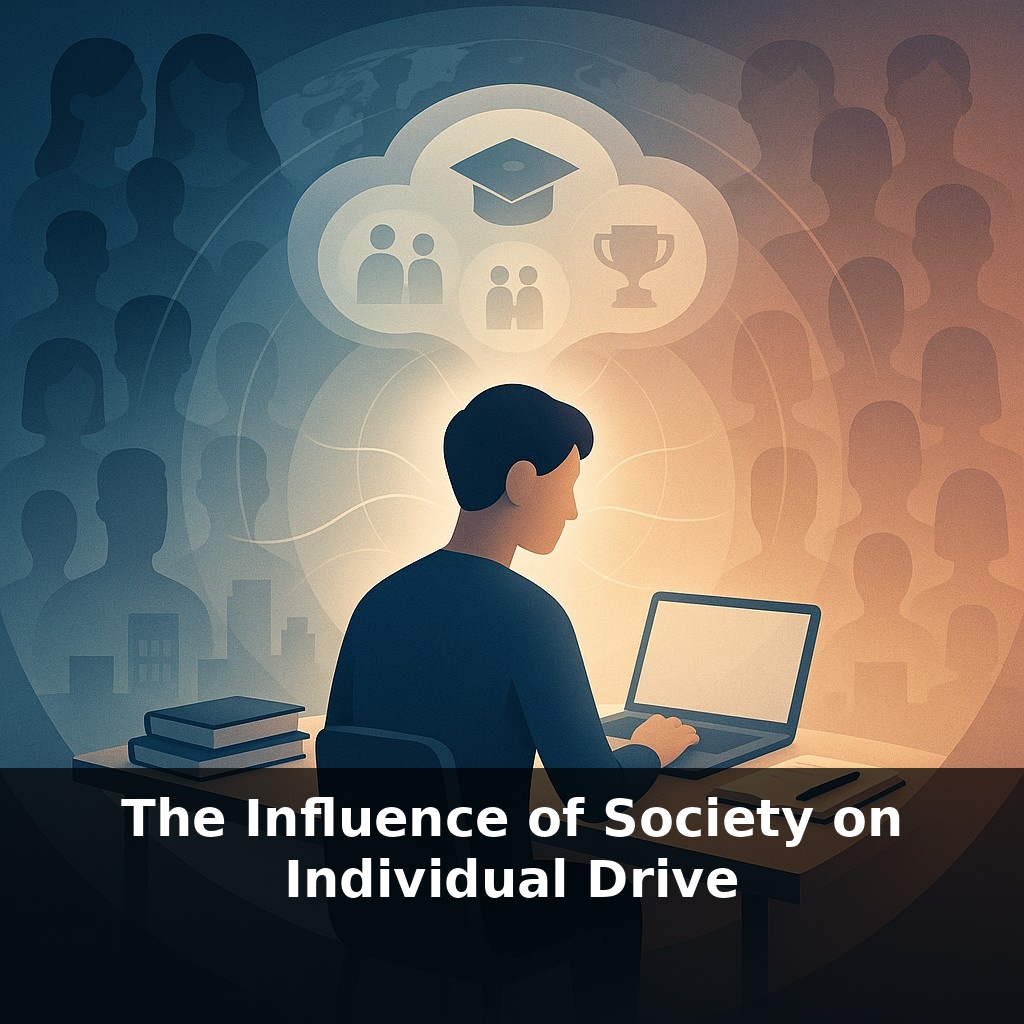
About two-thirds of students in some countries say their top reason to study hard is family honor, not personal dreams. Now, hold that thought. You’re sitting at your desk, exhausted, about to quit early—until you remember who’s watching, and suddenly, you push a little further.
You’ve just seen how different motives can sit on the surface—family, self, reputation. Underneath, something deeper is happening: society is quietly editing what even feels “worth wanting.” A teenager in Seoul and a freelancer in Berlin might both say they’re “working hard,” but the emotional fuel running their engines isn’t the same. One feels pulled by obligation, the other by self-expression—both are answering a question their culture has already asked for them: “What *should* a good life look like?”
This is where norms, stories, and role models do their work. Not by shouting orders, but by narrowing the menu of “acceptable” ambitions. A startup founder praised for “hustle,” a nurse admired for “sacrifice,” a parent respected for “stability”—each learns to crave what brings applause in their world, and to quietly drop the rest.
A key twist is that this social sculpting doesn’t just happen in childhood; it’s ongoing, moment‑to‑moment. Every “like,” promotion, side‑eye, or silence is a tiny vote on which version of you should survive to tomorrow. Over time, those votes add up. Some goals get starved of recognition and quietly wither; others, lavishly reinforced, grow roots so deep they feel “naturally mine.” That’s why the same person can feel fiercely driven at work yet strangely inert about health or creativity: different arenas plug into different social circuits, with different odds of visible payoff.
Think about what actually gets celebrated, not just believed. Most people will say health matters; far fewer get a standing ovation for leaving work at 5 p.m. to cook a decent dinner. That gap—between public praise and quiet ideals—is where a lot of drive is silently redirected.
Zoom in on three levers society keeps nudging, often without anyone noticing:
First, **what is made visible**. In many offices, the hero is the person who answers emails at midnight, not the one who prevented a crisis at 3 p.m. by planning well. Visibility turns certain efforts into “real work” and others into background noise. Over time, your brain becomes a ruthless investor: it funnels energy toward moves that are likely to pay off in visible returns.
Second, **who gets to be the protagonist**. When media and leaders repeatedly spotlight one type of success story—say, the lone genius founder, or the selfless caregiver—they aren’t just reflecting reality; they’re reallocating ambition. If the promoted stories say, “impact looks like X,” then wanting Y starts to feel like a strange, slightly embarrassing preference, even if Y would fit you better.
Third, **how failure is framed**. In some groups, missing a target is treated like data; in others, it’s treated like a moral verdict. The same setback can either sharpen your drive (“interesting, that didn’t work, what next?”) or shrink it (“clearly I’m not that kind of person”). The social script around failure decides whether persistence feels honorable or pathetic.
This is where social feedback loops get especially powerful. Once a certain pattern is established—late‑night responsiveness, constant availability, public displays of hustle—it creates a moving benchmark. Colleagues subtly compare themselves, managers adjust expectations, clients come to assume instant replies. What started as a few overachievers quietly reshapes the “normal” that everyone has to push themselves to meet.
Companies and communities can harness this on purpose. When a firm openly tracks and praises mentoring, not just sales; when a lab celebrates careful replication as much as flashy novelty; when a friend group actually cheers someone for saying no to an extra commitment—these aren’t soft gestures. They are structural edits to what effort feels rewarding. Over time, they don’t just change what people *do*; they change what people *want* to do.
In one tech firm, engineers who quietly fix legacy bugs keep the product alive, but “rockstar” status goes to whoever ships a flashy new feature. Within a year, the best minds drift toward surface‑level innovation; maintenance becomes a backwater. Not because anyone *decided* to neglect stability, but because applause flowed in one direction.
Now contrast that with a hospital that posts monthly “invisible saves”: moments when a nurse prevented an infection, or a resident double‑checked a dosage. Those shout‑outs start to tug interns’ attention toward vigilance, not just dramatic heroics. The stories people swap at lunch change the kind of effort that feels satisfying.
Even in friend groups, this rerouting happens. A circle that laughs about “grind culture” but lights up when someone describes a long walk, a book, or therapy is quietly editing which sacrifices feel admirable. Over time, the same person might push ruthlessly in one setting and downshift in another, tracking where effort reliably meets warmth.
When AI platforms learn what lights you up, they won’t just show more of it; they may start tuning *why* you strive. A fitness app can praise streaks or celebrate rest days, quietly steering how you treat your body. A learning platform can frame tough topics as “for geniuses” or “for curious minds,” nudging who even tries. As more of life runs through such systems, choosing *which* values they spotlight becomes less like UI design and more like writing a social script.
So the live question isn’t “Am I driven?” but “Driven *by whom* and *toward what* right now?” Your calendar, feed, and hallway chatter quietly answer that. Like swapping out an app’s default settings, you can tweak which cues you expose yourself to—different peers, stories, metrics—and watch how your inner momentum subtly, but measurably, re-route.
Try this experiment: For the next 3 days, deliberately swap one socially-approved “busy” behavior with a personally-driven one and track how your motivation changes. For example, instead of staying late to answer non-urgent emails because “everyone does,” leave on time and spend that same hour on a project you’d do even if no one ever saw it (learning a skill, building something, training, etc.). Before and after each swap, quickly rate your energy and satisfaction from 1–10, and notice whether your drive feels stronger when you’re reacting to social expectations or when you’re following your own internal pull.