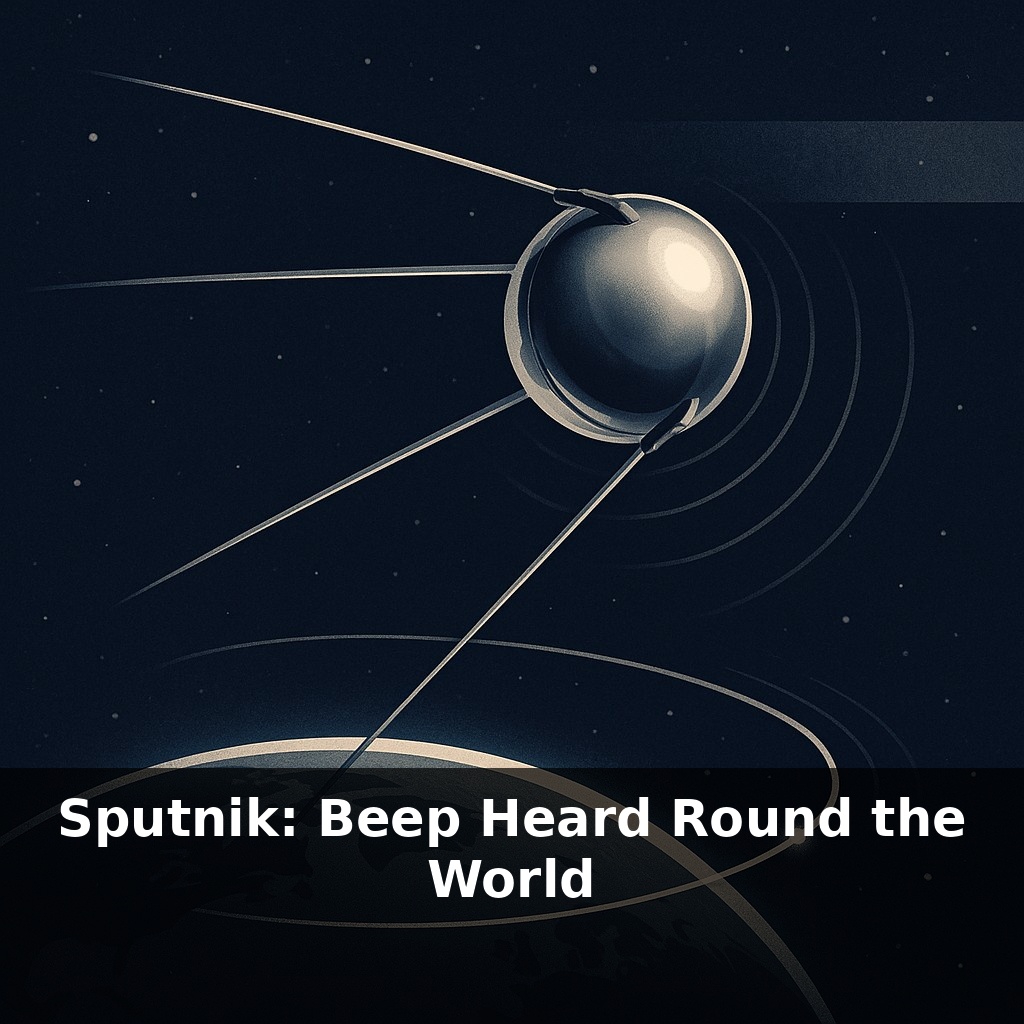
A polished metal ball, barely bigger than a beachball, circles Earth in about an hour and a half—yet almost no one on the ground can see it. Instead, they hear it: a thin, steady beep on shortwave radios. One sound, crossing borders and oceans, quietly announces a new era.
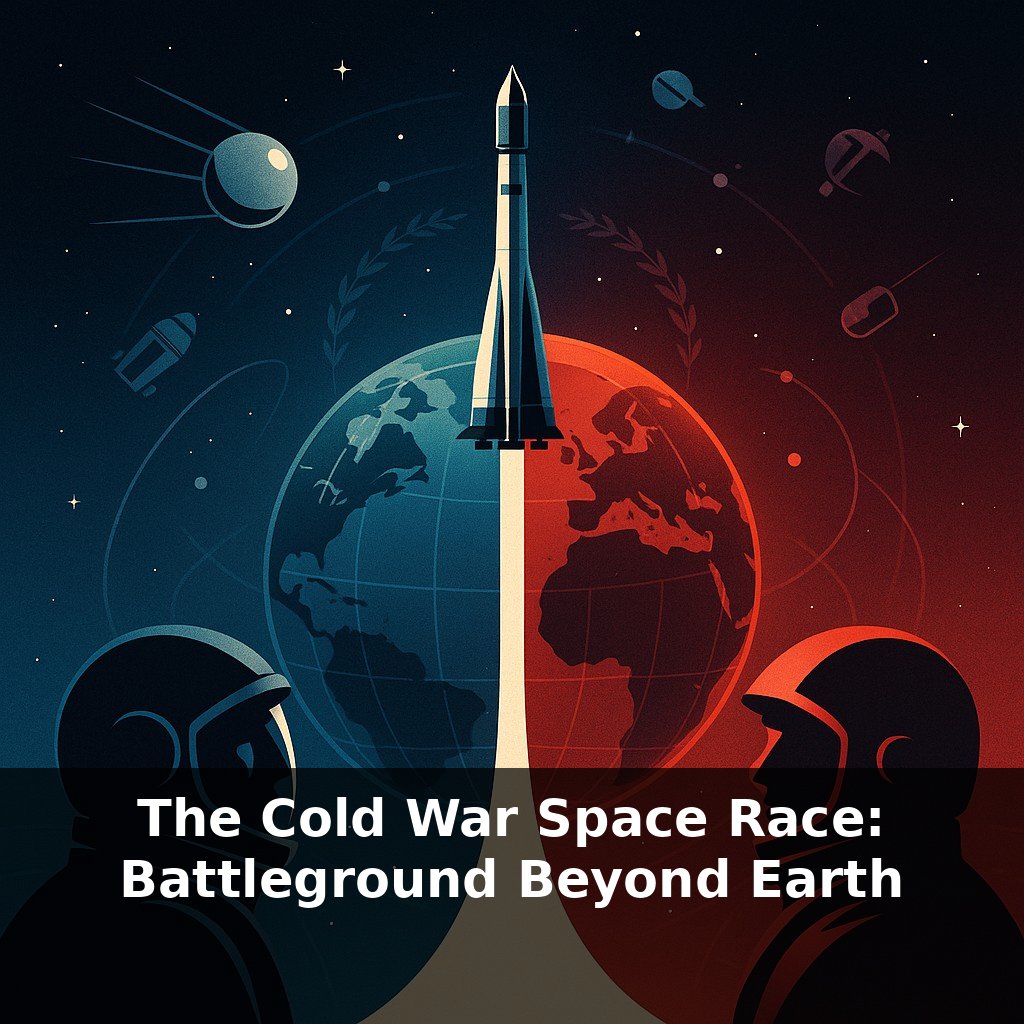
Far below that faint signal, most people went about their routines—until headlines broke the spell. Newspapers shouted of a “Red Moon” overhead; parents, teachers, and politicians all asked the same startled question: if they can put that up there, what else can they put up there? In classrooms, globes suddenly felt outdated; the world was no longer just maps and borders, but orbits and trajectories. Radio hobbyists twisted dials to catch the passing tone, like tuning into a distant station that shouldn’t exist yet. In Washington, military planners stared at trajectories on chalkboards, recalculating vulnerability. In Moscow, officials savored a rare moment of technological prestige. The beeping sphere turned night skies into a scoreboard, where every pass overhead reminded both superpowers that the high ground had just moved far above the clouds.
Governments scrambled to interpret what that passing signal really meant. In U.S. suburbs, children still traded baseball cards, but dinner-table talk shifted to missiles, math, and “fallout shelters.” Congress funneled money into science education; slide rules and lab benches suddenly felt as strategic as tanks. The Soviet press framed the launch as proof that history itself was tilting eastward. Allies and neutral nations watched closely, weighing which superpower truly owned the future. Overhead, every orbit quietly underlined a new rule: whoever mastered the sky lanes might someday dictate the terms below.
The beeps themselves were almost painfully simple: a monotone pulse, about three times a second, sent on two frequencies. No words, no music, no secret code—just the electronic equivalent of “I’m here, I’m here, I’m here.” On paper, that looked unimpressive. In practice, it was terrifyingly elegant. Anyone with the right receiver could hear it, which meant no one could pretend it wasn’t real.
Inside that smooth shell, the hardware was rugged and modest. Batteries, not solar panels. A basic radio transmitter. Thermometers and a pressure switch to confirm the hull stayed airtight. The signal changed slightly with temperature and internal pressure, so scientists could tell if it was overheating or leaking. There were no cameras, no microphones, no spy gear tucked away. What unnerved foreign observers was not what it carried, but how it had gotten there.
To place that 83.6‑kilogram sphere into orbit, the Soviets had to prove they could launch something much heavier—like a warhead—on an intercontinental trajectory. R‑7, the booster underneath Sputnik, was officially a “rocket,” but every analyst knew the same physics powered ICBMs. The satellite’s path became a public demonstration of range and accuracy. Each 96‑minute circuit quietly underwrote a new kind of deterrence.
Scientifically, the little sphere pulled more than its weight. As it circled, its radio waves passed repeatedly through Earth’s upper atmosphere. By measuring how those signals bent and faded, researchers mapped the ionosphere and refined models of atmospheric drag. Tracking stations recorded tiny shifts in the orbit that revealed how thin air at high altitudes still tugged on objects. That data fed directly into calculations for future spacecraft, reentry capsules, and even long‑range weather forecasts.
The political drag was stronger still. In the United States, the launch detonated across institutions that had felt unshakeable only days earlier. Committees convened overnight. Budgets that had stalled suddenly surged. Within months, Congress created NASA and passed the National Defense Education Act, pouring money into physics labs, engineering programs, and language training. The message was blunt: catching up in orbit meant retooling the entire pipeline from elementary school to advanced research.
Abroad, governments listened closely to the beeps and to the reactions. Some saw proof that aligning with Moscow might offer access to cutting‑edge technology. Others doubled down on Washington, hoping to anchor themselves to an American comeback. Newly independent countries realized that space was not just a distant spectacle; it might become a new arena where prestige, aid, and leverage would be negotiated.
Meanwhile, engineers on both sides began sketching what might come next: heavier satellites with instruments, weather observation from above storms, communications relayed beyond the horizon, and eventually, crewed missions. The surprise of that first launch created a paradoxical clarity: if such a small, crude payload could shift global strategy overnight, then a future filled with larger, smarter machines in orbit would demand entirely new rules, agreements, and expectations.
The race was no longer about proving that orbit was possible; it was about deciding what kind of world would emerge now that it undeniably was.
For many listeners, Sputnik’s beep didn’t feel abstract at all; it was as practical as checking the weather forecast before leaving home. Within a few years, engineers were sketching satellites that could spot storms, relay phone calls, and guide ships and aircraft. The beeping sphere proved you could send signals that ignored mountains, borders, and censors, a preview of global communications networks. Students who stared up at news illustrations of its path later became the programmers, mission planners, and policy analysts who designed navigation constellations and climate‑monitoring fleets. The launch also nudged smaller nations to think creatively: if they couldn’t build giant rockets, they could invest in tracking stations, data analysis, or cooperative missions, carving out niches in a domain once reserved for missile powers. The first signal thus doubled as an invitation: space would not only be a proving ground for strength, but also a shared laboratory where radio waves, radiation belts, and distant planets became common problems to solve.
Sputnik’s echo still shapes choices we’re only beginning to notice. Its beeps foreshadowed today’s GPS routes, satellite-banked payments, crop maps, even disaster alerts. As constellations multiply and lunar surveys quietly chart metal-rich craters, policy lags behind payloads. Think of low orbit as a crowded harbor at dawn: fishing boats, tankers, and research vessels all jostling for lanes, signals, and safety rules that don’t yet fully exist.
Your challenge this week: whenever you use a GPS pin, satellite map, or live weather radar, pause and by Friday, research the top space agencies currently influencing orbital rules. Specifically, focus on their latest policy changes or upcoming missions that might affect global space infrastructure.
Sputnik’s faint chirp has long faded, but its aftershock keeps rippling: every launch license, debris guideline, and spectrum auction is a quiet argument about who gets to write the next chapter overhead. Like neighborhoods watching new towers rise, we’re still deciding which orbits stay public, which become gated, and who gets a key to the locks.
Before next week, ask yourself: If I suddenly heard a “Sputnik moment” in my own life—a small signal that the world is shifting (like that faint radio beep in 1957)—what might it be right now, and am I treating it as background noise or as a wake-up call? Looking at how the U.S. scrambled to catch up in rocketry and science education after Sputnik, where in my own work or learning am I clearly behind, and what’s the *one* skill or subject (e.g., coding, data literacy, basic astronomy, language learning) I’m finally ready to start taking seriously this week? Thinking about how Sputnik turned fear into a focused national push (NASA, math/science reforms), what’s one concrete project or habit I could start today that would turn my current anxiety about the future—AI, space, climate, geopolitics—into deliberate preparation instead of passive worry?