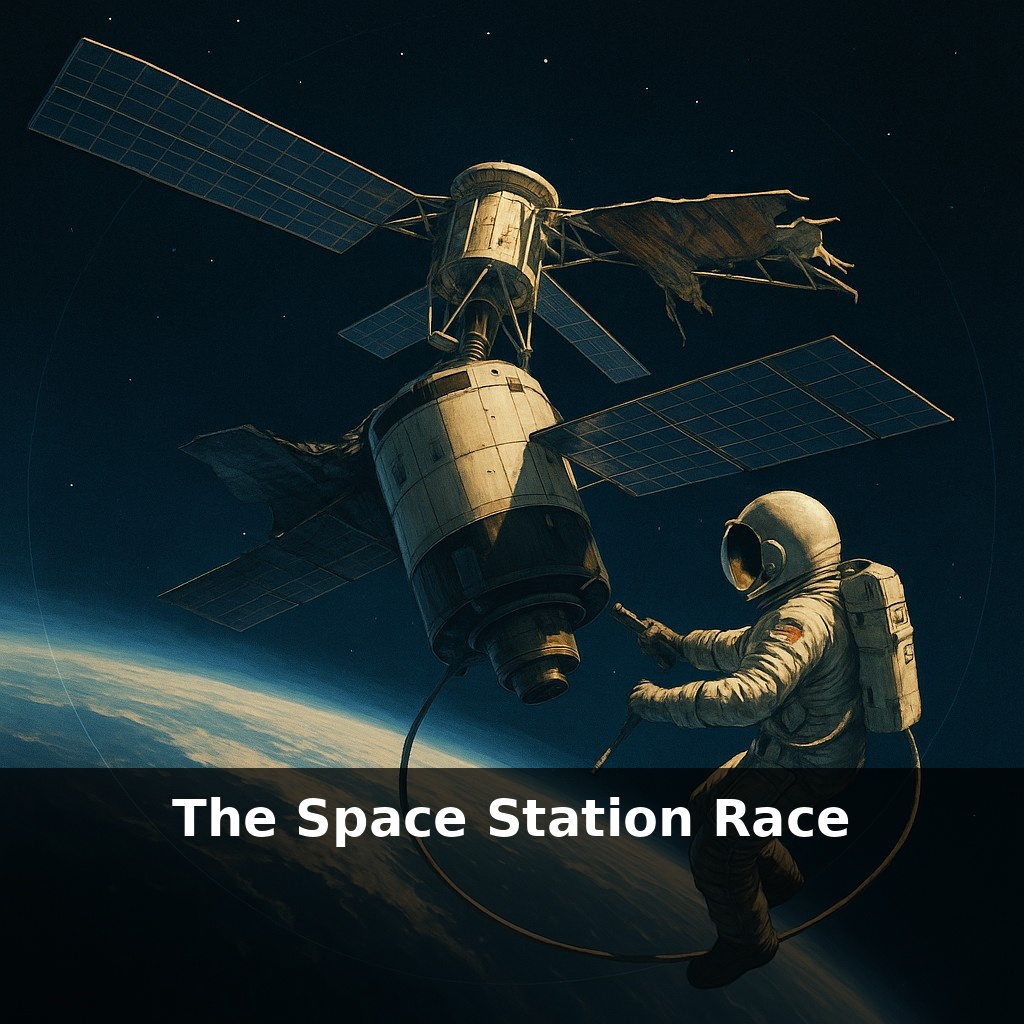
When Skylab first reached orbit, it was half-crippled—torn insulation, jammed solar panels, power bleeding away every minute. Down on Earth, engineers scrambled. Up above, astronauts prepared for what was basically an in-space repair job on a one-of-a-kind, drifting home.
The race to build space stations wasn’t about flag-planting anymore; it was about endurance. After those early repair dramas, the real question became: could a crew stay in orbit not for weeks, but for seasons—long enough to watch entire weather systems cycle across Earth below? The U.S. doubled down on extracting as much science as possible from a few focused Skylab missions. The Soviet program, by contrast, treated each station like a rehearsal for the next: Salyut after Salyut, each one tweaking life-support, power systems, and docking ports. Out of that steady rhythm grew Mir, a station that felt less like a testbed and more like a rough, working frontier town in orbit, where cosmonauts learned not just how to survive off-world, but how to make long-duration spaceflight routine.
To both superpowers, these orbital outposts were more than hardware—they were prototypes for entire ways of living off Earth. Crews now had to manage cramped schedules, experiment failures, and the mental strain of seeing home as a shrinking globe outside the window. Medical teams watched bones thin and muscles weaken, then designed strict exercise “prescriptions” to counteract them. Engineers refined solar arrays and thermal control the way farmers tune irrigation and shade, searching for stable, predictable conditions in an inherently unstable environment: airless, weightless, and utterly unforgiving of mistakes.
American and Soviet designers tackled the “how do we live up here for months?” question in strikingly different ways. The U.S. bet on going big in one shot: launch a spacious workshop, stock it heavily, then fly a few well-trained crews to use every square meter efficiently. That meant cramming medicine, astronomy, materials science, and solar physics into tightly scripted campaigns. Each visiting crew pushed human limits a little further, stretching stay times and workload without overhauling the basic hardware.
The Soviet strategy looked more like tuning an evolving musical piece. Early Salyut stations were short, distinct “movements,” each with its own quirks and failures. Engineers treated them as rapid prototypes: adjust a valve here, add a docking port there, swap out instruments next time. Mir emerged not as a single masterstroke but as a layered composition—core module first, then new sections added over years, each bringing different experiments, storage, and living areas.
This shaped daily life. American astronauts slept, ate, and worked in a comparatively roomy, unified interior; every mission had a clear beginning, middle, and end. Soviet and later Russian crews adapted to a place that slowly changed around them: new modules, visiting spacecraft from different nations, temporary “neighbors” arriving and departing. Tasks drifted from purely national goals to joint projects with Europeans, Japanese, and eventually Americans, using the same orbiting address.
The science, too, diverged and then converged. U.S. planners front-loaded Earth and solar observations, aiming to squeeze out maximum results before hardware aged. Soviet planners emphasized medical and psychological data from ultra-long stays, accepting cluttered interiors and aging systems as part of the trade. Over time, both sides realized that the real prize wasn’t just individual experiments—it was the accumulated know‑how of running a crewed complex for years: scheduling to avoid fatigue, routing cables without blocking hatches, deciding what absolutely must be redundant and what can safely fail.
By the time plans for a joint station solidified, neither side was starting from scratch. They were bringing two philosophies and decades of lived experience to a shared, orbiting compromise.
On Mir, routines evolved the way cities adjust to changing seasons: lights shifted to match crew sleep cycles, exercise blocks moved around docking schedules, and whole days could be reshuffled when a cargo ship arrived early or a crucial experiment failed. One cosmonaut compared the station’s constant hum—pumps, fans, electronics—to “living inside a mechanical forest,” where each sound told you whether the environment was healthy. When a tone changed, they didn’t just call ground control; they traced cables, opened panels, and sometimes improvised fixes with whatever was on hand. Meanwhile, American planners quietly noted which experiment racks generated the most useful data per hour of crew time, building playbooks later reused on the ISS. Doctors on both sides learned that even small changes—tweaking treadmill harness tension, adjusting meal schedules, rotating tasks to limit monotony—could measurably improve mood and performance, insights now baked into every long stay in orbit.
Mars planners now treat those early stations like field notes from a harsh expedition: which routines kept tempers cool, which layouts trapped clutter, how much “quiet time” a crew really needs. Upcoming commercial hubs will test those lessons under budget pressure, mixing tourists, robots, and career astronauts. Expect odd questions: who sets workplace rules in orbit, or designs a “corner office” where the corner is everywhere at once?
The next “race” won’t be about flags or firsts, but whose stations feel most livable. Designers now weigh window views against radiation, quiet corners against cramped hulls, like gardeners trading sunlight for shelter. Your challenge this week: sketch your ideal room in orbit—and note what comforts you’d refuse to give up, even 400 km above Earth.