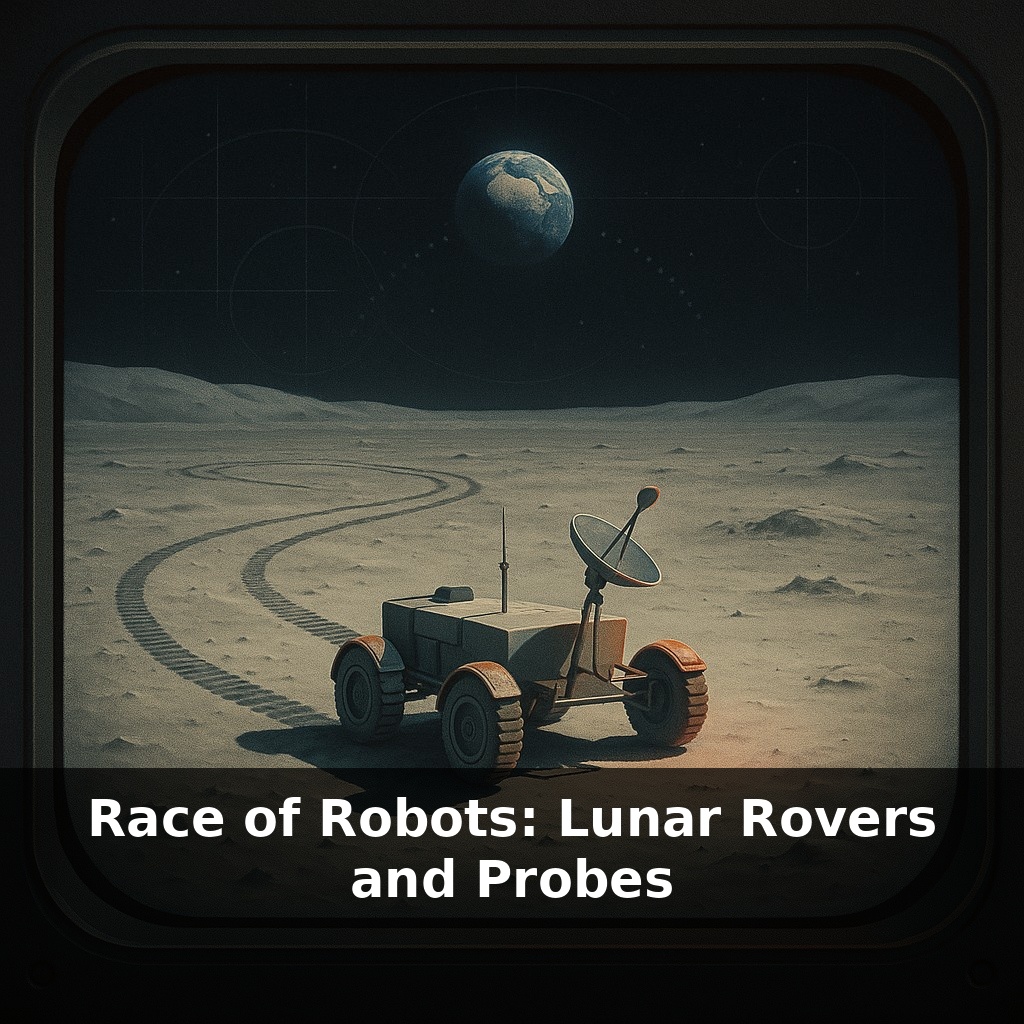
A robot once drove across the Moon for almost a year, sending home tens of thousands of ghostly photos—while its human controllers sat in a dark room on Earth, steering it by delayed snapshots. Tonight, we dive into that quiet, high‑stakes race of machines between superpowers.
By the late 1960s, both sides had quietly realized a hard truth: metal survived where flesh might not. So they doubled down on robotic scouts, hurling wheeled laboratories and armored probes into hostile terrain that would kill a person in seconds. Some rolled across dusty plains; others slammed into alien atmospheres thick as oceans or thin as mountaintop air. Together they turned distant worlds from bright dots into mapped landscapes, complete with craters, cliffs, and chemical fingerprints. Engineers suddenly had to think like off‑world explorers, asking: How do you drive with no horizon, drill with no mechanic nearby, or call home from farther away than any ship had sailed? Each answer became a new tool—smarter guidance, tougher electronics, thriftier power—that quietly rewired the future of exploration.
Both blocs also quietly shifted *why* they flew these craft. Early on, missions chased headline‑grabbing “firsts”: first soft landing, first close‑up of another planet, first rover tracks in alien dust. But as victories traded hands, the question changed from “who got there first?” to “who understands this place better?” That meant longer‑lived missions, richer instruments, and careful mapping of hazards for future crews. Data, once a trophy, became a kind of currency: mineral clues for industry, radiation maps for defense, and proof that your engineering could survive the harshest “weather” in the Solar System.
On one side of this race rolled Lunokhod‑1, a boxy Soviet vehicle with eight wire‑mesh wheels and a flip‑top lid studded with solar cells. It trundled across the regolith for months, stopping often so its lid could open like a mechanical flower and drink in sunlight. Its controllers in Crimea worked from mosaics of low‑resolution frames, nudging the rover a few meters, then waiting for proof it hadn’t sunk into dust or clipped a boulder. Signals covered the quarter‑million‑mile gap in just over a second, but that was enough lag to make “driving” an exercise in patience and foresight rather than reflexes.
The Americans went a different route with their Lunar Roving Vehicle. Instead of being driven from Earth, it unfolded from the side of a lander and carried astronauts in real time. Its spidery frame, batteries, and electric motors were pared down to the minimum, because every extra kilogram had to be blasted out of Earth’s gravity well. Engineers shaved mass from the wheels, seats, and even the fenders, yet still demanded performance on powdery slopes and in vacuum‑chilled nights. The payoff was vast: crews could range kilometers from their landing sites, sampling varied terrain that a fixed lander would never touch.
Farther afield, the contest jumped from the lunar surface to the deep black between worlds. The U.S. Mariner and Pioneer series tested the new craft of planetary flybys, shooting past Venus, Mars, and Jupiter on carefully tuned paths. Mariner 10’s gravity‑assist at Venus was a revelation: by stealing a sliver of the planet’s orbital energy, it bent its course toward Mercury without an impossibly large fuel load. Trajectories became a kind of celestial billiards problem, each encounter setting up the next shot.
The Soviet Venera craft took on a different nightmare: Venus’s crushing air and lead‑melting heat. They wrapped instruments in pressure vessels, pre‑chilled electronics, and accepted that each lander would live for minutes, not years. This “sprint” philosophy contrasted with NASA’s long‑distance strategy, culminating in Voyager’s grand tour and the Viking landers’ extended work on Mars. Taken together, these paths turned once‑theoretical planets into places with weather, seasons, and soil chemistry that strategists and scientists alike could study.
Think of each mission like a different kind of musical performance, all playing in the same cosmic concert hall. Lunokhod’s long traverse was a slow, methodical jazz improvisation—probing, pausing, adjusting the route. The sprint‑style Venus landers were more like punk tracks: short, loud bursts of data recorded before the environment tore the “instruments” apart. Viking, by contrast, was a patient symphony movement, repeating experiments over Martian seasons to see how the atmosphere and ground changed with time. Mariner 10’s gravity assist opened the door for more ambitious “tours,” letting a single craft visit several worlds instead of flying a lonely one‑note solo. Voyager pushed this idea to the extreme, weaving past multiple giants and discovering ring structures, active volcanoes, and magnetic fields nobody had modeled correctly. Today’s Mars rovers and private landers inherit those strategies—some built to sprint and burn out, others to play the longest, quietest songs in deep space.
Tomorrow’s explorers may roam places no pilot could survive: dark oceans under Europa’s ice, haze‑drowned valleys on Titan, caverns on asteroids where radio links are patchy or absent. There, on‑board AI will have to decide what is “interesting” without waiting for a nod from Earth, the way a seasoned hiker chooses side trails on instinct. Your challenge this week: watch any mission update feed and note every time a probe’s software makes a decision humans once kept for themselves.
Each new rover or probe also quietly reshapes life on Earth: refined antennas become better mobile networks, hardy power systems inspire remote sensors, and navigation tricks echo in your car’s route planner. Like distant weather fronts steering tomorrow’s forecast, choices made for distant worlds slowly bend the trajectory of everyday technology.
Here's your challenge this week: Design your own mini “lunar rover mission” at home by picking a real rover from the episode (like VIPER, Pragyan, or Rashid) and copying one of its goals using everyday materials. For example, set up a “crater field” on your floor with boxes and bowls, then build a simple rover from LEGO, cardboard, or a small RC car and give it a mission like “map all craters” or “find the ‘water ice’ (hidden blue objects).” Time and record three test runs, tweaking your rover’s design or navigation strategy between each run the way real mission teams iterate. By the end of the week, write a 3-sentence “mission report” summarizing what design worked best and what you’d change for a second-generation rover.