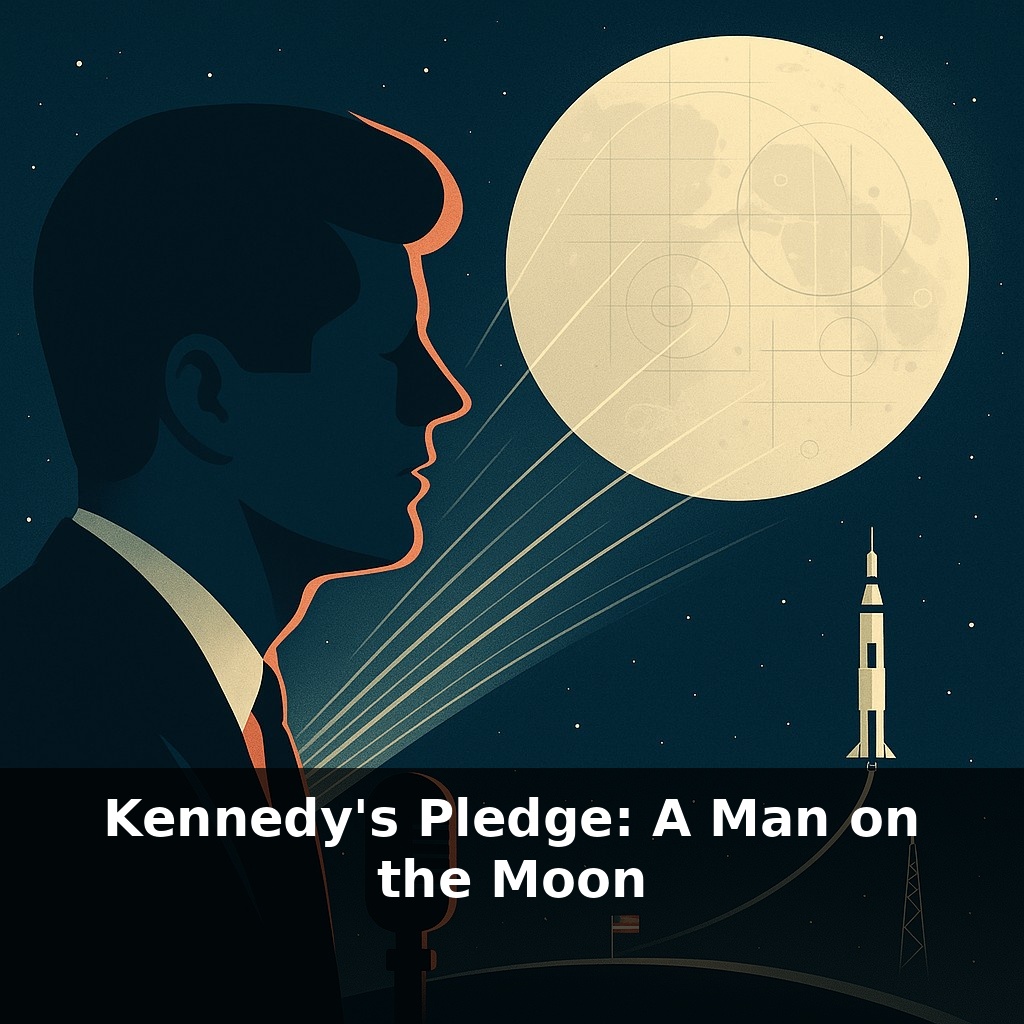
In 1961, a young president calmly promised the Moon—literally. No blueprint, no rocket ready, no computer small enough to fly. Yet the deadline was firm: before the decade was out. How does a democracy rally millions of strangers around a goal that wild, and actually make it real?
Kennedy’s pledge didn’t start with a rocket; it started with a sentence. One speech turned a vague national anxiety about Soviet missiles and Sputnik into a focused, audacious assignment: go farther than anyone, faster than history says is reasonable. Overnight, “space” stopped being a hazy backdrop of stars and became a to‑do list. Congress wasn’t just funding science; it was buying a visible scoreboard for the Cold War. Engineers weren’t just tinkering; they were suddenly part of a national deadline, like musicians handed a nearly impossible new score and told the concert is in eight years. And NASA—barely out of its experimental phase—had to transform into an industrial-scale organizer of talent, money, and risk. In that shift lies the real story: how a sprawling, skeptical society tried to behave, briefly, like a single, determined mind.
Kennedy’s promise dropped into a Washington ecosystem that wasn’t exactly built for speed. Budgets crawled, committees argued, agencies guarded turf. Yet suddenly, everything had to align around a date on the calendar. To make that happen, NASA leaders turned policy into choreography: universities got money for labs, factories retooled for exotic alloys, and thousands of small firms learned to machine parts to tolerances thinner than a sheet of paper. Like a river system fed by countless tiny streams, the “Moon goal” depended on decisions in forgotten offices and shop floors no camera ever filmed.
Kennedy’s pledge started as a sentence, but it quickly hardened into numbers, schedules, and diagrams. Inside NASA, the question shifted from “Should we go?” to “What breaks first if we try?” The answer, at least in 1961, was “almost everything.” The rockets that existed couldn’t lift the required mass, the guidance computers didn’t yet fit in a cockpit, and no one had tested how to navigate another world’s gravity well and return alive. That gap between promise and capability became the agency’s real task.
NASA’s leadership made a crucial decision: instead of betting on a single genius idea, they spread risk across many parallel paths. Multiple contractors designed competing versions of critical systems, from spacesuits to guidance platforms. Failure stopped being an embarrassment and became an expected data point. A test that ended in an explosion wasn’t a career-ending disaster; it was a crude but honest peer review, written in flame.
The money amplified everything. With NASA’s budget swelling into the mid‑1960s, administrators could do something rare in government: say “yes” to big, overlapping efforts. They funded both the Saturn I and Saturn V, both Earth‑orbit and lunar‑orbit rendezvous studies, both incremental upgrades and radical redesigns. This redundancy looked wasteful to critics, but it gave engineers room to learn in public.
The politics were just as engineered as the hardware. By distributing contracts across all 50 states, NASA ensured that almost every senator could point to a factory, test stand, or university lab back home and say, “We’re part of this.” The Moon might be distant, but the paychecks were local. Even so, polling showed that enthusiasm rose and fell; support was not a straight line upward. After tragedies like the Apollo 1 fire, congressional patience thinned, and NASA had to defend not just its methods but the very idea that the goal was still worth pursuing.
Technologically, each solved problem exposed the next. Master a rocket stage, and guidance becomes the bottleneck. Improve guidance, and life‑support limits mission length. In that cascading sequence of obstacles, Kennedy’s deadline acted less like a finish line and more like a metronome, forcing decisions at a tempo that normal bureaucracies rarely sustain.
Apollo’s progress feels, in hindsight, like a straight line. Up close, it looked more like a jazz ensemble learning a new piece while already on stage. Each “solo” project—lunar module, command module, Saturn V, mission control software—improvised within tight constraints, adjusting in response to what others discovered the previous month. When engineers at MIT squeezed more reliability out of the guidance computer, mission planners could stretch trajectories; when spacesuit tests showed unexpected fatigue, flight rules tightened to protect the crew.
Specific flights became pivot points. Gemini 6 and 7 practicing orbital rendezvous turned an abstract concept into muscle memory for future crews. Apollo 8’s bold decision to orbit the Moon in 1968—without a lander ready—was both a geopolitical signal and a rehearsal in navigation, communication delays, and human psychology. Each mission wrote a new line in a playbook that Artemis planners still annotate today, from how to sequence checklists to how to design meaningful workdays for people living off Earth.
Kennedy’s vow also changed how we think about “impossible” timelines. Instead of waiting for every technology to mature, planners now sometimes fix a date first, then let that pressure pull new tools into existence—much like planting a flag on a distant shoreline and letting shipbuilders back home worry about the hull. Today’s climate targets and cancer “moonshots” borrow that logic, gambling that public deadlines can bend research curves faster than caution would allow.
The legacy of that promise now threads through everyday life in quieter ways: navigation in your phone, materials in your sneakers, sensors in medical devices. They’re like ripples from a stone dropped decades ago, still reaching new shores. The open question isn’t whether bold deadlines work—it’s which frontier deserves that kind of wager next.
Start with this tiny habit: When you see or read today’s date, whisper to yourself, “We choose to go to the moon,” and picture one bold goal you secretly care about but haven’t admitted out loud. Then, jot just **three words** about that goal in the corner of whatever you’re already using (a meeting agenda, notebook margin, phone notes), like “book, 1960s NASA” or “startup, clean energy.” Each day, when the date shows up again, keep the same goal but tweak the three words to reflect one tiny next step, like “read 1 page” or “email 1 mentor.”