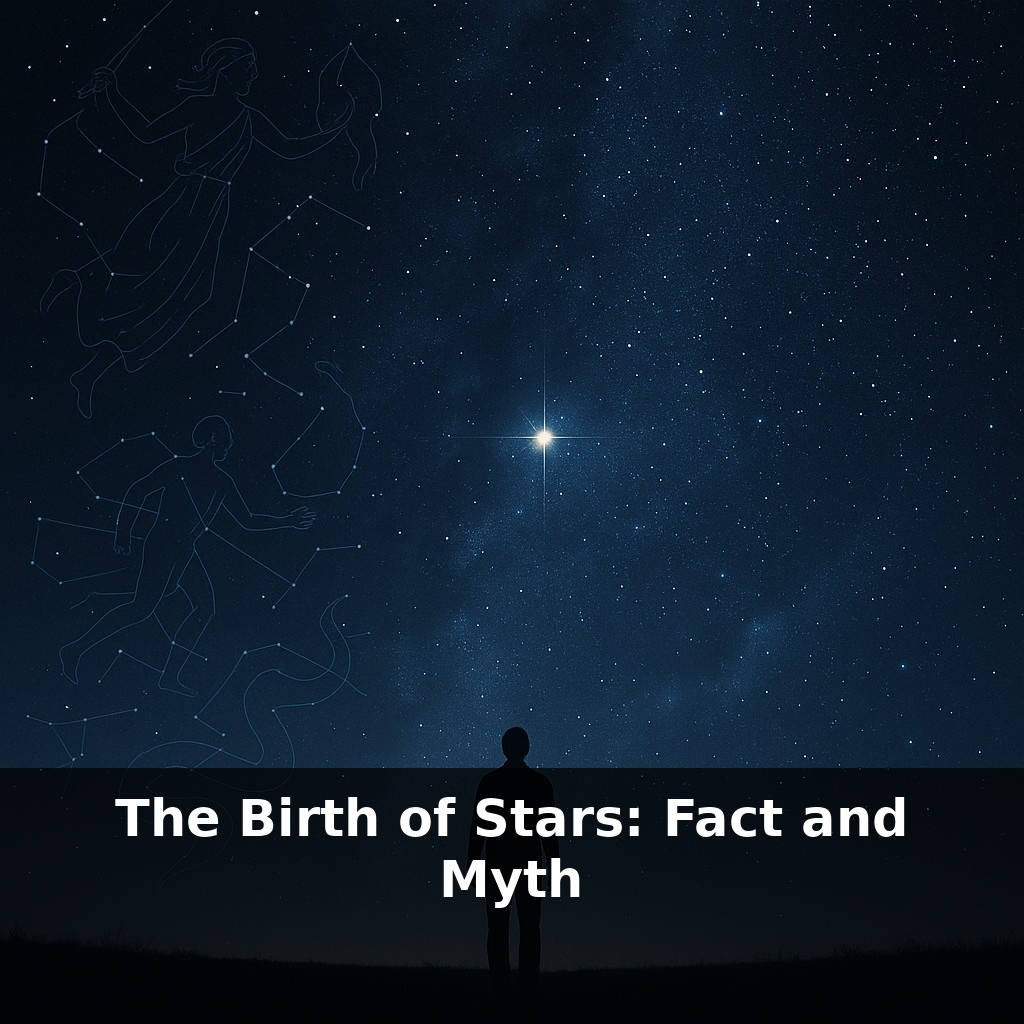
The Birth of Stars: Fact and Myth
📝 Transcript
A star is born only when roughly one out of many hundreds of cold, dark clouds actually succeeds in lighting up. Tonight, you’re standing in a silent field. Above you: a sky of ancient stories. Behind them: newborn suns still wrapped in cosmic darkness.
Most of the stars you see tonight were already shining before the first written myths were told about them. To early skywatchers, those points of light weren’t physics problems; they were messages. A hunter frozen in mid‑chase, a river goddess poured across the sky, a trail of ancestors keeping watch. Long before telescopes, people noticed that some stars wander (planets), some flare and fade (novae, comets), and some seem fixed like nails in a great invisible dome. From this patchwork of motions and colours, cultures spun wildly different answers to the same question: who lit these fires, and why? Modern astronomy now reaches behind the stories, into the hidden nurseries where new suns first glow. Yet the old tales still cling to the constellations, like subtitles over a film whose backstage we’re only just beginning to explore.
Some of those “fixed” stars in the sky are anything but permanent. Over millions of years they drift, disperse, and vanish from their birthplaces, the way classmates scatter after school and rarely gather in the same room again. The Sun is one of those runaways; its siblings are now strewn across the galaxy so widely that we’ve only just begun to hunt for them by matching their chemical “fingerprints.” While telescopes trace these quiet motions, the old stories stay pinned to the same patterns, preserving a human map on a sky that never really stands still.
Star‑birth begins in places the naked eye mostly fails to betray: giant molecular clouds so cold that hydrogen huddles into molecules and dust grains hoard starlight. Within them, turbulence and shock waves carve out denser knots. Most of these knots never amount to much. Only a few percent of the cloud’s gas will end up as stars; the rest is blown back into space, raw material for future generations.
Once a knot tips past a certain mass, gravity wins decisively. If it gathers at least about 8% of the Sun’s mass, its core can eventually ignite hydrogen fusion. Fall short of that threshold and you get a brown dwarf: too heavy to be a planet, too light to sustain a long, bright stellar life. These “failed stars” still glow dimly at first, cooling slowly over billions of years, reminders that collapse alone isn’t enough—you need sufficient weight to press atoms into fusion.
The timing of this process depends strongly on mass. A future O‑type giant can race from initial collapse to the main sequence in roughly a hundred thousand years, gulping matter and flaring into brilliance while nearby clumps are still only beginning to contract. Tiny red dwarfs take the opposite route: they assemble cautiously, taking tens of millions of years to stabilize, trading drama for longevity.
Our own Sun likely grew up in a busy cluster of perhaps a few thousand siblings, born from the same cloud about 4.6 billion years ago. That setting was crowded and hazardous: massive neighbours whose winds and explosions sculpted the environment, and perhaps even helped shape the outer architecture of the young Solar System. Today those siblings are scattered so widely across the Milky Way that they hide in plain sight among billions of unrelated stars.
As new tools arrive, the story grows more detailed. In 2023, JWST’s NIRCam instrument detected clear signatures of water vapour in a disk around a forming star only 1.3 million years old—cosmically, an infant still wrapped in its delivery room blanket. Such observations show that the ingredients for oceans and, potentially, life can assemble very early, while the central star is still negotiating its own identity.
Think of an ancient storyteller tracing a pattern in the sky and saying, “There—that’s where the hero lit the first fire.” Today, when astronomers look at the same region with infrared eyes, they often find not one “fire,” but a whole construction site of newborn suns. Some are still swaddled in dusty cocoons, some have carved glowing cavities, some are already clearing space for future planets.
Here’s where fact and myth quietly shake hands: many cultures placed divine forges, celestial courts, or ancestral campfires in the brightest, mistiest patches of the Milky Way—exactly where real stellar nurseries tend to crowd together. The hazy band that became a river of souls in China, a spilled grain trail in Greece, and a sky‑road in many Indigenous American traditions is, in physical truth, a cross‑section of our galaxy’s most crowded neighbourhoods.
Seen this way, old sky‑stories weren’t wrong so much as low‑resolution: they sensed that “something special” was happening in those glowing smudges long before the details came into focus.
Soon, simulations will evolve star‑birth the way weather apps evolve storms, testing how different cosmic “climates” shape suns and their potential planets. Missions like Roman will sweep wide, catching entire stellar nurseries in a single glance and tallying loner objects that never quite became stars. As this census grows, we’ll not only retrace our Sun’s crowded childhood, but also map where galaxies are quietly stockpiling fuel for future generations of worlds.
In the end, fact doesn’t erase myth; it extends it. Future children may hear bedtime tales where deities share the stage with collapsing clouds and spectral lines, like authors co‑signing the same book. Your night sky can be both a lab notebook and a library of legends—each star a footnote in physics, and a fresh prompt for whatever stories we tell next.
To go deeper, here are 3 next steps: 1) Open NASA’s “HubbleSite” or ESA’s “ESASky” in your browser and spend 10 minutes zooming into the Eagle Nebula (M16) and Orion Nebula (M42), comparing the real star-forming regions with what the episode described about stellar nurseries. 2) Grab a copy (or audiobook sample) of *The First Three Minutes* by Steven Weinberg or *Origins* by Neil deGrasse Tyson & Donald Goldsmith, and specifically read/listen to the chapters on protostars and early universe structure to connect the physics with the myths mentioned in the episode. 3) Tonight, use a free stargazing app like Stellarium or SkySafari to locate Taurus and Orion, then look up the associated myths (Greek, Maori, or Hindu) on the “World Mythology” section of the World History Encyclopedia site and compare how different cultures turned those same star-forming regions into stories.
From this course
The Cosmic Storyteller: Tales of the Universe
5 episodesUnlock all episodes
Full access to 5 episodes and everything on OwlUp.
Subscribe — $1.99/monthLess than a coffee ☕ · Cancel anytime