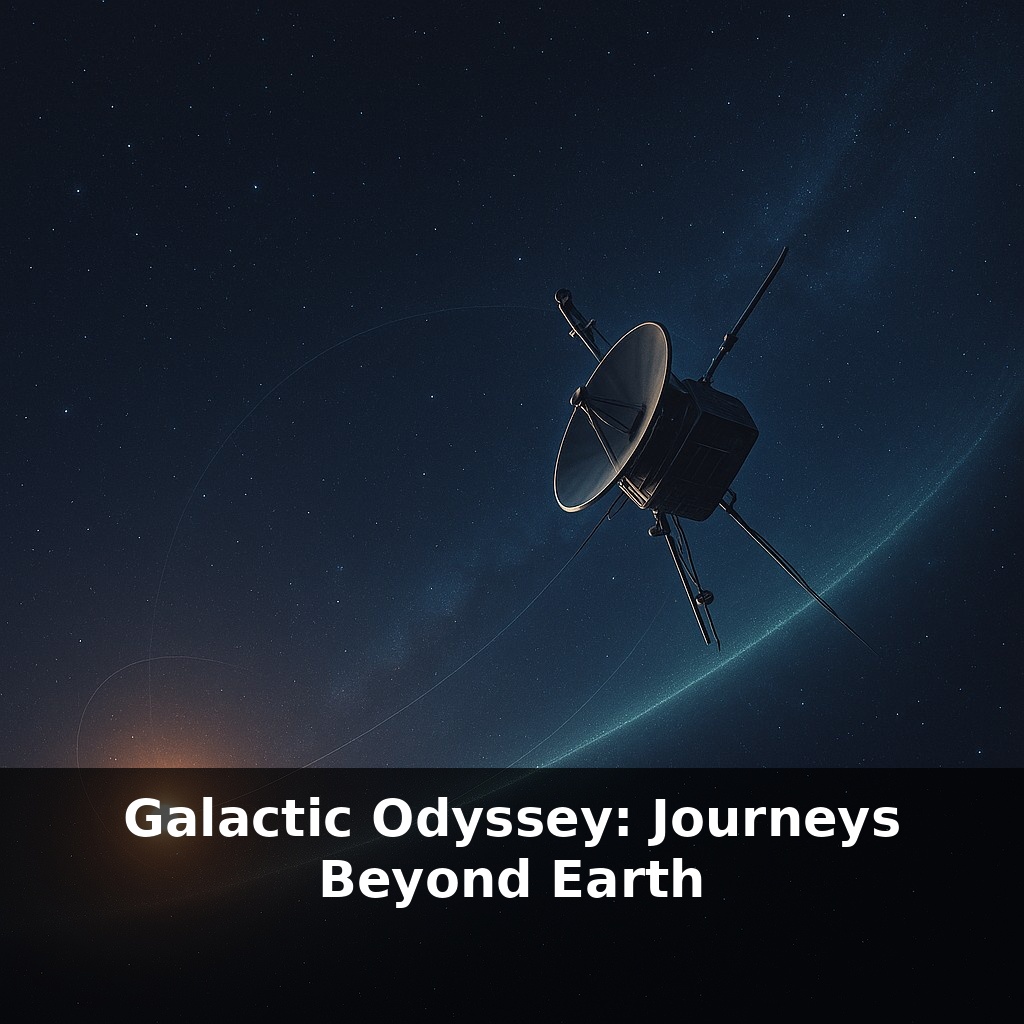
An invisible line, far beyond Pluto, marks where the Sun’s breath fades—and a machine the size of a small car has already crossed it. Tonight, we’re hitching a ride on that lonely spacecraft, racing into the dark to ask: how far can a species from one small world really go?
We didn’t begin our journey with grand starships; we started by barely lifting off the planet. For most of history, “space” was a word for poets and priests, not engineers. Then, in 1961, a human orbited Earth for the first time—and suddenly the sky stopped being an upper limit and became a starting line. In just a few decades, we went from tentative leaps to building an entire research outpost that never touches the ground, a laboratory where sunrise and sunset flick past like the ticking of a cosmic clock. Today, rockets don’t always die after one flight; some come back, dust themselves off, and fly again, trimming the price of reaching orbit the way discount airlines reshaped travel. Meanwhile, silent observatories far from Earth’s glare collect ancient light, turning faint whispers from the universe into sharp, new questions.
Now our journey stretches in two directions at once. On one side, engineers push outward, planning habitats near the Moon and plotting careful paths to Mars, where delay-filled radio calls will force crews to make decisions without instant help from home. On the other, we fill near‑Earth space with constellations of small satellites, letting phones, ships, and farms tap into data once reserved for space agencies. These orbits form a kind of planetary nervous system, while probes like Voyager drift into interstellar quiet, turning our local experiments into the first hints of a truly galactic map.
Every escape from Earth begins with a blunt, unforgiving number: 11.2 kilometers per second. Reach that speed and you’re no longer just in orbit—you’re leaving, trading the comfort of closed loops for open trajectories that don’t come back unless you burn fuel to bend them homeward. That threshold shapes almost everything we send outward, from the mass of a crew capsule to the thickness of a probe’s armor against dust and radiation.
Once free of Earth’s grip, journeys fork into distinct regimes. Some missions skate within the inner Solar System, borrowing momentum from planetary flybys the way a skilled cyclist tucks behind faster riders to gain speed with less effort. Others commit to years‑long cruises, like Voyager 1, which took slingshots past multiple giants before easing toward interstellar space. The farther we go, the thinner the sunlight, until solar panels become less like broad wings and more like emergency candles struggling to stay useful.
Closer in, near‑Earth orbit has its own challenges. At roughly 400 kilometers up, where the ISS loops around the planet, gravity hasn’t vanished; spacecraft are simply in continuous fall. That delicate balance demands frequent nudges to counter atmospheric drag, orbital junk, and tiny gravitational tugs from the Moon and bulges in Earth’s shape. A misplaced burn by just a few meters per second can mean missing a docking window by kilometers.
Deep‑space observatories face a different trade. The James Webb Space Telescope sits near a gravitational sweet spot, where the pulls of Earth and Sun nearly cancel. There, its 6.5‑meter mirror—more than six times Hubble’s light‑collecting area—can drink in faint glows from early galaxies and cold exoplanets. But that perch comes with risk: no quick repair visits, no easy upgrades. Every component must work, and keep working, in a place humans can’t yet reach.
On the launch pads back home, reusable boosters chip away at cost and access. Each successful landing isn’t just a stunt; it’s a data point, feeding models that predict wear, refine guidance, and steadily stretch the lifetime of hardware that used to be thrown away after minutes of use. Step by incremental step, the economics of reaching orbit shift from rare spectacle toward infrastructure—less like a one‑off fireworks show, more like a freight network you can schedule things on.
Meanwhile, two misconceptions quietly warp how we see this odyssey. First, our own celestial neighborhood is still largely frontier. Humans have walked on exactly one other world, and crewed missions have ventured only as far as its gray plains. Robotic scouts have widened that footprint, but vast swaths of moons, comets, and dwarf planets remain untouched. Second, “weightlessness” isn’t an absence of gravity; it’s the sensation of falling without hitting the ground, a state that turns everyday acts—pouring water, sleeping, even swallowing—into small engineering problems.
Yet even from these early forays, benefits cascade back. Technologies honed to time satellite signals with absurd precision keep GPS systems accurate enough to guide planes and tractors. Tools designed for moonwalkers inspired cordless devices now common in workshops. Sensors built to catch faint cosmic signals evolved into instruments that peer inside human bodies without a scalpel. The path outward keeps looping inward, tightening the weave between exploration and everyday life.
Your challenge this week: think of one specific thing you do daily that quietly relies on space tech—maybe a map app, a weather forecast, or a medical scan—and trace it backward. Whose decision to fund a mission, design a sensor, or solve a navigation problem made that routine moment possible?
Out past Voyager’s path, another kind of journey is unfolding much closer to home: the way space quietly threads through ordinary tools. The same timing tricks that let probes sync with far‑flung antennas now help your bank move money securely across continents. Weather satellites don’t just warn of hurricanes; they guide cargo ships, shape crop insurance prices, and even influence the cost of your morning coffee by predicting frost in distant farms. When engineers learn how to fold giant mirrors or antennas into slender fairings, that discipline of packing and deployment echoes in ultra‑compact cameras and sensors in your phone.
Think of deep‑space missions as high‑risk “R&D departments” for civilization. A mission might spend a decade in planning and seconds crossing a critical launch window, but the software built to steer it, test it, and keep it alive becomes a toolkit other industries quietly adopt. One carefully flown trajectory can rewrite spreadsheets in logistics companies, tune algorithms in hospitals, and refine climate models that help cities plan for rising seas.
Voyager’s distant path hints at a coming shift: our maps may soon extend naturally from city streets to cis‑lunar “highways” and resource depots. Lunar ice could be refined into fuel, turning the Moon into a kind of orbital gas station and logistics hub. As the space economy grows, contracts and treaties may matter as much as thrust—who owns mined water, who cleans debris, who speaks for a fragile moon or asteroid before it’s carved into supply chains.
Soon, leaving Earth may feel less like a rare expedition and more like catching a long‑distance train: scheduled windows, known routes, refueling stops in orbit. As we sketch those timetables, new questions surface—who controls the “tracks,” who buys a ticket, who gets left standing on the platform—reminding us that the next frontier is as social as it is cosmic.
Start with this tiny habit: When you look up at the sky (even just walking outside or glancing out a window), quietly pick one star or bright point and imagine which episode of "Galactic Odyssey" would feature a journey starting there. Then, whisper a one-sentence mission log to yourself like, “Day 1 of my voyage to Proxima Centauri: I’m stepping outside my comfort zone by [tiny thing you’re doing today].” If you’re indoors at night, use any small light (like your phone notification LED) as your “star” and do the same thing.