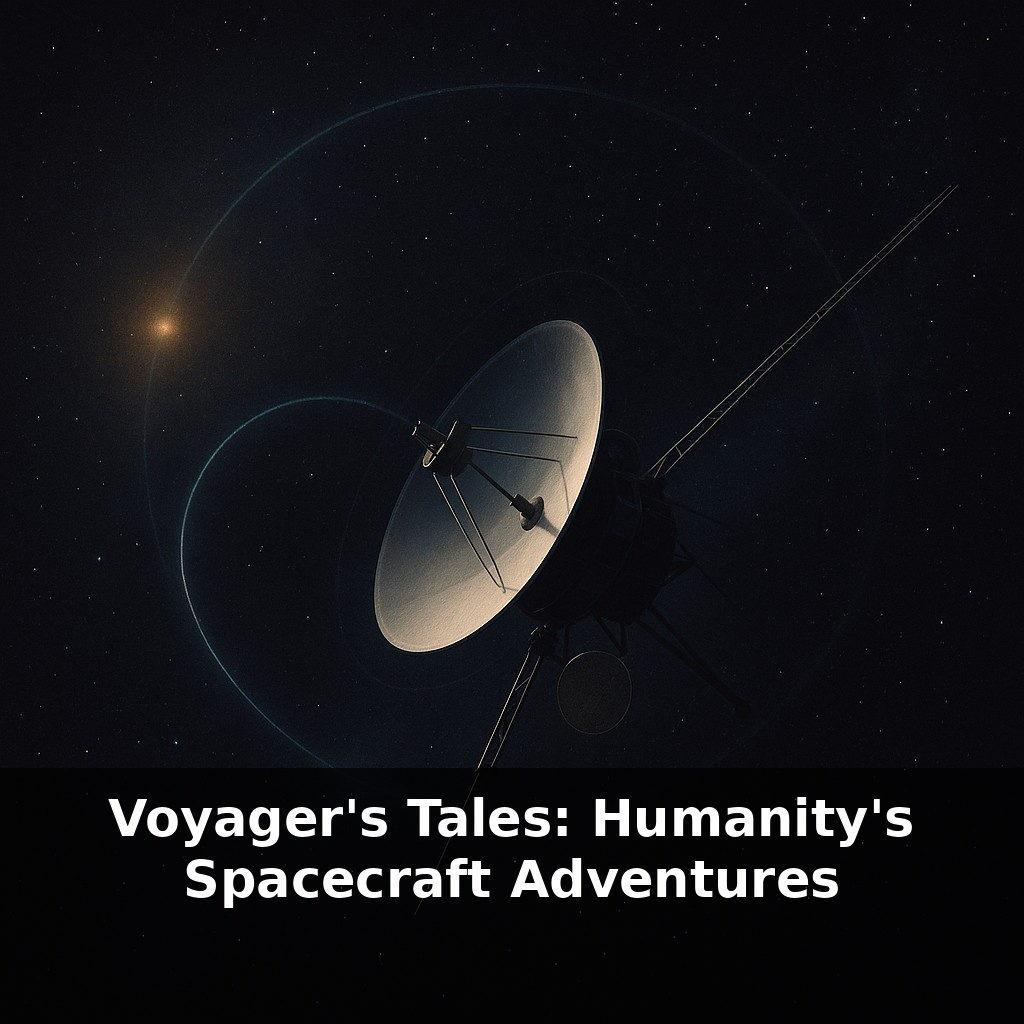
In the late seventies, two spacecraft left Earth with computers weaker than a cheap calculator—yet they’re still talking to us from beyond the edge of the Sun’s influence. Tonight, we’ll drop in on them mid-journey, as they coast through the dark between the stars.
Out there, the usual ideas of distance and time start to fall apart. A radio signal from Voyager 1 now takes well over 20 hours to reach us, racing at light speed; when engineers “speak,” they wait almost two days to hear the spacecraft “reply.” Commands are sent in tight, carefully encoded sequences, because a typo out here isn’t just a bug—it can waste weeks. Each bit of data that returns is precious, squeezed through transmitters weaker than a refrigerator light bulb and caught by giant radio dishes on Earth listening in exquisite silence. Beyond the last major traces of the solar wind, both Voyagers sample a new environment: thin interstellar plasma, energetic cosmic rays, and the subtle pressure of space between stars. This isn’t just empty dark; it’s a kind of quiet ocean, and the probes are our drifting buoys, logging conditions in a sea no human will touch for generations.
Each Voyager also carries something stranger than instruments: a message in a bottle. Bolted to the side of each probe is the Golden Record, a copper LP plated in gold, engraved with instructions for how to play it and what it contains. Inside its grooves: greetings in dozens of languages, sounds of wind, birds, and heartbeats, and music from Bach to Blind Willie Johnson. It’s not for us, or even for our grandchildren. It’s for anyone—or anything—that might someday stumble upon these artifacts, long after Earth’s current civilizations have shifted, merged, or vanished from memory.
If you could hitch a ride beside Voyager 2 right now, you wouldn’t see a grand, glowing boundary line where “solar system” ends and “interstellar space” begins. You’d see blackness, scattered stars, and a thin rain of invisible particles. Yet the spacecraft’s instruments can tell, quite precisely, which side of that invisible frontier they’re on.
Engineers watched the change happen twice, years apart, along two different paths. As each craft approached the heliopause—the region where the Sun’s outward wind loses its fight against the surrounding medium—the data shifted. The flow of solar particles dwindled. High‑energy cosmic rays, once partly held back, surged. Then, on specific days in 2012 and 2018, the numbers snapped into a new pattern and stayed there. No banner, no signpost, just a permanent change in the “weather report” coming from those far‑flung sensors.
What makes this remarkable is how much had to go right for that moment to be recorded at all. The Voyagers were never primarily designed as interstellar scouts. Their original job was the “Grand Tour”: a rare planetary lineup that let a single trajectory slingshot past Jupiter, Saturn, Uranus, and Neptune. Jupiter’s gravity bent and boosted them toward Saturn; Saturn shaped Voyager 1’s route upward and out of the planetary plane, while Voyager 2 skimmed onward to Uranus and Neptune. Each flyby was a trade: come in fast and close to harvest more speed, or stay farther out and collect more detailed data. Mission planners squeezed both science and velocity from every encounter.
Those choices at the giant planets fixed their fates decades later. Voyager 1’s steeper path carried it to the heliopause sooner and at a higher latitude; Voyager 2’s more equatorial route produced a slightly different crossing profile. Comparing their measurements lets physicists probe how lumpy, dynamic, and asymmetric the heliosphere really is.
Sustaining that exploration is an ongoing exercise in triage. Their plutonium power sources fade by roughly four watts each year. To keep the most valuable instruments alive, teams periodically shut off heaters or non‑critical systems, reshuffling a limited power budget the way a small lab might unplug equipment to keep a single, crucial experiment running. Every few years, another component goes dark so the mission can continue at all.
Think of each Voyager as a 1970s vinyl record player strapped to a motorcycle: rugged, limited, but tuned so well that engineers still coax useful “tracks” from it nearly fifty years on. The “playlist” now is mostly about the space between stars, and the data rate is painfully slow: a few thousand bits per second, less than an old dial‑up modem. That trickle has to be shared among instruments, status reports, and occasional engineering experiments, so teams on Earth debate which questions are worth asking at all. At distances of 130–150 AU, even a tiny course correction is unthinkable—the thrusters’ fuel is too precious, reserved for keeping the antenna pointed with exquisite precision. Faults that would once trigger quick troubleshooting can now take months to unravel; a single flipped bit in memory might not be noticed until patterns in the “weather” shift oddly. Yet these constraints turn the mission into a kind of ultra‑slow science, where patience is the main tool and every new plot is a once‑in‑a‑lifetime surprise.
In a few years, the Voyagers’ last sensors will wink out, leaving only carrier tones, then silence. Yet their true afterlife is as prototypes. Engineers planning interstellar probes now treat them like veteran climbers who left notes on a treacherous route: where the “weather” shifts, how hardware ages, which backups actually matter. Archivists, meanwhile, study them as precedent—our first serious attempt at a message built to outlast not just nations, but species.
Long after their instruments fall quiet, their paths keep going, like investment accounts left to compound for millennia in the dark. Future astronomers around distant stars might one day detect these tiny relics crossing their skies, puzzled by their deliberate trajectories. For us, the real legacy is closer to home: proof that our curiosity outruns our technology.
Here’s your challenge this week: spend one evening creating your own “Golden Record for Earth, 2025” by choosing exactly 10 sounds, 5 images, and 3 short messages you’d beam into deep space if your USB drive hitched a ride with Voyager 1. Use free public-domain sources (like NASA’s image and audio libraries) and actually save them into a single folder named “My Golden Record.” Before you’re done, write a 2–3 sentence “interstellar greeting” you’d include for any civilization that might find it, inspired by the original Voyager greetings.