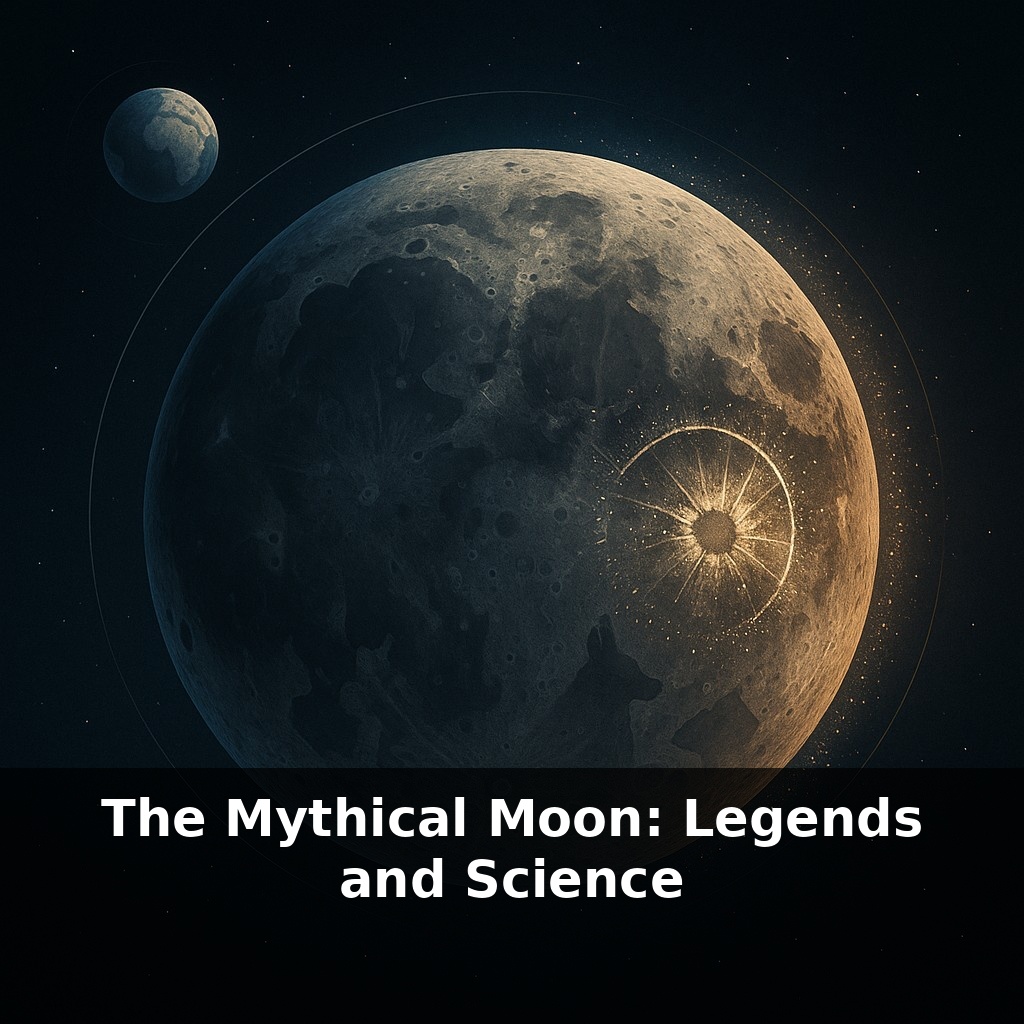
A cold, airless rock, darker than worn asphalt, once ruled our dreams as a god, a rabbit’s lantern, and a beacon for werewolves. Tonight, that same Moon is a crime scene. The mystery: how did one silent impact in deep time reshape every story humans tell about the sky?
When that long-ago collision flung molten debris into orbit, it didn’t just sculpt a satellite; it rewrote the script for our entire planet. Our days slowed, our oceans learned to breathe in tides, and the tilt of our world steadied enough for seasons to become reliable instead of chaotic rumor. In the sky, people later traced this steady companion into myths—seeing not a scarred survivor of cosmic violence, but a watchful face, a ladder to heavens, a calendar carved in light. Yet now, probes and landers creep across its dust the way an archivist turns fragile pages, searching for clues in glassy beads and tiny ice grains. Each new mission is less a conquest than an interview: what was Earth like when it was young, how stable is our good fortune, and what futures hide in that pale, ancient orbit?
Now, as we stand in the LED glow of the 21st century, the Moon is quietly changing jobs again. For Artemis planners in Houston, it’s a launchpad; for Chang’e engineers in Beijing and Chandrayaan scientists in Bengaluru, it’s a test kitchen for new ways of living off-world. Its pale light, once a nightly story prompt, now doubles as a laboratory logbook written in craters, glass spherules, and seams of hidden ice. Lasers bounced off retroreflectors time the Moon’s slow drift away from us, while seismometers listen for quakes like a doctor checking an elderly patient’s heartbeat, searching for lingering inner warmth.
There’s a twist to this “crime scene” in the sky: the suspect is long gone, but the evidence is so sharp we can read numbers off it. Those Apollo rocks—some older than any Earth rock—carry time stamps in the ratios of radioactive elements, letting geologists pin the Moon’s solid crust to roughly 4.46 billion years ago. When they sliced those samples thin and peered through microscopes, they didn’t just see crystals; they saw an entire thermal history, from global magma oceans to slow cooling and cracking.
Modern orbiters add overhead surveillance. NASA’s Lunar Reconnaissance Orbiter maps boulders only a few feet wide. India’s Chandrayaan missions sniff out hints of water bound in sun-baked grains. China’s Chang’e landers scoop up fresh basalt and glass beads. Each nation asks a slightly different question, but the answers keep converging: this “dead” world is quietly active in subtle ways. It quakes. Its surface churns as micrometeorites pepper it. Even its tenuous exosphere—so thin it barely counts as an atmosphere—blooms and fades with solar activity.
Tidal locking, once an obscure orbital curiosity, turns out to be a design feature for exploration. Because one face always looks homeward, you can park antennas there and stream data with brutal simplicity, while the far side lounges in permanent radio quiet—prime real estate for telescopes hunting whispers from the early universe. It’s as if nature pre-installed both a noisy front office and a soundproof research lab on the same world.
Then comes the ice. Radar and neutron measurements point to polar craters so deep the Sun never climbs their rims. In those permanent shadows, temperatures plunge colder than Pluto, and ancient water molecules—delivered by comets, asteroids, or sputtered out of rocks—can linger for eons. That ice is more than a curiosity: split into hydrogen and oxygen, it becomes propellant and breathable air. Suddenly, the Moon shifts again in human imagination, from mystical mirror to logistical hub, a place where folklore about “lunar influence” quietly yields to spreadsheets calculating launch costs and fuel margins.
The myths don’t vanish; they get archived alongside mass spectra and laser ranges, another layer in the growing dossier of how one small world keeps rewriting our story.
In older stories, each full Moon was a kind of deadline: harvest now, sail now, marry now. Today, the “deadlines” are launch windows and lighting cycles mapped down to the second. Apollo planners, for example, timed landings so astronauts would arrive just after local sunrise, when shadows carved craters into sharp relief but temperatures hadn’t yet soared past the boiling point of water. That practical choreography quietly echoes ancient lunar calendars, only now the stakes are life support and power budgets instead of planting and festivals.
Artists and filmmakers still raid lunar science for images: the idea that the Moon is slowly drifting away has inspired breakup albums and sci‑fi plots in which future eclipses no longer fit old prophecies. Even finance has followed the Moon’s lead. Companies proposing “cislunar” infrastructure talk in prospectuses about high‑ground logistics and fuel depots, using phrases that sound suspiciously like updated voyages of mythical moon‑chariots, except this time the chariots file quarterly reports.
Future lunar outposts may feel less like remote forts and more like coastal ports—places where crews, data, and materials continually flow. As engineers test 3D‑printed habitats, farmers experiment with sealed “moongreenhouses” and robotic miners practice extracting resources with surgical precision. These trials will quietly shape rules about who can drill, build, or preserve sacred and historic sites, turning orbital paperwork into the next chapter of space folklore.
So the next time pale light washes over your street, let it be both telescope and diary margin. One side of your mind can note launch schedules, crater maps, and ice budgets; the other can smuggle in wolves, lovers, and sky‑rabbits. Between those columns—like notes in the margin of a cookbook—we quietly draft recipes for futures that don’t exist yet.
Start with this tiny habit: When you notice the Moon in the sky—whether you’re walking to your car or looking out a window—say out loud one thing you remember from the episode (like “tidal pull,” “lunar eclipse,” or a mythic figure such as Chang’e or Artemis). Then, take literally 5 seconds to guess what phase it’s in (waxing, waning, full, or new-ish) before you move on. If you’re indoors and can’t see the Moon, just glance at a nearby clock and quickly imagine how its gravity is tugging at Earth’s oceans right then, the way the episode described.