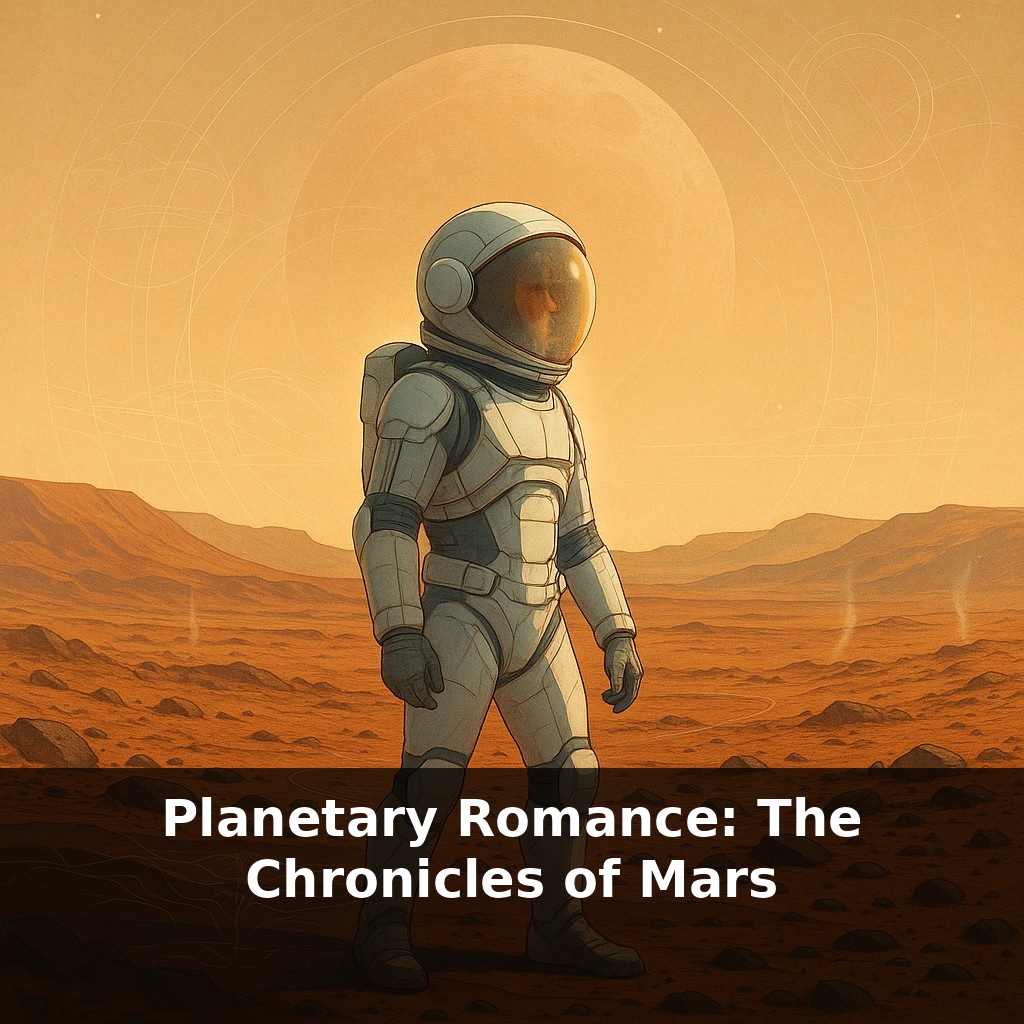
A world almost as long‑dayed as Earth, cold enough to freeze carbon dioxide, still tempts us as our next home. A lone explorer steps onto rusty dust, breath fogging inside a fragile suit. Is this truly alien ground—or just an older, harsher chapter of our own story?
Mars is not just red; it’s layered. Rusted dust hides basaltic rock, ancient riverbeds, and sediments laid down when water once flowed wide enough to carve deltas. Under faint sunlight, the sky can glow butterscotch, and dust devils prowl like thin, wandering ghosts across plains that have waited billions of years for footprints and tire tracks.
This is the stage where planetary romance collides with hard data. Orbiters trace dry valleys once mistaken for canals, while rovers nose through rocks for salts, clays, and organic molecules—clues that the planet’s past climate may have swung from brutal cold to episodes warm enough for lakes.
We stand at an odd crossroads: telescopes and landers reveal a frozen desert, yet each new spectrum, drill core, and seismic whisper hints that Mars might still be quietly active—geologically, chemically, perhaps even biologically.
Average midday in the Martian tropics might nudge up toward a mild Earth spring, yet step into the night and the same ground can plunge to Antarctic deep‑freeze. A sol stretches just a sliver longer than our day, but the year drags on nearly twice as long, so seasons linger, drawing out winters and dust‑storm summers. Above, an atmosphere thinner than a mountaintop breath leaves ancient volcanoes like Olympus Mons exposed, silent, and vast. Below, polar caps and buried ice quietly hoard enough frozen water to coat the entire planet in a shallow global sea if it ever melted and spread.
Life on Mars, if it ever took hold, would have had to thread a narrow needle. Today’s air is mostly carbon dioxide, leaking slowly into space, with surface pressure so low that unprotected liquid water boils away almost as soon as it melts. Yet scattered minerals—salts, clays, sulfates—quietly testify that stable water once lingered long enough to alter rocks in place. That’s why rovers obsess over pale, fine‑grained layers: they’re not just pretty strata, they’re time‑capsules of ancient chemistry.
In those capsules, missions like Curiosity and Perseverance have sniffed out organic molecules: carbon‑bearing compounds that on Earth are entangled with biology, but can also arise purely from geology. The puzzle is not just whether organics are present, but how they’ve survived billions of years of cosmic radiation under such a thin sky. That’s one reason drills bite into the subsurface—each extra centimeter can mean dramatically better preservation.
Another subtle clue flexes the Martian air itself. Trace amounts of methane have been measured, sometimes spiking in plumes, sometimes fading to near nothing. On Earth, much methane comes from microbes or geologic reactions between water and certain rocks. On Mars, neither explanation has been confirmed, and the fact that different instruments disagree about how much methane is there—and when—keeps the question open. It’s a bit like a stock you only glimpse at random intervals: you can see that it moves, but not yet why or on what schedule.
Meanwhile, the crust remembers an era when volcanoes belched gases, lava seas cooled into plains, and impacts punched deep basins that may have cradled long‑lived lakes. Seismometers from missions like InSight have started to outline that hidden interior, catching “marsquakes” that hint at a planet not entirely frozen solid inside. A slowly cooling core, fractured lithosphere, and pockets of lingering heat could still drive reactions between rock, ice, and trapped gases.
Link these threads together—organics in old sediments, erratic methane, a restless interior, vast reserves of buried ice—and a picture forms of a world that may never have been lush, yet may have been intermittently habitable. Not a twin of Earth, but a cousin whose youth followed different rules, and whose present still refuses to be entirely predictable.
Martian exploration now plays out like a slow‑burn mystery series, each mission a new season with its own twist. One rover studies fine grains that settled in a crater basin, decoding subtle color shifts to infer when minerals met briny water. Another scouts an ancient river mouth, mapping where channels once fanned into a delta, then choosing drill targets that might have trapped microscopic cells—or their chemical shadows—in mud. Orbiters, watching from above, track shifting dust, trace faint gases, and refine gravity maps to weigh hidden ice and rock. They flag promising locales where underground ice lurks close enough to reach, crucial for any future outpost that must drink, grow food, and make fuel from local resources. Landing sites are now chosen not just for safety, but for story potential: places where a future astronaut‑geologist could walk through billions of years of Martian history in a single afternoon, reading craters, canyons, and layered buttes as if they were chapters in a planetary autobiography.
A confirmed Martian “second genesis” wouldn’t just tweak textbooks; it would reshape our sense of rarity. Biologists might hunt for parallel solutions to DNA, while doctors mine Martian microbes for strange enzymes, like chefs testing a new spice that bends every recipe. Engineers would treat Mars as a testbed for closed‑loop life support, honing systems we later export to asteroids or ocean worlds. And ethicists would face a new question: how much should humans edit a living planet to live there?
So the chronicles stay unfinished. Each lander is less a flag than a bookmark, saving pages where ice, salts, or wisps of methane hint the plot isn’t over. As crews follow, their footprints will annotate those chapters—testing soils for breathing, rocks for building, skies for flying—until “the red planet” reads more like a co‑authored travel journal than a distant myth.
Before next week, ask yourself: 1) If I were dropped onto the red plains of Mars from this episode—dust storms, ancient canals, lost cities and all—what one scene, location, or culture from the story would I want to explore first, and why does that setting tug at me more than the others? 2) Which character decision or Martian custom from the episode made me think, “I’d never do that” or “I wish I were that brave,” and what does that reaction reveal about how I currently face risk, loyalty, or the unknown in my own life? 3) If I treated my everyday world like a planetary romance—full of hidden ruins, strange sky-colors, and secret histories—what’s one ordinary place (a street corner, commute route, park, or room in my house) I could deliberately “reimagine” in Martian terms today, and how would that shift the way I move through it?