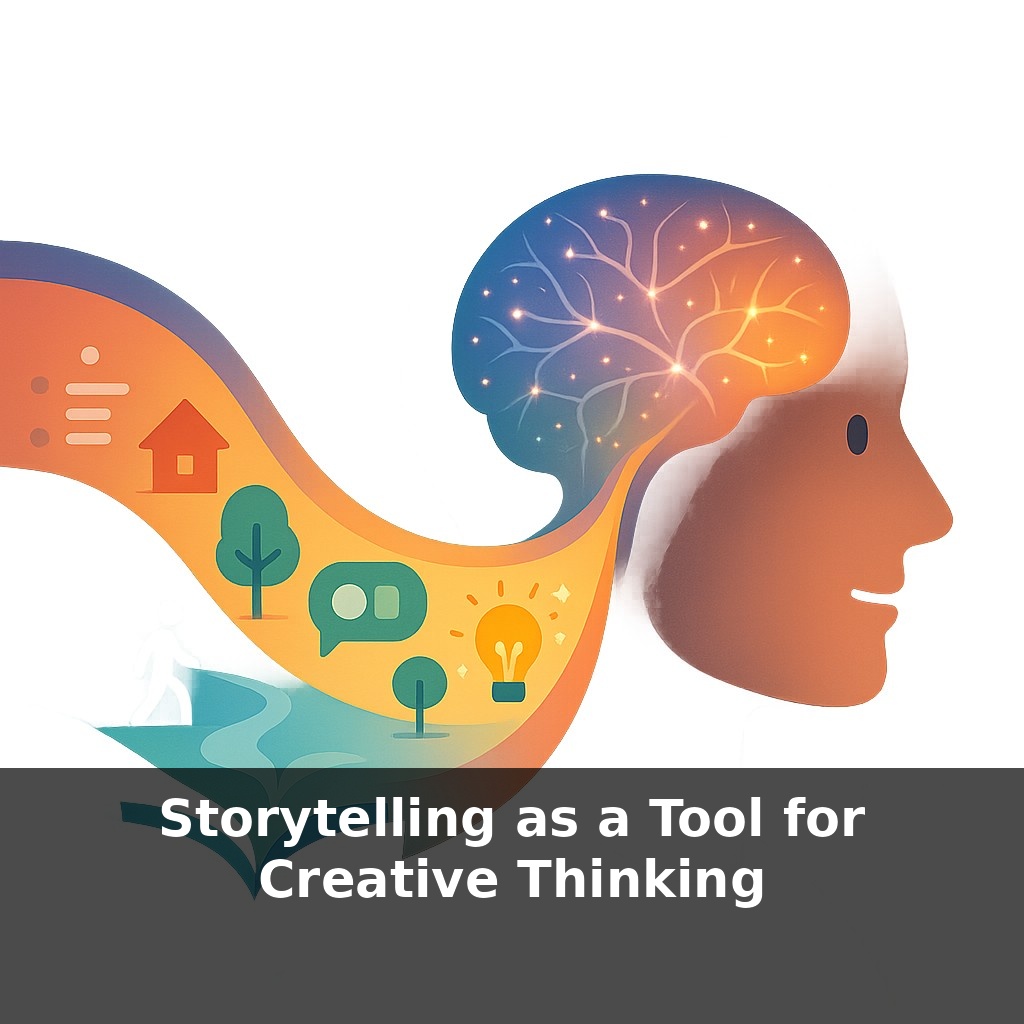
Neuroscientists can now predict what story you’re hearing just by watching your brain light up. You’re in a meeting, bored by bullet points—then someone tells a quick customer story, and suddenly the room wakes up. Why does a tiny narrative do what a giant slide deck can’t?
A 2014 Stanford study found that when you wrap facts inside a story, people remember them up to 22 times better a week later. That’s not just about better presentations—it’s a cheat code for creative thinking. When your brain holds onto details more easily, it has more raw material to remix into new ideas. Think of a product roadmap: as a dry list, it evaporates after the meeting; framed as a customer’s “day in the life,” it sticks, evolves, and invites “what else could we do for them?” questions. The same is true in classrooms where students turn case studies into short scripts, or in design teams that sketch “a day in the future” instead of listing features. Structured approaches like Pixar’s Story Spine or “What–So What–Now What” don’t just organize thoughts—they pull your team into a shared mental movie, where it feels natural to test wild possibilities before reality has a chance to shut them down.
In fast-moving teams, story-based thinking becomes a practical tool, not a “nice to have.” A designer mapping a clunky sign-up flow might turn bug reports into a short “scene” where a rushed parent hits three dead ends before giving up. Suddenly, the problem isn’t an abstract “conversion drop” but a character you want to help, and new options surface: fewer fields, clearer progress, a save-later feature. In strategy work, leaders who frame a change as “the next chapter” invite people to co-author outcomes, rather than passively receive instructions or resist a vague, threatening shift.
When neuroscientists at Princeton tracked speakers and listeners in an fMRI scanner, they saw something wild: as a story unfolded, the same brain regions lit up in both people, almost in sync. That “neural coupling” isn’t just about connection—it’s a shortcut to collaborative creativity. When a team shares a mental timeline of “what happened,” it becomes much easier to diverge together (“what else could have happened?”) and then converge on better options.
This is why simple story frames show up inside some very analytical environments. At IDEO and other design firms, engineers don’t start with feature lists; they draft short “episodes” from a user’s life, then systematically push on them: What’s the moment of friction? What if that moment flipped from failure to delight? What totally different technology could enable that? The story gives everyone the same starting scene; the questions crack it open into speculative futures.
Law schools have quietly used this logic for years. A case brief is essentially a compressed narrative: who did what, when, and with what consequences. Once the baseline story is clear, students are trained to run variations: change one fact, one motive, one constraint. Instantly, a forest of new legal interpretations appears. They’re not “being creative” in the artsy sense—they’re using narrative structure as a controlled lab for alternative realities.
In business innovation programs, facilitators exploit the emotional arc of a story to loosen rigid thinking. Teams map “the low point” for a customer—confusion, delay, cost—and then deliberately exaggerate it: How bad could this get? Pushing the pain to extremes paradoxically makes room for bolder remedies: automation, elimination of whole steps, partnerships that once felt off-limits.
Think of it like refactoring legacy code in software: you don’t randomly rewrite functions; you first trace the execution path for one real request, end-to-end. That concrete “run” exposes hidden dependencies and weird edge cases, which then suggest smarter architectures. In the same way, walking through one specific storyline reveals where your assumptions live—and those assumption hotspots are often exactly where fresh ideas are waiting.
A UX team at a global fitness app once ran into a wall redesigning their progress screen. Charts and metrics all looked the same. So they drafted five ultra-short “scenes,” each starring a different user on a specific day: an injured runner, a burned‑out new parent, a retiree training for a first 5K. Reading them out loud, they noticed every scene stalled at the same emotional beat: “I don’t know what to do next.” That single repeated moment became the design target, eventually turning into a “coach suggests the next tiny step” feature that boosted weekly activity across segments.
You can do something similar even without a team. Take a stubborn problem—say, your mornings are chaos—and sketch three fast “alternate timelines” of the same hour with one rule changed: you wake up 20 minutes earlier; your phone stays outside the bedroom; breakfast is prepped the night before. Don’t judge, just write. Then circle the version that feels oddly energizing or surprising. That’s your prototype to test in real life.
As AI tools improve, you’ll be able to “sketch” alternate futures in minutes: drag‑and‑drop storyboards of markets, careers, even cities, then watch simulations play out. Portable brain‑sensing could quietly flag which versions truly grip people, long before surveys catch up. In classrooms, kids might debug a physics concept by rewriting the “plot” of an experiment. Your challenge this week: take one decision you’re stuck on and draft three radically different future “episodes” before choosing.
Let this be your quiet upgrade: instead of replaying the same internal monologue, start treating stuck moments like draft episodes you can revise. Shift the point of view, change the “setting,” or time‑jump to a consequence you hadn’t considered. Like rearranging furniture in a familiar room, tiny rewrites can open paths you didn’t know were there.
To go deeper, here are 3 next steps: 1) Block 20 minutes today to watch Andrew Stanton’s TED talk “The Clues to a Great Story,” then pause after each “story rule” he mentions and rewrite a current work or life challenge as a Pixar-style “Once upon a time… Every day… One day… Because of that…” story in a notes app. 2) Open the free tool StoryDice (or use a random story prompt generator like storyshack.com/tools/story-idea-generator) and generate 5 random prompts; force yourself to connect each one to a real project you’re working on, typing a 3-sentence “what if…” scenario for each that deliberately breaks your usual assumptions. 3) Grab a short story from the collection “Stories of Your Life and Others” by Ted Chiang (any edition), read just one story, and then use a mind-mapping tool like Miro or XMind to map how a single “what if” premise in that story branches into characters, conflicts, and outcomes—then mirror that same branching structure onto a stuck idea from your own work.