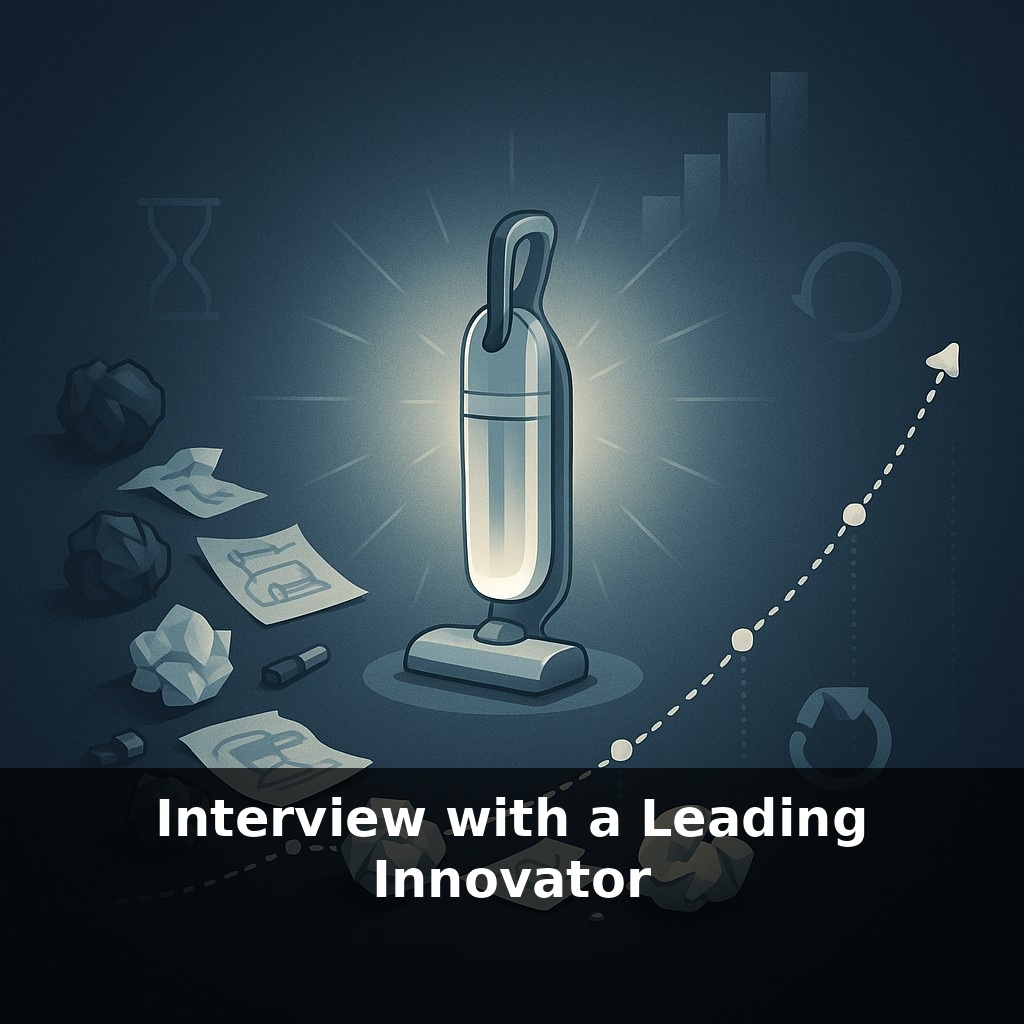
“Five thousand failed attempts… and then a multibillion‑dollar vacuum cleaner. James Dyson’s story hints at a strange truth: world‑changing ideas often look like long, boring streaks of failure. So how do the best innovators stay in the game when everything looks broken?”
Seventy‑five to ninety percent of venture‑backed startups still fail within ten years, even with more tools, data, and capital than any generation before. So the real mystery isn’t why so many attempts collapse; it’s how a small minority manage to navigate the same odds and still ship something the world actually adopts.
In this episode, we step inside that minority. Not through theory, but through the lived mechanics of disciplined experimentation, uncomfortable feedback, and the awkward early versions most people never see.
Think of the process less as waiting for lightning and more as learning to build a reliable power grid: connecting diverse “sources” of insight, routing energy where it’s needed, and designing for inevitable surges and breakdowns.
We’ll explore how leading innovators structure their days, teams, and decisions so creativity becomes repeatable—especially when the pressure is on.
In our interview, what surprised me most wasn’t a secret hack or genius‑only insight, but how mundane breakthrough work often looks up close. Long stretches of calendar blocks labeled “prototype review,” standing meetings just to kill weak ideas quickly, and recurring debriefs where the only agenda is, “What did we learn the hard way this week?”
Instead of chasing inspiration, they design systems: decision rules for when to double down, when to pivot, and when to walk away—even from personally beloved concepts. That structure is what keeps creativity moving under real‑world constraints like budgets, deadlines, and skeptical stakeholders.
“Most of what we try doesn’t work.” That line came early in the interview, delivered without drama. Then the follow‑up: “Our advantage is that we find out faster, and for less money, than everyone else.”
When we dug into what that actually looks like, three patterns kept surfacing.
First, they obsess over shrinking the gap between idea and contact with reality. In hardware, where that 3–7 year clock is always ticking, they create “ugly but honest” prototypes that can be tested this week, not perfected next quarter. In software, where 6–18 months can make or break a product, they push tiny releases to carefully chosen users, not splashy launches to everyone. The question isn’t “Is this good?” but “What about this fails first, and with whom?”
Second, they treat creativity as a contact sport between disciplines. Our guest described a standing rule: no major decision without at least three perspectives in the room—technical, customer, and financial. A designer might sketch an interface while an engineer quietly lists what would break, and a marketer asks, “Who would switch to this, today, and why?” Tension isn’t a bug; it’s the raw material. The most promising ideas often emerged not from consensus, but from productive disagreement that forced sharper thinking.
Third, they engineer how failure shows up. Instead of heroic all‑in bets, they stage risk: small experiments early, bigger commitments only after specific evidence. One venture they led died in month four, not year four, because they’d pre‑defined red lines: if regulators blocked X and acquisition cost stayed above Y, they would exit. That decision freed people and capital for the next bet—one that eventually contributed to the 25% of revenue their company now gets from recent products.
The paradox is that this kind of rigor feels less glamorous than the lone‑genius story. Yet it’s closer to watching an elite sports team run drills: repetitive, precise, designed so that when the rare breakthrough opportunity appears, they’re ready to execute, not just to dream.
A founder we spoke with keeps a wall of “retired experiments”: screenshots, failed pitch snippets, even photos of clunky hardware. Each artifact has a sticky note: date, hypothesis, outcome, and one line starting with “Next time we’ll…” It’s not nostalgia; it’s a live database of pattern recognition. When her team faces a big decision, they don’t brainstorm from zero—they scan that wall and ask, “What looks eerily familiar?”
Another leader runs a weekly “collision hour.” For 60 minutes, a data scientist, salesperson, and lawyer dissect a single assumption: a user behavior, a pricing rule, a regulatory risk. No slides, just a whiteboard divided into three columns: “We think,” “We know,” “We’ve tested.” The goal isn’t to agree; it’s to move at least one item from belief to evidence.
Think of it as architectural load‑testing for ideas: before anyone pours concrete, they’re quietly jumping on the beams, looking for the wobble while it’s still cheap to fix.
Soon, AI copilots will sit inside these creative drills, stress‑testing ideas before they touch the market—like a sparring partner that never gets tired. Open labs, bio‑foundries, and shared hardware platforms will let small teams attempt problems once reserved for governments. The catch: as tools make it easier to launch anything, discernment becomes the scarce skill. The real edge will be knowing which problems to walk away from, and which to prototype one more time.
Your creative edge might not be a bigger idea, but a tighter learning loop. Think less about protecting concepts and more about stress‑testing them in public: small pilots, frank debriefs, fast edits. Your challenge this week: pick one “someday” idea and move it one notch closer to the real world—by 5%, not 500%.