Half the “brilliant ideas” inside companies never make it past a slide deck—yet a few, like Airbnb’s early pivot, quietly rewrite entire industries. In this episode, we’ll step into those meeting rooms and unpack why some ideas die, while others reshape the whole game.
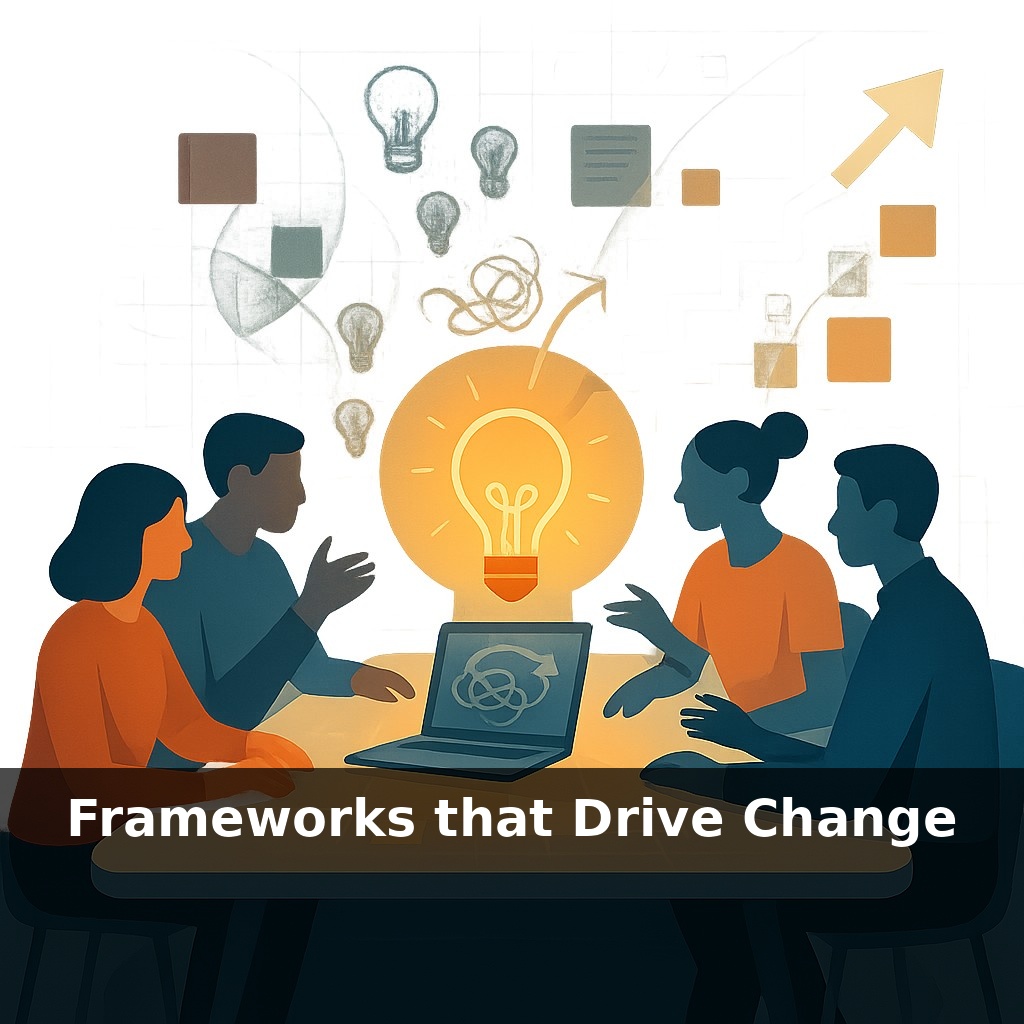
Seventy percent of change initiatives fail—not because the ideas are weak, but because the path from insight to implementation is chaos. In this episode, we’ll explore what happens when you stop relying on raw inspiration and start using frameworks that quietly stack the odds in your favor. Design Thinking, Kotter’s 8 steps, ADKAR, Lean Startup—these aren’t buzzwords, they’re more like an architect’s blueprint: they show you where to put the beams so the whole structure doesn’t collapse the first time the market shakes. We’ll look at how teams at IBM, Microsoft, and others turned fuzzy goals like “be more innovative” into concrete behaviors, milestones, and metrics—and why executive sponsorship and cross‑functional squads are the real force multipliers for your creativity at work.
Most teams treat “being innovative” like shooting three‑pointers in the dark: every now and then someone sinks a miracle, but no one can repeat it on purpose. The organizations that break out of that pattern don’t just brainstorm harder—they change the way decisions get made, who is in the room, and what “good” looks like at each stage. In this episode, we’ll zoom in on how structured approaches quietly rewire habits: which meetings exist, which questions leaders ask, which metrics get tracked, and how everyday friction gets turned into a visible, shared pipeline of experiments instead of a graveyard of stalled ideas.
Most people first meet these frameworks as diagrams on a slide. The real unlock happens when they start to change what you *do in a single week of work*.
Take the murky instruction “be more customer‑centric.” On Monday, that’s a platitude; by Friday, with a framework in play, it can look like this: you’ve run three short interviews with actual users, rewritten one feature spec based on what you heard, and killed a pet idea that nobody outside your team cares about. Same aspiration, but now it leaves fingerprints in calendars, documents, and roadmaps.
This is the quiet power of structured approaches: they turn vague ambitions into specific behaviors you can schedule, observe, and improve. At IBM, “empathy” stopped being a value on a poster and became a recurring activity block: discovery sprints, playback sessions, user validation gates. The 75% cut in design‑to‑development time wasn’t magic; it was hundreds of tiny, repeatable moves replacing one‑off heroics.
Notice how these methods also redistribute *who* gets to move the needle. When you have a shared process, the bottleneck shifts from “who has the best idea” to “who is closest to the next step.” A junior engineer can trigger a quick experiment because the criteria and guardrails are visible. A product marketer can flag that you’re skipping a critical adoption step because the roadmap is explicit, not tribal knowledge.
They also make resistance less personal. Instead of “why are *you* blocking my project?” the conversation becomes “where are we in the sequence, and what’s not satisfied yet?” That doesn’t remove conflict, but it channels it into the structure: Are we rushing validation? Are we missing sponsorship? Are we measuring the wrong thing? Disagreements shift from ego to evidence.
Think of elite sports teams running set plays. In the last two minutes of a tight game, they don’t invent from scratch; they run practiced patterns that create space for creativity *within* them—when to pass, when to cut, when to take the shot. In high‑stakes projects, frameworks serve the same role: they provide the choreography, so your limited creative energy is spent on the moves that matter, not on arguing about basic sequencing.
Crucially, the most effective organizations don’t swear loyalty to a single model. They borrow. A culture initiative might blend a few of Kotter’s moves with ADKAR language for managers. A product push might mix lean experiments with elements of journey mapping. Over time, those mash‑ups harden into a local “playbook” that everyone recognizes—even if nobody could draw the original diagrams anymore.
This is where your own creativity comes in: not in rejecting structure, but in hacking it to fit your context, then using it to make better experiments cheaper, safer, and more frequent.
A team at a mid‑size bank kept launching “innovative” features that customers ignored. When they adopted a simple, hybrid playbook—map the customer moment, run one tiny test, then check adoption before scaling—something shifted. A product manager noticed that users dropped off right after viewing loan offers on mobile. Instead of debating for weeks, the team ran a 3‑day experiment: rewrite the copy, simplify the form, add one reassuring message about data security. Adoption ticked up 18% in a month, and that small win became a template for the next five experiments.
Or zoom into a culture shift. A retail COO wanted frontline staff to suggest improvements but kept hearing silence. By borrowing just two moves—a visible “opportunity board” and a weekly 20‑minute huddle to choose one idea to test—stores started treating annoyances as input, not noise. Within a quarter, they’d cut average checkout time by 12% through tiny, staff‑led changes. No grand program—just a repeatable way to turn friction into forward motion.
Algorithmic tools are about to supercharge how you use those structures. Instead of annual retros, you’ll see live dashboards flag where momentum is stalling—almost like sensors on a bridge warning of stress before cracks appear. ESG pressures will nudge every experiment to show its impact on people and planet, not just profit. Over time, the real edge won’t be a single method, but a culture where updating your “playbook” is as routine as updating your apps.
So as you sketch your own playbook, resist copying any model verbatim; instead, treat them like open‑source code you can fork and remix. Use them to expose hidden assumptions, surface quieter voices, and shorten the lag between “we sense something” and “we tried something.” Over time, your craft won’t be ideas—or tools—but orchestrating learning at scale.
Here’s your challenge this week: Pick one recurring problem in your work (e.g., handoffs between teams, slow approvals, or confused ownership), and run it through the full “change framework” from the episode in a single 30-minute block today. Map the current state with a quick swimlane or sticky-note flow, then define a specific “future state” in one sentence that would make this problem almost disappear. Before you end, create one experiment using the episode’s “smallest viable test” idea (for example, a 1-week pilot with one team, one project, or one client) and put a date on the calendar to review the result with at least one other person.