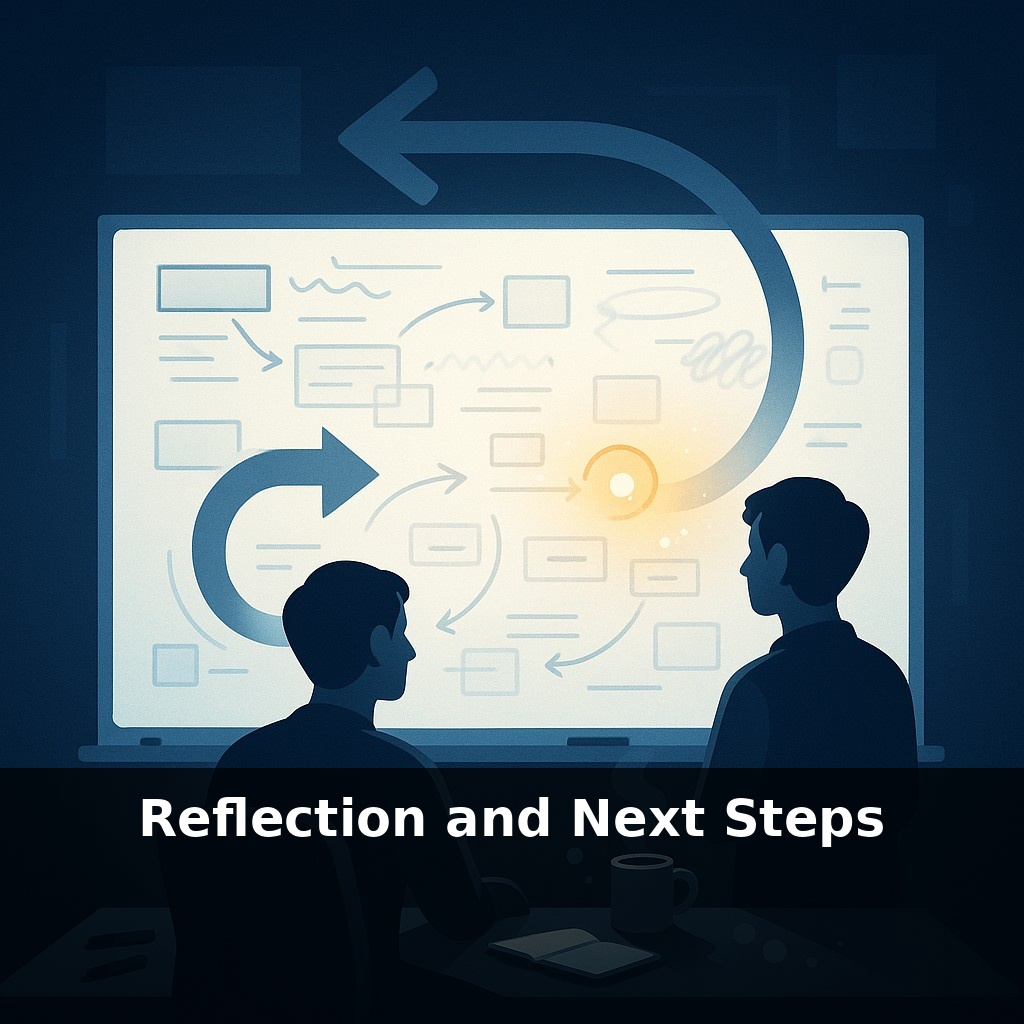
A group of employees spent just 15 minutes a day reflecting—and their problem‑solving jumped by nearly a quarter. Now, drop into a late‑night studio: the whiteboard is full, coffee is gone, ideas feel stuck. The missing move isn’t more brainstorming…it’s looking backward.
Most teams race from one project to the next, collecting “lessons learned” the way apps collect unread notifications—fast, unconsciously, and quickly ignored. But creative breakthroughs rarely come from adding more input; they come from upgrading the *operating system* that interprets what you’ve already done. That’s where systematic reflection and explicit “next steps” change the game.
The most innovative companies don’t just ask, “What happened?” at the end of a project. They ask, “What does this *teach us* about how we think, decide, and build—and what will we *try differently* next time?” They treat each launch, pitch, or failed draft as raw data for a simple loop: review, distill, experiment, measure. Over time, this loop turns scattered efforts into a repeatable creative engine—one you can run as an individual, a team, or even across a whole organization.
Most people treat their projects like streaming episodes: as soon as one ends, they’re already auto‑playing the next. The credits roll, but there’s no “director’s commentary” on what really happened behind the scenes. In high‑performing teams, that commentary isn’t a bonus feature—it’s the main event. They don’t just ask whether something was a hit; they trace which tiny choices in casting, timing, or edits made the difference. Skipping this is like updating an app’s interface without ever touching the underlying code: the screen looks new, but the same bugs keep crashing in the background.
When you look closely at consistently creative people and teams, you notice something odd: they don’t necessarily have better ideas *in the moment*—they have better *loops* between moments.
Neuroscience offers one clue. When you deliberately step back and analyze how you approached a challenge, you light up prefrontal networks linked to error detection, pattern recognition, and planning. That “meta” layer is what turns isolated wins and losses into reusable mental models—shortcuts your brain can call on next time you face a messy brief, an unclear client, or a blank page.
High‑performing organizations bake this into their cadence. At IDEO, for instance, project postmortems aren’t optional or sentimental; they’re scheduled, structured, and time‑boxed. The point isn’t to rehash the project narrative—it’s to surface *specific choices* that either accelerated or blocked progress: Which prototypes gave us the most information per hour? Where did approval bottlenecks quietly add three weeks? From there, they tweak how they scope, sequence, and test the *next* project.
Here’s where many people slip: they either stay at the level of vague takeaways (“communicate more”) or they jump to grand plans (“we need a whole new process”). The leverage is in between: tiny, testable shifts in how you think and work.
A practical way to do this is to treat each cycle of work like a product release and your own habits like features. You identify one mental habit to refactor: maybe you notice you default to polishing too early, or you avoid sharing half‑baked ideas with stakeholders. Instead of declaring a personality flaw, you design a micro‑experiment: “For the next two pitches, I’ll share a rough version 24 hours earlier than usual and track the quality of feedback and my stress level.”
That experiment has clear parameters, a time window, and observable data. Afterward, you can decide: keep, tweak, or discard. String together enough of these small bets and you’re essentially running an internal R&D lab on your own practice, upgrading how you think, not just what you produce.
Over time, this shift—from project outcomes to process experiments—builds a quiet confidence. You don’t need every idea to land; you need each cycle to teach you something actionable about how to create the next one.
A design lead at a sportswear company started ending each campaign with one simple question to the team: “What should future-us thank present-us for?” Instead of replaying the whole project, they hunted for one decision worth repeating. In a year, their launch playbook shifted from a vague checklist to a sharp, prioritized sequence: who to involve first, which risks to test early, what to delay until the data is in.
A solo creator can do something similar by tagging each project with three quick labels: “surprise win,” “predictable slog,” and “avoidable mess.” Over a few months, patterns emerge—certain collaborators always turn “slogs” into “wins,” certain types of briefs almost guarantee “messes.”
Think of a basketball team watching game film: they’re not reliving every minute, they’re isolating two or three plays that, if executed differently, would change the scoreboard. The power isn’t in how long they watch, but in how precisely they decide what to try in the next game.
As AI tools flood you with options, the edge shifts from who has ideas to who can *steer* them. Reflection becomes a kind of “strategy mode” where you notice how you choose, not just what you choose. Expect creative careers to look more like pro athletes’ seasons: cycles of performance, review, and targeted tweaks. Teams that normalize short, honest debriefs will adapt faster to new tools and markets, while those chasing constant output risk getting locked into yesterday’s patterns.
Treat this cycle like tuning an instrument between songs, not shutting down the whole concert. The point isn’t perfection; it’s learning your own “sound” under different pressures, collaborators, and constraints. Over months, these small calibrations stack. Your work starts to feel less like a grind and more like a series of intentional riffs you actually meant to play.
To go deeper, here are 3 next steps: Re-listen to the “Reflection and Next Steps” episode with a notebook open and pause at each reflection question, then capture your answers directly into a free tool like Notion or Google Docs so you can track how your responses evolve over time. Grab a copy of *The Gap and The Gain* by Dan Sullivan and Dr. Benjamin Hardy and, using what the episode said about looking back before planning forward, do their “Gain” exercise specifically on this past season of your life or project. Finally, open a free account with Trello or Asana and build a simple “Next Steps” board using the exact categories the host mentioned (e.g., “What Worked,” “What Didn’t,” “Experiments,” “Non‑Negotiables”) and move at least three concrete actions into a “This Week” column before you close the app today.