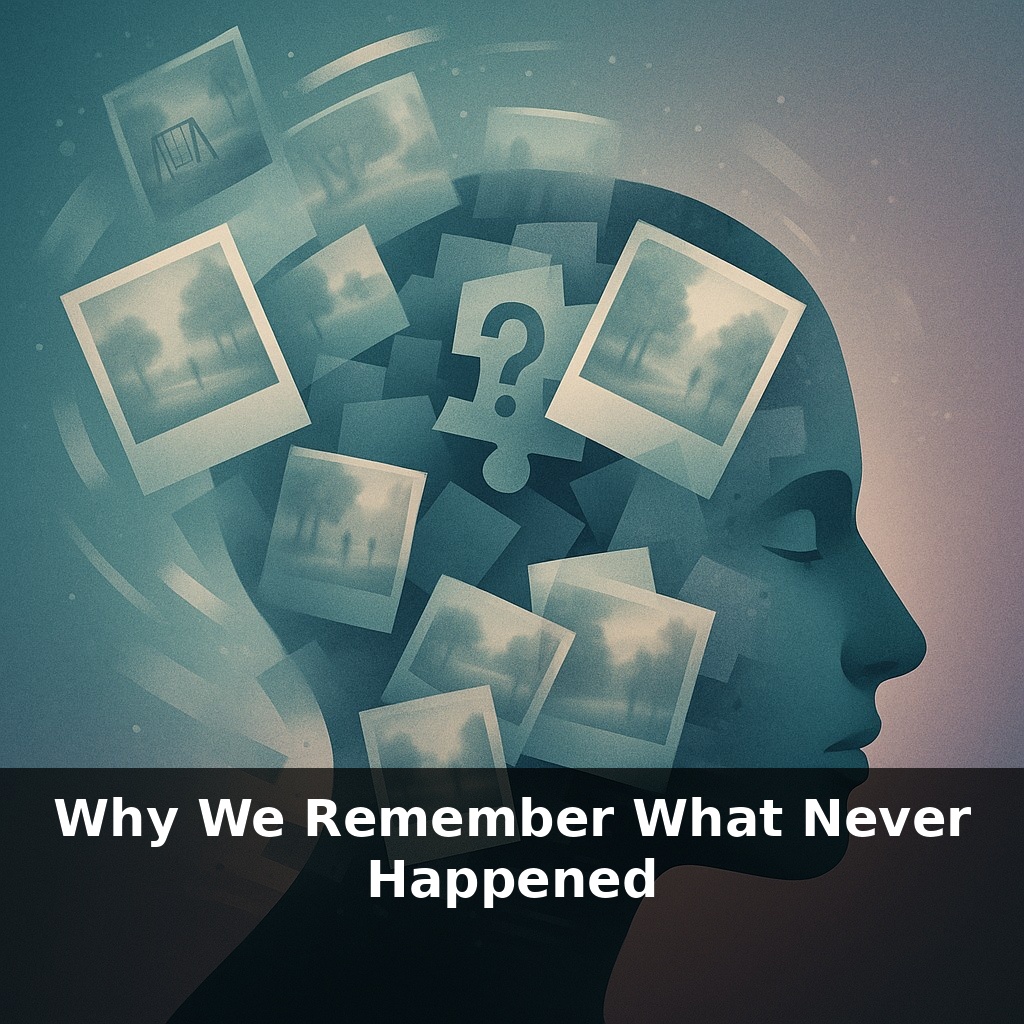
Why We Remember What Never Happened
📝 Transcript
About a third of people in one classic study warmly recalled a childhood event that never happened—complete with feelings, colors, even dialogue. On today’s episode, we’ll step into that strange space where your most vivid memories might actually be expertly crafted fictions.
So if our minds can lovingly craft memories of things that never happened, what does that mean for everything we’re so sure about—our friendships, our childhood, our sense of who “we” are? Your brain isn’t just storing life; it’s continuously revising it. A casual comment from a sibling, a faded photo, even a movie scene that “feels right” can slip into an old story and quietly reshape it. Over years, that story hardens into something you’d swear you could bet your life on. Yet two people at the same dinner can later “remember” totally different conversations and both feel completely certain. This isn’t a glitch reserved for dramatic courtroom cases; it shapes how families argue about the past, how online communities agree on things that never existed, and how you decide which version of yourself you believe.
Psychologists call this “reconstructive memory,” and it quietly steers everything from eyewitness testimony to internet debates about movie lines no one can quite verify. We’re not just talking about dramatic, life‑changing events; even last weekend’s brunch, the tone of a text, or who started an argument gets rebuilt on the fly. Small errors stack up: a suggestion from a friend, a miscaptioned meme, a viral post that “sounds right.” Like a recipe you tweak every time you cook it, the dish still feels like “Grandma’s original,” even though the ingredients—and the flavor—have slowly shifted.
Think about where those “solid” memories come from in the first place. When something happens, your brain doesn’t grab a perfect recording; it stores fragments—who was there, the emotional tone, a few sharp details—and heavily compresses everything else. Later, when you recall it, those fragments are unpacked and filled in with whatever fits: your current mood, what other people say they remember, snippets from similar experiences, even scenes from films or memes that share the same emotional flavor.
This is why confidence is such a terrible lie detector. In lab experiments, people will confidently “remember” hearing words that were never played, or recount a childhood event their parents know didn’t occur, and they’ll insist they can still see it. Their brains have stitched together something that feels internally consistent, and that feeling of coherence is what we mistake for proof.
You can see this play out socially. Online, thousands of strangers “remember” the same movie line that doesn’t exist, or the spelling of a brand that was never used. These collective errors don’t spread randomly; they often cluster around what sounds smoother, looks more familiar, or matches cultural patterns. “Berenstein” simply feels like a more common name than “Berenstain,” so once a few people assert it, others’ half-formed impressions snap into that shape.
Vulnerability to this isn’t static, either. Factors like stress, fatigue, and lack of sleep nudge the system toward efficiency over precision. When you’re exhausted, your brain leans more on shortcuts: stereotypes, expectations, the gist instead of the detail. That makes suggestive questions, misleading headlines, or confidently told stories more likely to be absorbed as if you’d witnessed them yourself.
On the neural level, brain scans show something even more unsettling: when people recall both accurate and inaccurate events, core memory regions light up in similar ways. Only when you look closely do you see that false memories tend to show weaker reactivation in sensory areas—less of the raw visual and auditory trace, more of the conceptual outline. But from the inside, they feel the same. That means your “this is so clear in my mind” sensation is more about how well the pieces fit together now than about what actually happened then.
Think about how this plays out in everyday life. Two siblings compare notes on a family vacation and suddenly “remember” different versions of who got in trouble at the airport. One confidently insists it was you; after a few retellings—and maybe a teasing joke—you start to “recall” the scene too. Not because you’re gullible, but because your brain favors a version that feels socially consistent with how your family already sees you.
Workplaces are another quiet laboratory. A manager repeats a polished origin story for a successful project at every all‑hands. Over months, team members who joined late form vivid mental images of being “around when it all began,” even though they arrived much later. Their brains blend second‑hand stories, office photos, and their own habits into a seamless memory.
On a larger scale, whole communities can lock onto a shared but inaccurate “first time” something happened, from a local protest to a viral meme. Once that date or detail hardens in anniversary posts and news recaps, even people who were there may start to feel that the corrected version is somehow “less real” than the one everyone agrees on.
Legal, tech, and mental health systems may soon treat memory less like a sacred record and more like a draft. Courts could pair testimony with probabilistic “reliability scores,” shifting focus from “who’s lying” to “how sure are we, really?” Wearable cameras and passive phone logs might act as external witnesses, but also create pressure to “live on the record.” Therapists could time interventions to moments when recollections are briefly flexible, reshaping how we heal from grief, breakup stories, even political disillusionment.
So where does that leave you? Not with a broken mind, but with a creative one. Memory’s looseness lets you update who you are: soften an old grudge, reinterpret a failure, reframe a breakup. Like rearranging furniture in a familiar room, the walls stay, but the experience changes—and those small shifts can quietly redirect your future choices.
Start with this tiny habit: When you catch yourself telling a story about a past event (even just in your head), add one sentence: “One thing I’m not totally sure I remember correctly is ______.” Don’t try to fix the memory or fact-check it—just quickly name the fuzzy part, like who said what first or how intense it really felt. This tiny pause teaches your brain that memories are reconstructions, not recordings, which is exactly what the episode says makes them so flexible (and sometimes wrong).
From this course
The Curious Mind: Exploring Cognitive Quirks
6 episodesUnlock all episodes
Full access to 6 episodes and everything on OwlUp.
Subscribe — $1.99/monthLess than a coffee ☕ · Cancel anytime