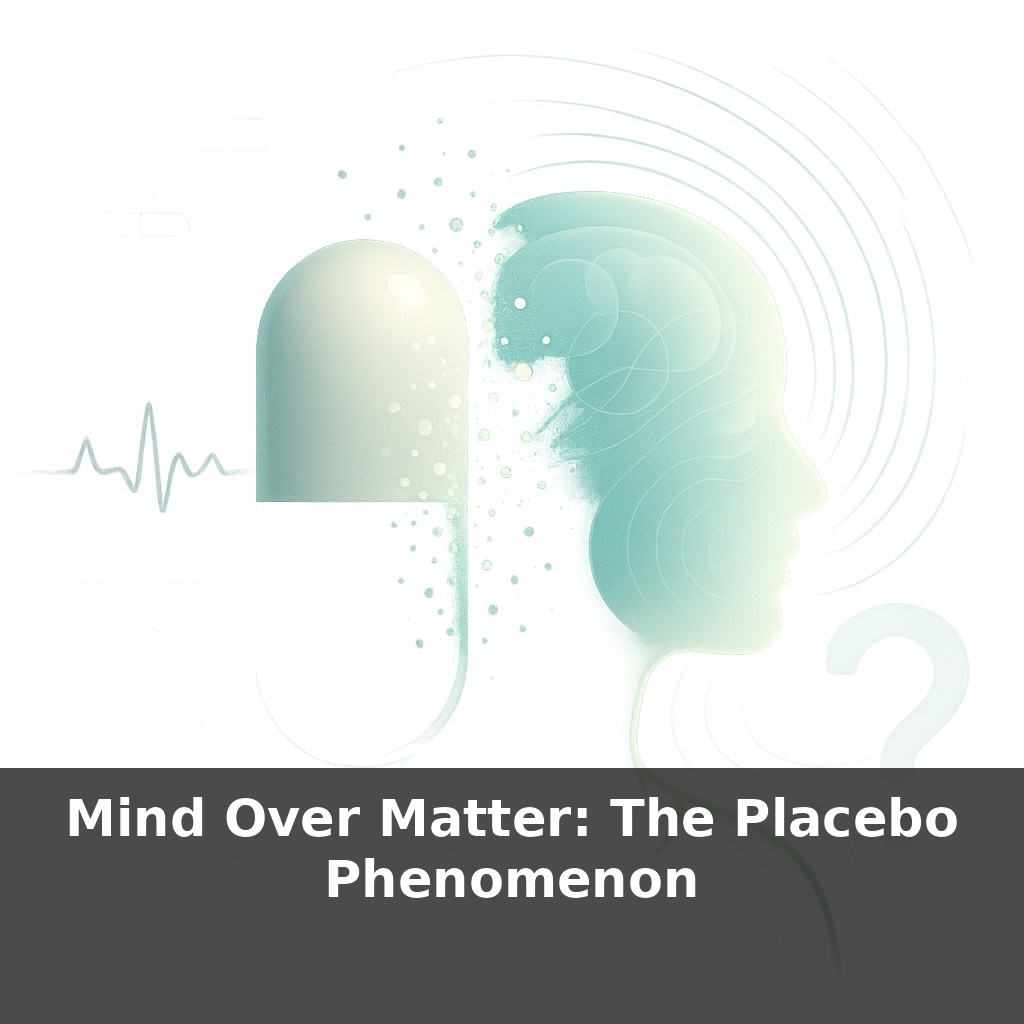
Right now, somewhere in a hospital trial, a sugar pill is easing pain almost as well as a real drug. No secret ingredient, no hidden chemistry—just belief. In this episode, we step into that strange space where expectations rewrite what the body feels as real.
Clinical trials quietly depend on this strange power. To prove a new painkiller or antidepressant works, it first has to beat… nothing. Or rather, it has to outperform people getting a convincing “something” that contains no active drug. That’s how seriously medicine takes this effect: every modern treatment must clear the placebo bar.
But outside trials, this isn’t just a curiosity—it’s shaping real decisions. Surgeons debating whether to operate on arthritic knees, psychiatrists choosing between pills and therapy, even neurologists treating Parkinson’s are forced to ask: how much of what we see is chemistry from the drug, and how much is chemistry the brain is already willing to provide?
Suddenly, hospital routines start to look less like neutral procedures and more like carefully staged performances—white coats, complex machines, clinical language—all potential amplifiers of what the body can do for itself.
Yet here’s where it gets even stranger: placebos can work even when people are told, clearly, “this is a placebo.” In irritable bowel syndrome studies, patients swallowed pills labeled as such—and still reported real relief. Parkinson’s patients, wired up in scanners, showed surges of dopamine from an injection they knew was inert. The story isn’t gullibility; it’s responsiveness. Clinical rituals, tone of voice, the confidence of a doctor, even the color and shape of a pill all act like subtle “settings” on this system, nudging symptoms up or down in ways we can now measure.
A useful way to see what’s going on is to follow the money—not in the healthcare system, but inside the body. When someone in pain agrees to a treatment, the brain doesn’t just passively wait to see what happens; it starts investing resources. Within seconds to minutes, pain circuits in the spinal cord can be dialed down, stress hormones recalibrated, and immune messengers adjusted. These are not subtle effects at the edges of perception: blood tests, spinal taps, and brain scans all pick up shifts triggered by nothing more than the expectation of care.
That internal spending is surprisingly specific. In pain studies, blocking endorphin receptors with naloxone can erase placebo pain relief, as if you’d turned off a tap. In Parkinson’s, the same inert injection can flood movement-related regions with dopamine on one day and do almost nothing on another—depending on how likely the person thinks it is that they’re getting an active dose. The nervous system is not simply “turning up hope”; it’s running a probability calculation and then placing biochemical bets.
Context can change the size of those bets in dramatic ways. A sham knee operation, with real incisions but no actual repair, didn’t just make people “feel” better—it matched genuine surgery in restoring function, enough that walking tests and follow‑ups forced surgeons to reconsider when cutting is justified. In irritable bowel syndrome, being invited into a structured, respectful study and handed a bottle clearly labeled “placebo pills” still led to clinically meaningful symptom drops, reshaping what “honesty” can look like in treatment.
Yet this same machinery can work against us. Talk up every possible side effect of a medication in a grim, mechanical way, and rates of headache, nausea, even perceived heartbeat irregularities climb—sometimes in people taking only inert capsules. This “nocebo” response shows the darker side of the loop: expectations of harm recruit the very pathways that amplify pain, anxiety, or discomfort.
All of this forces an uncomfortable question for modern medicine: if procedures, words, and symbols can shift biology this much, where exactly does “the real treatment” begin and end—and who is truly in charge of it?
Consider how differently people react to the same “treatment” in everyday life. Two runners drink identical sports drinks before a race; one has been told it’s a cutting‑edge performance formula, the other that it’s just flavored water. Heart rate monitors and split times often show the first runner pushing a little harder, breathing a little easier, even when chemistry says they shouldn’t have an edge at all.
Companies quietly lean on similar dynamics. In migraine trials, for example, branded tablets in glossy boxes often outperform identical generics in plain packaging. The molecule is the same; what changes is the story wrapped around it—and symptom scores follow the story.
In Parkinson’s clinics, a patient offered a “high chance” of getting an active treatment will sometimes show smoother movements than on a “low chance” day, even with the same injection. It isn’t that people fake outcomes; it’s that their nervous system updates its internal odds and reallocates effort accordingly, like software shifting more processing power to a task it now treats as important.
If mind‑driven chemistry is this potent, medicine’s future may look oddly like software updates. VR headsets might “patch” pain pathways, apps could drip‑feed encouraging feedback that quietly shifts symptoms, and genomic tests may flag who responds best. But there’s a social risk: if only the well‑resourced get finely tuned expectation‑based care, we’ve upgraded biology while downgrading fairness—and trust may become the scarcest drug of all.
Maybe the real frontier isn’t inventing new molecules, but learning to “program” this response more wisely—like updating an operating system without breaking what already runs. Your challenge this week: notice when symptoms ease right after reassurance or routine, and treat that shift not as a fluke, but as data about how trainable your biology might be.