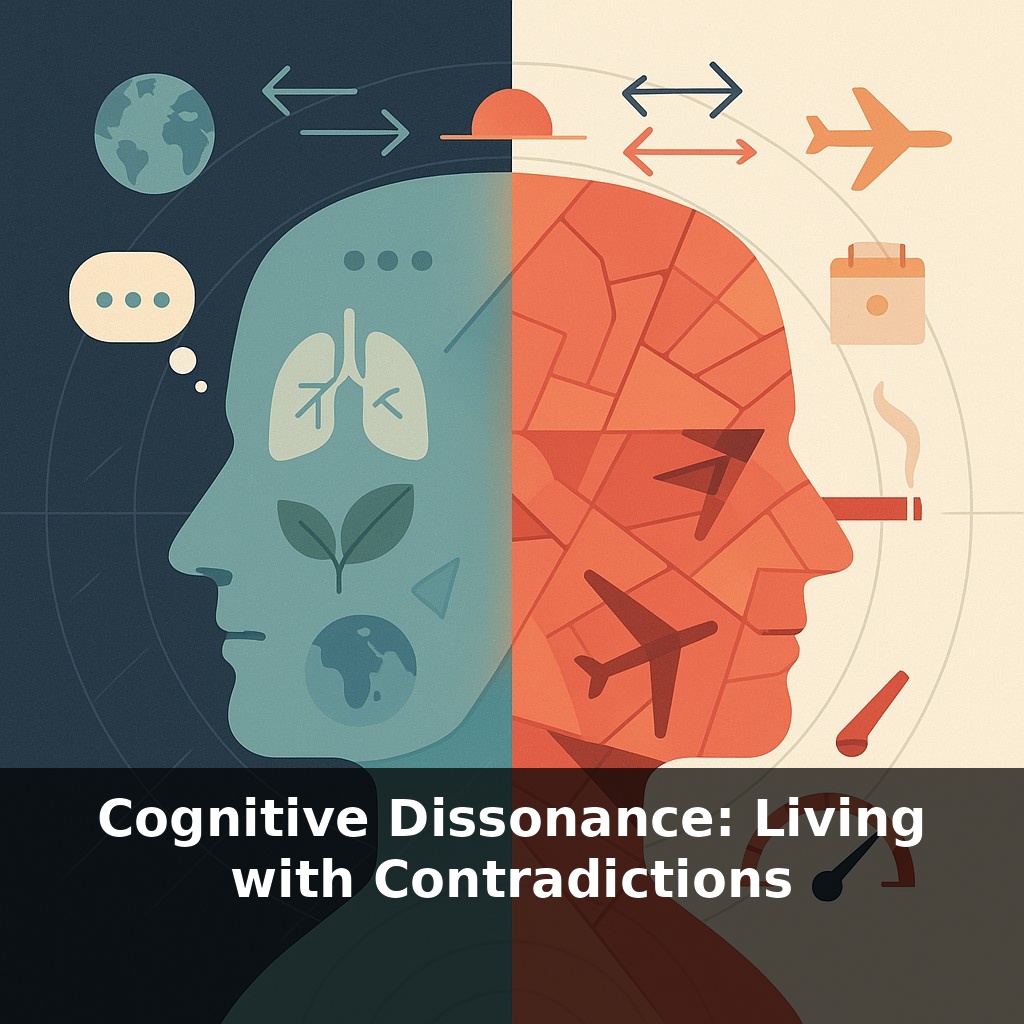
You can believe “Smoking kills” and still light up every morning—and think you’re the exception. On Monday you donate to climate causes; on Tuesday you book a cheap, long-haul flight. We call it hypocrisy in others, but in ourselves, it just feels… normal. How do we live with that?
Leon Festinger, the psychologist who introduced this idea, once joined a doomsday cult—not to convert, but to watch what happened when the world stubbornly refused to end on schedule. The prophecy failed. The sun rose. No floods, no fire. You might expect members to abandon the belief and go home embarrassed. Instead, some became even more devoted, convinced their faith had “saved” the world.
We like to think beliefs follow facts in a straight line, but often our identities, social circles, and past choices pull harder than evidence. Dissonance doesn’t just twist private thoughts; it can reshape whole communities, political movements, and even scientific debates, quietly rewarding the stories that let us stay the same.
Psychologists don’t just study this in extreme cults; they see the same mental gymnastics in everyday choices. In classic experiments, people agree to do something mildly uncomfortable—like arguing against their own position—for very little reward. Later, many genuinely shift their attitudes to match what they just said. The twist: the less external justification they have (“I barely got anything for this”), the more the mind leans on inner re-writing of the story. It’s as if your brain keeps two ledgers—actions and values—and when the numbers don’t match, it quietly “adjusts” whichever column feels easier to edit.
Think about how this plays out in slow motion across a life. You choose a career that demands 70-hour weeks. Years later, you’re exhausted, relationships are thin, and the work isn’t what you pictured. Walking away would mean admitting, “I built my life on a mistake.” That’s a heavy psychological bill. So the mind looks for discounts: “Stress means I’m doing something important,” “Other people just aren’t as committed.” The story flexes so the choice can stand.
The 1959 experiment you heard about became a template: dissonance shows up when we feel responsible, free to choose, and unable to blame circumstances. Neuroimaging adds another layer. In van Veen’s study, when people wrote essays against their true views, the anterior cingulate cortex—often involved in conflict detection—lit up first. Then regions linked to value and self-relevance weighed in. It’s as if the brain flags, “Something’s off,” then starts negotiating which part of the self to edit.
We see the same pattern in health behavior. Many smokers don’t actually deny the data; they narrow its relevance: “Those statistics are for heavier smokers,” “My grandfather smoked and lived to 90.” The CDC numbers suggest a quiet split screen: abstract agreement with the risk on one side, local exceptions on the other. The risk isn’t invisibility of facts, but their emotional quarantining.
Cognitive dissonance also shapes moral life. After hurting someone, we can repair, apologize, and possibly need to see ourselves as fallible but decent—or we can reframe the other person as oversensitive, deserving, or “not my responsibility.” Over time, repeated choices harden into character, not because we planned a moral trajectory, but because we kept choosing stories that let yesterday’s self remain innocent.
The Harmon-Jones meta-analysis shows these shifts aren’t huge on any single occasion, but they’re reliable. Like compound interest in finance, small adjustments accumulate. A slightly softened stance on a policy, a slightly harsher view of an outgroup, a slightly rosier view of our own choices—played over years, these can tilt entire belief systems without a single dramatic conversion.
You can see this conflict between what we do and what we say we value in small, almost invisible moments. A friend insists they “hate drama” but keeps retelling the latest conflict at work; a manager claims “family comes first” yet answers emails during every school play. Most people aren’t lying—they’re narrowing the spotlight to whichever part of the story feels most comfortable that day.
One domain where this shows up powerfully is money. Think of someone who’s declared, “This year I’m getting serious about savings,” then taps “Buy Now” on another impulse purchase. There’s a sting, but also a quick mental patch: “It was on sale,” “I’ll be more disciplined next month.” The brain is doing damage control on the narrative “I’m financially responsible,” even as the spreadsheet quietly disagrees.
When many people share the same private compromises—on spending, on fairness, on honesty—those tiny, personal edits can scale into workplace cultures, political norms, even national myths about who “we” are and what “we” stand for.
As deepfakes, curated feeds, and personalized news multiply, mental “error-checking” has to work harder. Dissonance may become less a bug and more a daily operating cost of staying informed. Policies that quietly allow people to change course—like amnesty programs or anonymous opt‑outs—could harness this, offering a way to update beliefs without public humiliation. In classrooms and therapy, teaching people to notice this tension early might turn it from a silent editor into a visible debate partner.
Noticing this quiet tension doesn’t mean erasing it; it means learning from it. Like a recipe you keep tweaking, each clash between values and choices can be feedback, not failure. You can ask: What story am I protecting here, and is it still serving me? Over time, that question turns dissonance from background noise into a guide for how you want to live.
To go deeper, here are 3 next steps: 1) Watch the first 20 minutes of the TED Talk “The Psychology of Your Future Self” by Dan Gilbert and pause anytime you feel a “ouch, that’s me” moment—use those spots to notice where your stated values and actual choices don’t match. 2) Grab Carol Tavris & Elliot Aronson’s book *Mistakes Were Made (But Not by Me)* and read just Chapter 1 today, underlining every example of someone justifying a contradiction that feels similar to how you defend your own habits or beliefs. 3) Install the free “Moodnotes” or “Daylio” app and, for the next 24 hours, log every time you feel tense, defensive, or guilty after a decision; tag those entries as “dissonance” so you start building a personal map of where your biggest inner contradictions really live.