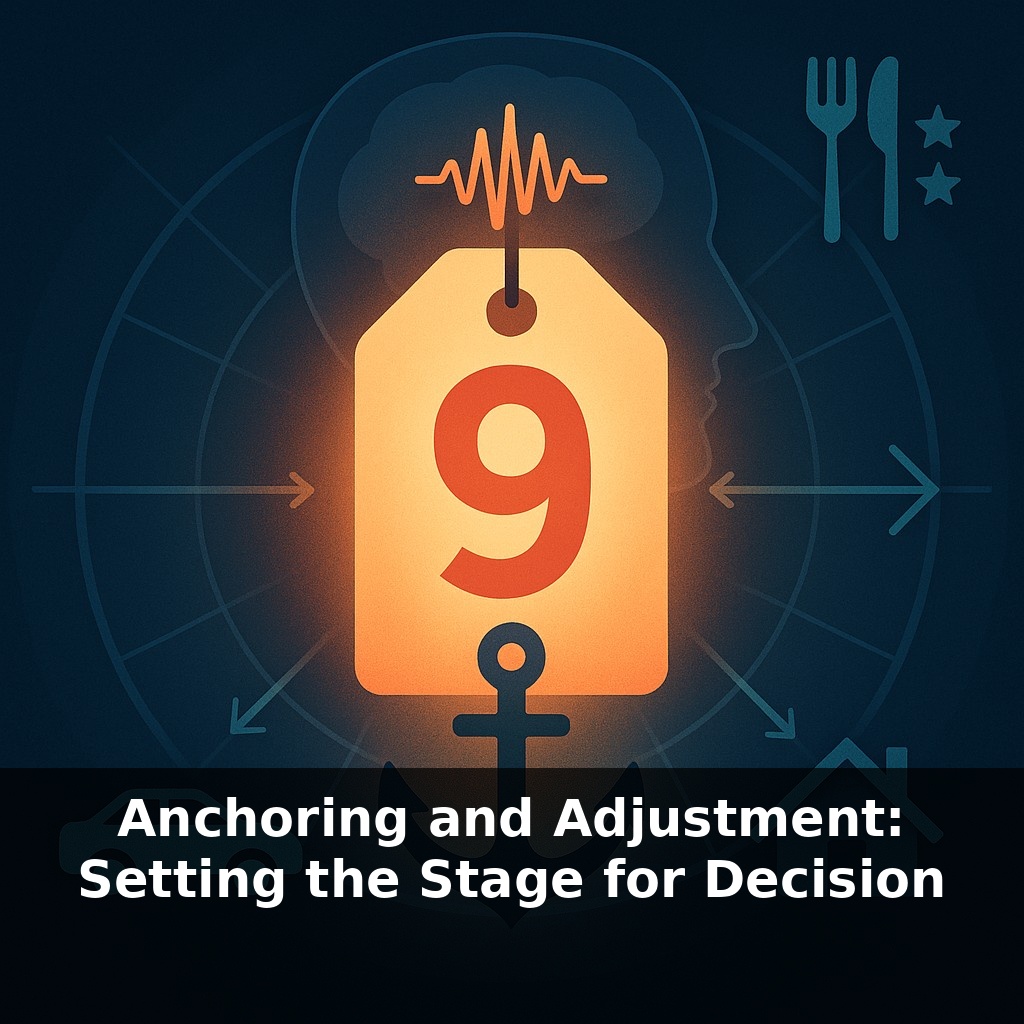
A random spin of a wheel can change how much you’ll pay for a car, rate a restaurant, or judge a stranger’s talent. In this episode, we dive into how harmless “starting points” quietly steer your choices—and why your very first number is often the loudest voice in the room.
You don’t need a spinning wheel or a game show to be swayed by anchors. Walk into a store and see a jacket “reduced” from $180 to $119, and that crossed‑out price quietly frames what feels like a bargain. Open a real‑estate app and a slightly inflated list price makes every later discount feel generous, even if you’re still overpaying. Anchors don’t just shape what we pay; they color how we judge skill, risk, and even our own worth. A single performance review score can shadow all later feedback. A first salary offer can trail you from job to job. In this episode, we’ll explore how those early numbers set the stage for negotiation, why experts aren’t immune, and how subtle tweaks—like seeing a “before” price or a suggested tip—can shift entire markets without changing the underlying reality.
Researchers have pushed this effect far beyond clever pricing tricks. Tversky and Kahneman showed that even a blatantly random number could drag people’s answers about geography by nearly 45 percentage points. Across more than 150 studies, the average anchoring impact is sizable—strong enough that professional appraisers and seasoned negotiators still lean toward whatever figure appears first. In housing markets, listing a property just 10% higher than an expert’s estimate can nudge the final selling price up several percent, quietly shifting who can buy, how neighborhoods are valued, and even how “fair” a deal feels to each side.
When researchers test anchoring in the lab, they often use obviously irrelevant numbers—a birthday, a locker code, a random roll—and still see people cling to them. Outside the lab, the anchors you meet are usually much more polished and intentional.
Marketers, for instance, build entire strategies around “setting your expectations high, then walking you down.” That stricken original price on a website isn’t just decoration; experiments suggest it can push more people to buy, even when every rational detail about the product stays the same. The same logic shows up in subscription pages that highlight a “Premium” tier first, quietly making the mid‑range option feel modest by comparison.
In real estate, the listing isn’t just information—it’s an opening move. Studies show that slightly higher list prices can pull buyers’ estimates and offers upward, even when they’ve toured many comparable homes. Experienced house‑hunters still end up circling near that first public number, partly because it shapes which other properties they treat as “similar enough” to compare.
Experts aren’t spared in their own domains. Financial analysts give higher valuations when they first see optimistic earnings forecasts. Doctors estimate probabilities of disease differently when a prior note in the file hints at a likely diagnosis. Judges, in some experiments, assign longer sentences after exposure to higher suggested numbers, despite believing they’re weighing only the facts.
Sometimes you even anchor yourself. The salary you accepted early in your career can trail you through “expected ranges” in later negotiations. An early personal best in running or coding speed can silently define what you treat as realistic progress versus “out of reach.”
One reason anchors are sticky is that they quietly steer what evidence you search for. Start from a high price, and you’ll notice the product’s strengths; start low, and the flaws pop out. It feels like careful evaluation, but your mind is tilting the table around that starting point.
All of this matters because anchors are cheap to set but expensive to escape. A single bold number on a slide, a “benchmark” in a meeting, or a first offer in a deal can echo through every later adjustment, long after everyone has forgotten where it came from.
At a charity auction, a celebrity‑signed guitar goes up first with a glossy “opening bid: $5,000” slide. Even if no one bites, the next items—vacation packages, artwork, even a simple dinner for two—suddenly feel more “reasonable” at prices that would’ve seemed steep 10 minutes earlier. In hiring, a recruiter who sees one résumé with an eye‑popping previous salary can unconsciously recalibrate what counts as “competitive” for the next candidate, even when roles differ. Performance reviews show a similar drift: once a manager has given a string of 4.8/5 ratings in one team, a solid 4.2 in another group can feel strangely “average,” shaping bonuses and promotions. Online, review platforms sometimes highlight a “featured” rating or expert score first; user scores that follow tend to cluster nearer that highlighted mark, subtly compressing disagreement. Across these domains, what appears early becomes a reference point that lingers, bending later judgments in directions we rarely notice in the moment.
As data trails grow richer, those “harmless” reference points can be tuned to each of us—like a thermostat quietly learning how warm you’ll tolerate a room before complaining. Dynamic prices, default contribution rates, even “typical” screen‑time nudges can all be calibrated to your past behavior. That power cuts both ways: it can stabilize your savings, or lock you into bad deals. Expect future debates over who gets to set those reference levels—and who audits them.
When you spot these subtle anchors, you start to see how “normal” is often negotiated, not discovered. Your challenge this week: whenever you’re offered a “standard” option—tip, warranty, upgrade—pause and invent your own number first. Like resetting a GPS, that small habit can stop inherited coordinates from quietly charting your route.