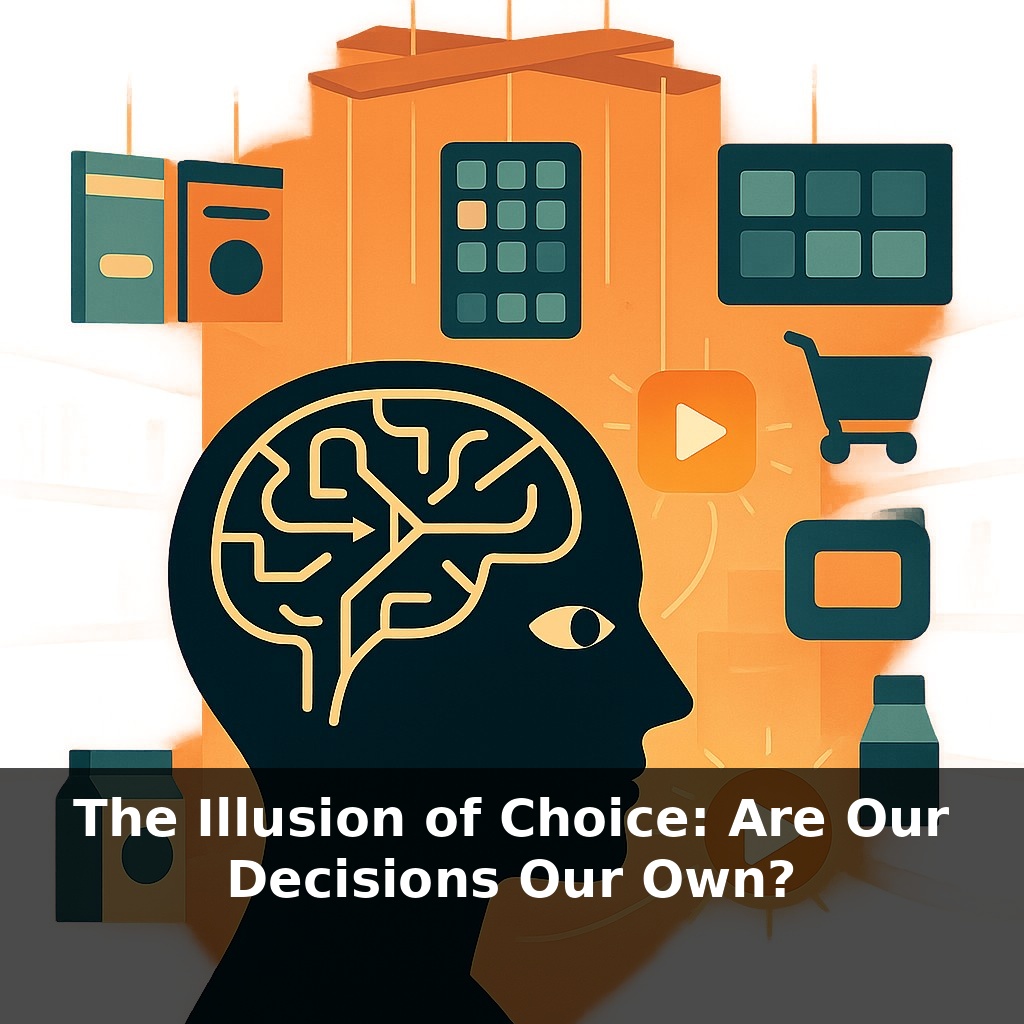
You make tens of thousands of choices a day—yet companies can boost clicks dramatically by just changing a button’s color. You feel in control at the grocery shelf, on Netflix, on your phone. But here’s the unsettling question: how many of those choices were actually chosen *for* you?
Walk into a supermarket and stop at the cereal aisle. Before you even think about fiber or sugar, your eyes are pulled to boxes at eye level, brighter colors, characters facing inward to “make eye contact.” None of this is accidental. Teams of marketers, designers, and data analysts have already run experiments on thousands of shoppers to learn exactly which layout, font, and shelf position will most likely win your “choice.”
Now zoom out: the same quiet engineering shapes your news feed, your streaming queue, even the forms you fill out at work. Psychologists call this “choice architecture”—the way options are arranged, framed, and timed so certain paths become frictionless and others feel oddly tiring. You still pick, you still feel the tiny thrill of deciding, but the path of least resistance has often been carefully paved in advance.
Behind all this design work is a quiet partner: your own brain. Long before you “decide,” it’s running shortcuts—favoring familiar brands, recent headlines, the option that feels safest or most normal. Neuroscience studies even show brain activity predicting which button you’ll press seconds before you report having made a choice. Add habits, cultural norms, and tiny environmental nudges, and a pattern emerges: we rarely meet decisions as blank slates. We arrive with momentum. The interesting question isn’t “Do we have free will?” so much as “Where, exactly, in this crowded process, does our real agency live?”
Stand in front of a fridge late at night: ice cream on one side, leftovers on the other. You “decide” in a second—but that moment is sitting on layers of history. Did your parents reward you with dessert? Did your last health check worry you? Did you just scroll past a fitness post or a bakery ad? The choice feels like a clean coin flip. It’s actually the end of a very long story.
Researchers talk about three broad forces in that story: the body you got, the experiences you’ve had, and the context you’re in right now.
Biology first. Your brain has a built‑in sensitivity to reward and threat that isn’t identical to anyone else’s. Some people literally get stronger dopamine responses to novelty or sugar or social approval. Twin studies show that even political leanings are partly heritable: identical twins raised apart still tend to land on similar spots in the liberal–conservative spectrum. That doesn’t dictate which party you’ll vote for—but it tilts which arguments will *feel* convincing.
Then experience layers on top. Every past decision leaves a trace. Habits form when repeating an action in a situation slowly hands control from conscious choice to automatic scripts. That’s why you can drive home “on autopilot” while thinking of something completely different. The script runs unless something interrupts it—a new street layout, a near‑accident, a passenger asking you to stop somewhere else.
Now add context. In restaurants, people reliably choose different dishes depending on what the person before them orders, even when they insist they’re “ordering what I want.” In meetings, the first suggestion anchors the whole discussion; later options are unconsciously compared to that initial reference point. In online shops, the “decoy effect” makes a mid‑priced option more attractive just by placing an obviously bad deal next to it.
Notice what this mix implies. Your “preference” in any moment is not a pure, stable thing living inside you. It’s more like a live calculation that leans heavily on whatever is easiest to access: your current mood, the example you just saw, the norm in the room, the option framed as standard. Change any of those, and the calculation can flip—while still feeling just as authentically “you.”
So where does that leave control? Not vanished—but narrower and more fragile than it feels from the inside. Real agency tends to show up in the rare moments when we *interrupt* the default flow: when we pause before clicking, question why one option feels obvious, or deliberately add friction to the path we suspect we’ll otherwise slide down.
Think about streaming platforms quietly auto‑playing the next episode. You didn’t “decide” to watch three in a row; you failed to resist a design that assumes continued consent. Or loyalty cards in coffee shops: a stamp card with two boxes already filled makes people complete it faster than a blank card with the same number of steps left. The progress isn’t real, but your brain treats it as momentum you don’t want to waste.
Supermarkets do something similar with “limit 12 per customer” tags. Most shoppers would never have taken more than two—but that arbitrary ceiling becomes a suggested target, nudging them upward. Dating apps exploit a different bias: endless swiping keeps you searching for a slightly better match, even when you’re already satisfied, because the interface makes moving on frictionless and committing feel like a bigger step.
In finance apps, “round‑up” savings features flip the script. By skimming small amounts into savings automatically, they use the same tendencies to *protect* you instead of profit from you.
Here’s the unsettling twist: as AI systems watch what you click, skip, and buy, they can start predicting not just *what* you’ll choose, but *when* you’re weakest. A notification pings right as you’re tired, a discount appears when your balance is low, a news story surfaces when you’re already annoyed. The same tools could defend you—like spam filters for manipulation—if we demand them. Your future “willpower” may depend less on grit and more on who controls these invisible dials.
So the real puzzle isn’t “am I free?” but “*where* am I freest?” In moments we design on purpose: setting app limits before we’re tired, planning groceries before we’re hungry, agreeing with friends to call out each other’s sketchy impulses. Your challenge this week: pick one daily habit and redesign its surroundings as if you were your own behavioral scientist.