Bretton Woods and the World Economy
📝 Transcript
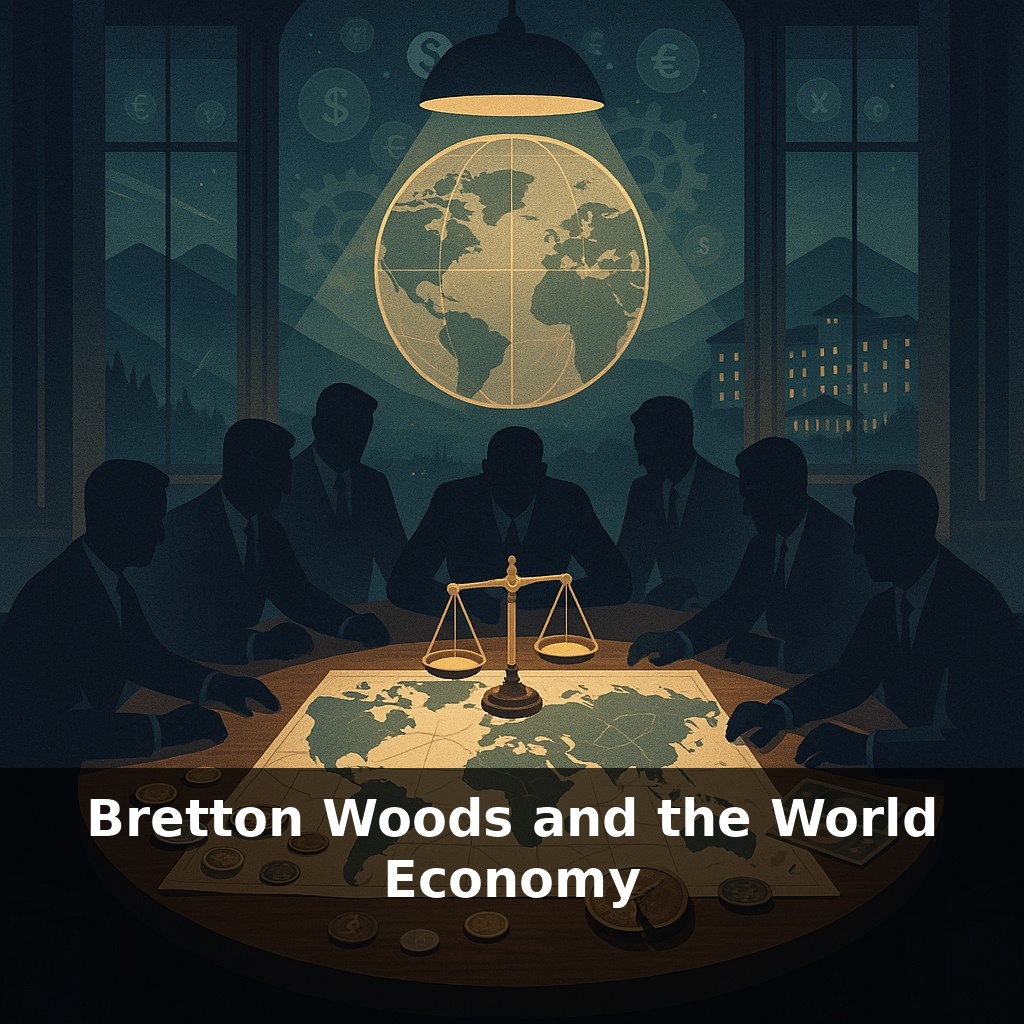
In the summer of 1944, while cities still burned across Europe, diplomats slipped into a New Hampshire hotel to redesign the world’s money. War raged outside; inside, they argued over a single question: who should control the value of everyone else’s currency?
By the time delegates reached Bretton Woods, they’d already seen what happened when money rules broke down: the Great Depression, beggar‑thy‑neighbour tariffs, competitive devaluations, and ultimately war. So in that crowded hotel, the real debate wasn’t abstract theory—it was how to stop the next catastrophe without freezing the world economy in concrete.
Two rival blueprints dominated the table. John Maynard Keynes, leading the British team, wanted a powerful, supranational clearing union with its own global currency and strict pressure on both debtors and creditors. The Americans, holding most of the gold and industrial capacity, backed Harry Dexter White’s leaner design: the dollar at the centre, gold in the background, and new institutions with limited but real power.
The outcome would decide not just postwar recovery, but who could safely run trade deficits, who had to save, and who would quietly set the tempo of global growth.
The compromise they reached in that hotel was oddly narrow and radically ambitious at the same time. Delegates were not writing a utopian manifesto; they were nailing down numbers, margins, and escape hatches. Currencies could move, but only a little. Countries could borrow, but only so far. And when trouble hit, governments were expected to talk first, devalue second, and default last. Behind the scenes, everyone knew who held the stronger hand: the United States, with its huge surplus and unmatched reserves, could afford generosity—so long as it kept ultimate veto power over the new machinery.
The system they built had three moving parts: how exchange rates behaved, how countries got emergency cash, and how reconstruction would be paid for.
On exchange rates, delegates pinned each currency to the dollar at a declared “par value” but left a narrow band for day‑to‑day fluctuation. Move beyond that band, and governments had to intervene—buying or selling their own money in foreign exchange markets. Formal changes in parities were allowed, but only after consultation. The goal was to keep prices between countries predictable enough that exporters could sign long‑term contracts without constantly fearing a surprise devaluation.
To backstop this, the IMF was given paid‑in quotas from each member. Those quotas did three jobs at once: they capped how much each country could borrow, they roughly tracked economic size, and they determined voting power. In a crisis, a government could draw on IMF resources instead of slamming on the brakes at home with brutal import cuts. Access came in stages: the more a country used, the more conditions it faced on its domestic policies. The principle was simple: temporary help for temporary problems, not an open‑ended subsidy for chronic mismanagement.
Alongside this, the IBRD was tasked with financing long‑term projects. Its early loans went to railways, power plants, ports, and factories—assets meant to raise productive capacity rather than plug short‑term budget gaps. Over time, that mandate widened into the broader World Bank Group, pulling in private investors and new affiliates focused on development.
What made the whole arrangement unusual was that it tried to reconcile national autonomy with shared discipline. Governments kept control over interest rates, capital controls, and welfare states, yet accepted obligations to keep their currencies roughly aligned and to submit to outside scrutiny when trouble hit. In practice, this meant that domestic choices—on wages, budgets, and credit—were now constantly refracted through an external constraint: how they affected the balance of payments.
French officials in the 1960s gave the most concrete stress‑test to this new order. Worried that American deficits might one day cheapen their savings, they began swapping surplus dollars for metal, quietly loading bullion onto planes bound for Paris. Britain, facing shrinking reserves and stubborn inflation, hit the limit from another angle: by 1967, it had to cut the pound’s official rate and lean on IMF support, exposing how politically painful even a negotiated change could be. Japan and West Germany, by contrast, rode a different trajectory. Their export booms kept piling up surpluses, pushing them toward revaluations and domestic debates over whether to spend more at home or keep riding external demand. Think of national treasuries in this era as fund managers stuck with one large, illiquid anchor asset: shift too fast and markets panicked, move too slowly and imbalances quietly compounded beneath the surface.
World money politics is again in flux. CBDC experiments hint at a future where central banks settle directly on shared digital rails, like trains switching from private tracks to a common high‑speed line. Climate risk is pulling finance toward long‑term “green rebuilding” rather than war‑damaged bridges. As reserves diversify and emerging giants demand louder voices, the quiet question is whether today’s patchwork evolves into Bretton Woods 2.0—or fragments into competing monetary blocs.
Bretton Woods didn’t script a permanent order; it set the habit of meeting in rooms and arguing over rules instead of waiting for collapse. Today’s fights over digital money, sanctions, and climate finance are sequels, not a new show—more like rewriting house rules as the family grows, hoping the plumbing survives the next storm.
Before next week, ask yourself: How would my country’s economy change tomorrow if the U.S. dollar suddenly stopped being the main reserve currency, and who around me (my job, my savings, my debts) would feel it first? If I imagined Bretton Woods being renegotiated today, which three rules would I insist on—about capital controls, exchange rates, or IMF/World Bank voting power—and why would those matter for people in my city? Looking at my own bank account, loans, or investments, where am I quietly “betting” on the stability of the current dollar-centered system, and what would I do differently if I believed that system might meaningfully shift in the next 10–20 years?
From this course
The Economic Front: Cold War and the Global Economy
9 episodesUnlock all episodes
Full access to 9 episodes and everything on OwlUp.
Subscribe — $1.99/monthLess than a coffee ☕ · Cancel anytime