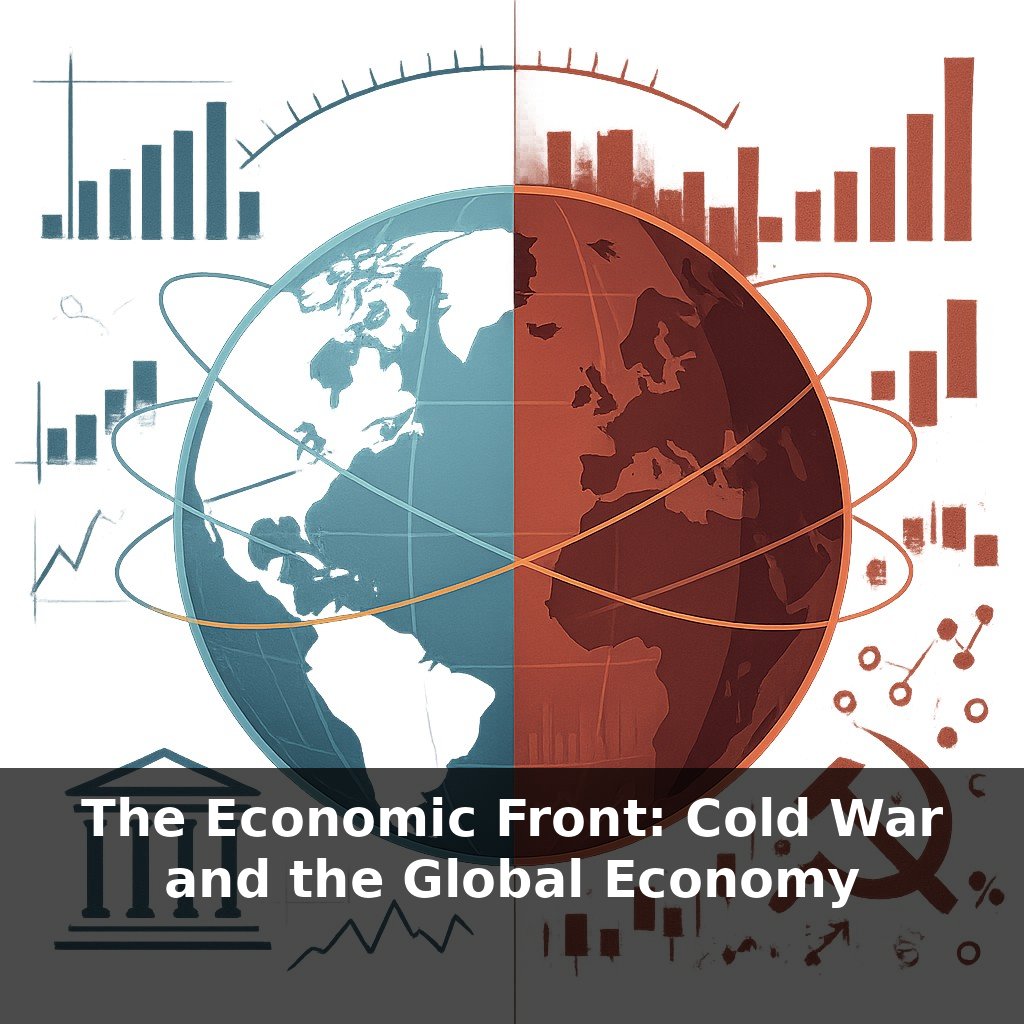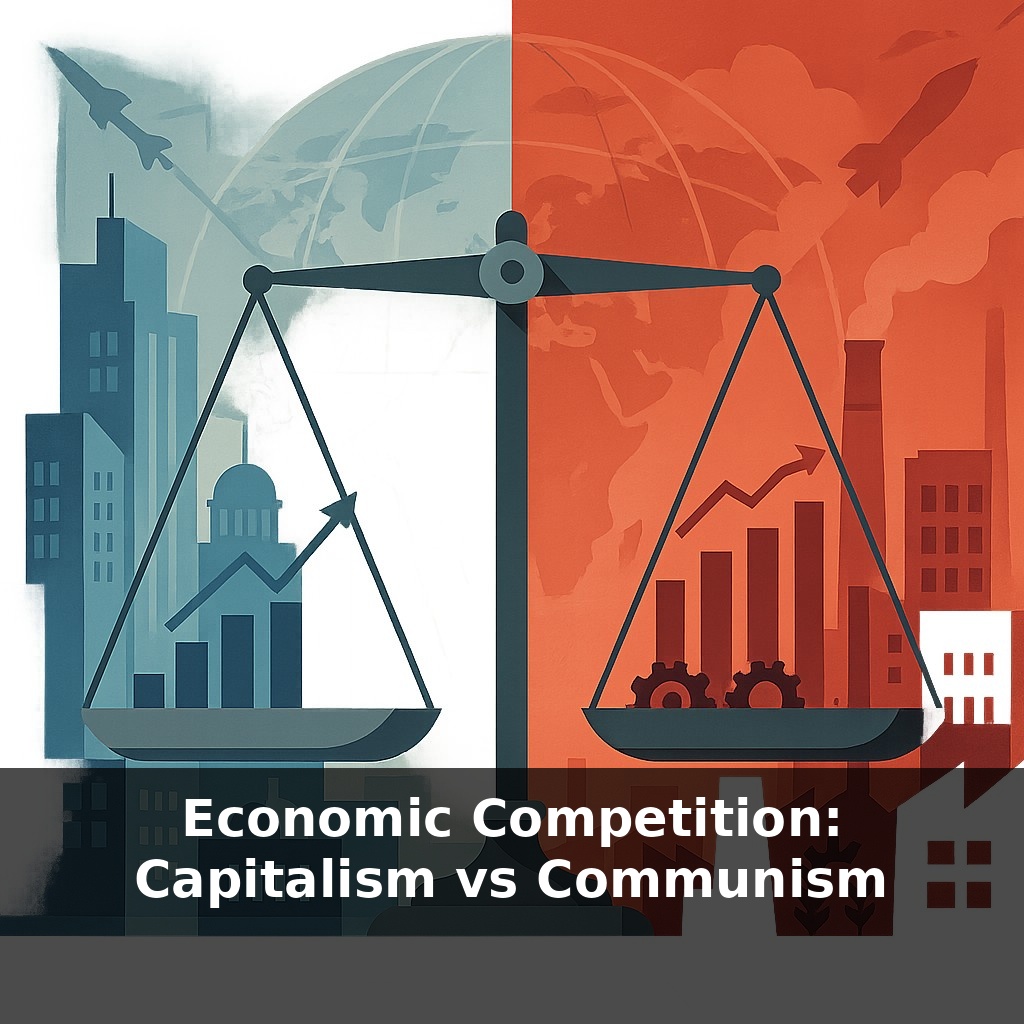
By the late Cold War, roughly a third of humanity lived under governments that insisted markets were the problem—while another vast bloc claimed only markets could deliver freedom. In this episode, we drop straight into that economic duel and ask: whose system actually worked?
By 1970, the Soviet Union had pushed its output per person to about 44% of U.S. levels—far behind, but far from failure. To many leaders in Asia, Africa, and Latin America, that gap looked small compared with the USSR’s starting point in 1917. So the question in the 1950s–70s wasn’t just “Which side is richer now?” but “Which path can get us from ruins to factories fastest—and on whose terms?”
Western Europe’s Marshall Plan boom advertised one answer: U.S.-backed capitalism tied into a rules-based trade system. Moscow offered another: state planning, rapid steel-and-coal build‑up, and heavy arms—development as a barracks economy. Newly independent states often treated these models like rival investment pitches, weighing not only growth, but control, inequality, and political risk. In this episode, we follow how that global audition reshaped both systems—and why today’s economies rarely copy either script straight.
Leaders choosing between these blueprints weren’t just reading theory; they were watching results roll in like quarterly earnings. On one side, Western firms flooded shelves with cars, fridges, and films that doubled as lifestyle ads for capitalism. On the other, communist states pointed to rockets, dams, and literacy drives as proof that discipline beat “chaotic” profit‑seeking. The rivalry seeped into school textbooks, trade fairs, even sports. And because each side needed to impress foreign audiences, both quietly tweaked their own rules—opening space for the mixed, hybrid economies we live with now.
Start with a puzzle: countries that tried the same “system” often ended up with wildly different results. West Germany and Italy both embraced private enterprise—but their labor markets, welfare states, and growth paths diverged. Meanwhile, East Germany and Romania both followed a command model—yet East Germany became the industrial “showroom” of the bloc, while Romania struggled with debt and energy shortages. The label on the system didn’t fully predict performance.
Under communist rule, the core economic tool was the multi‑year plan. Targets for steel, grain, and machinery were set from the top, then broken down into quotas for ministries and factories. That structure could deliver spectacular one‑off pushes—think of the USSR’s space successes or massive dam projects—but it coped badly when consumer tastes or technologies shifted quickly. Because planners feared disruption, they extended the life of outdated plants, keeping resources tied up in “old winners” rather than letting them fail.
Capital‑rich Western economies had a different problem: how to manage booms and busts without abandoning political support. After the shocks of the 1930s, most accepted that some state steering was necessary. Central banks tried to smooth credit cycles; governments used unemployment insurance and public works to keep demand from collapsing. Over time, this produced the so‑called “mixed economy”: private ownership, but with tax systems, safety nets, and industrial policies that differed sharply from country to country.
The rivalry pushed both sides into awkward compromises. The U.S. expanded social programs in the 1960s partly to counter the appeal of egalitarian rhetoric abroad. Moscow experimented with limited firm‑level incentives in the 1965 Kosygin reforms, allowing managers small bonuses for meeting quality targets. Neither went as far as ideologues wanted: American business leaders worried about “creeping socialism,” while party hardliners feared that profit measures would corrode discipline.
For newly independent states, this shifting landscape made choices harder, not easier. They weren’t just choosing between textbook models, but between evolving, improvised hybrids—each shaped as much by global rivalry as by domestic needs.
East Asia became the proving ground for hybrids. South Korea’s generals in the 1960s didn’t copy Wall Street; they drafted five‑year export plans while letting family‑run chaebol like Samsung chase profits abroad. Taiwan steered credit to targeted sectors yet allowed farmers to sell on competitive terms. Both governments borrowed planning tools from socialist states but hitched them to world trade and private initiative, creating growth spurts that rivaled any superpower.
By contrast, India’s “license raj” tried to stay non‑aligned, mixing Soviet‑style heavy‑industry priorities with British‑inspired bureaucracy. Starting a factory could require dozens of permits; firms often hit capacity ceilings set years earlier. Output rose, but slowly, and with notorious bottlenecks.
A helpful way to see these differences is to think of an investor’s portfolio: some countries bet heavily on one “asset” (tight planning or free enterprise), others diversified, combining state guidance, foreign capital, and local entrepreneurship—hedging against any single doctrine failing them.
Today’s rivalry is subtler: fewer flags, more spreadsheets. Governments blend tools once seen as opposites—industrial policy, carbon pricing, digital regulation—testing how far they can steer without stifling initiative. Think of it as tuning an engine while the car is moving: too much intervention, and you flood it; too little, and it stalls on shocks like climate or pandemics. The lesson from 1945–1991 isn’t “pick a side,” but “expect constant recalibration.”
The deeper we look, the less this rivalry resembles a tidy scoreboard and more a relay race with batons constantly passed and modified. Today’s “winners” borrow tools once branded heresy: communist giants lean on private firms, capitalist states wield industrial policy. Rather than a final verdict, the legacy is a toolbox—and a warning to stay wary of one‑size‑fits‑all blueprints.
Before next week, ask yourself: 1) “Looking at my own job, studies, or side projects, where do I personally feel the benefits of capitalist-style competition (like extra innovation or higher performance), and where do I feel the ‘downsides’ the episode mentioned, like burnout, inequality, or short-term thinking?” 2) “If my workplace or community suddenly had more ‘communist-style’ coordination—shared ownership, planning, and guaranteed basics—what’s one specific decision (about hiring, pricing, collaboration, or resource use) that would change tomorrow, and would I actually prefer that outcome?” 3) “Given what the episode said about mixed economies, what is one concrete policy or norm (e.g., stronger safety nets, profit-sharing, antitrust enforcement, or public investment in R&D) that I would realistically support in my own country, and why does that blend of competition and coordination feel right to me?”