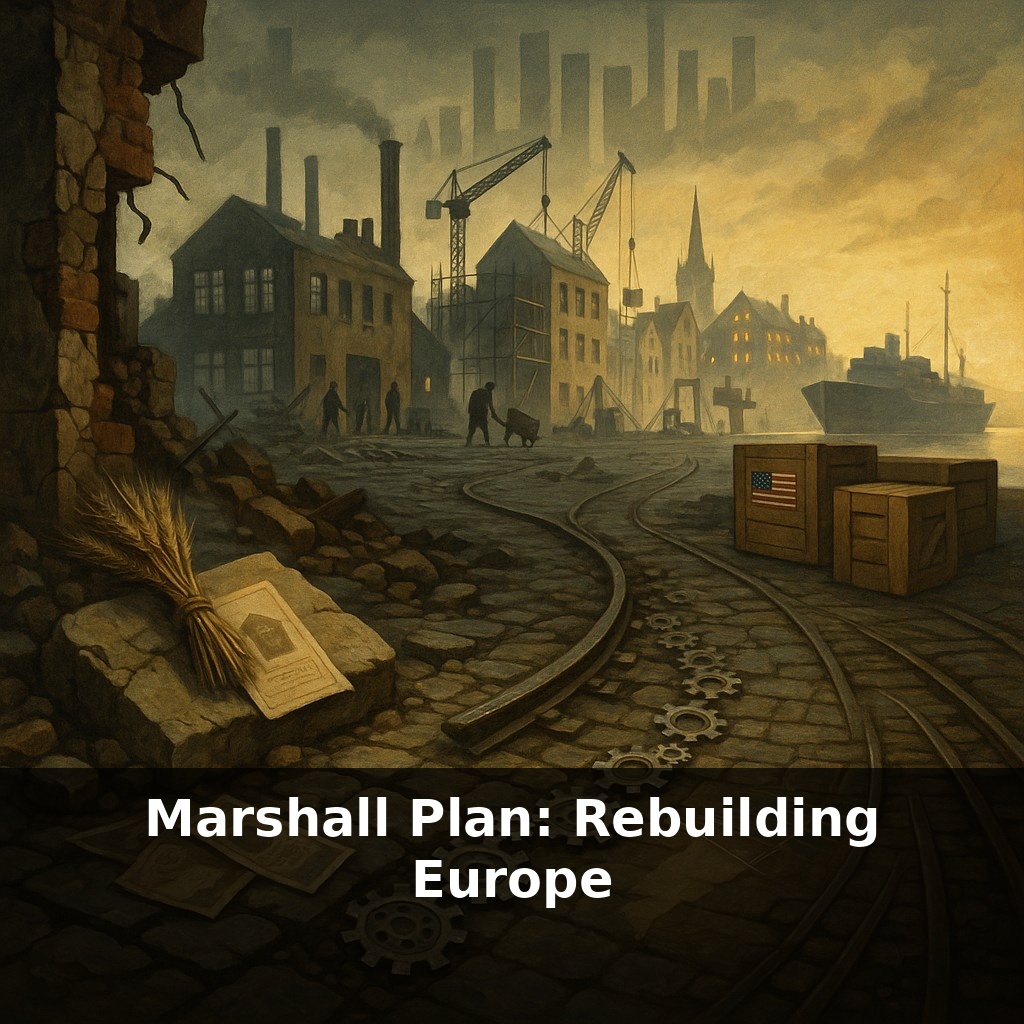
One country got roughly a quarter of all U.S. aid after World War Two—yet its cities were still scarred, its people rationed, its future uncertain. You’re walking through that grey, hungry Europe. Factories idle, money worthless. Here’s the puzzle: who pays to rebuild a continent?
By 1947, Western Europe’s industrial output was still stuck roughly 20–30 % below prewar levels, coal shortages shut factories for days at a time, and winter power cuts left cities literally in the dark. Inflation in places like Italy and France was eroding wages so fast that pay packets lost value between payday and the weekend. Yet the political stakes were even higher than the economic ones. In the 1946 French elections, the Communist Party won about 28 % of the vote; in Italy, its left-wing alliance approached 40 %. To U.S. planners steeped in the logic of containment, stagnation wasn’t just a humanitarian problem—it looked like an open door for Moscow. That’s the context in which the European Recovery Program emerges: not as charity, but as a calculated bet that jump-starting factories, trade flows, and consumer markets could also stabilize fragile democracies.
Washington’s turning point came with the winter of 1946–47, when food rations in Britain dipped below wartime levels and grain reserves across Europe could cover only weeks, not months. In Greece, civil war threatened to pull a NATO-hopeful state into chaos; in Turkey, Soviet pressure on the Straits signaled how economic weakness fed strategic risk. By mid‑1947, U.S. officials estimated Europe needed roughly $5–6 billion per year just to stay afloat. Yet Congress was wary: total U.S. federal spending was barely $37 billion, and voters were tired of overseas commitments.
The breakthrough came in June 1947, when Secretary of State George Marshall used a Harvard commencement speech to flip the debate. Instead of promising to “fix” Europe country by country, he offered a deal: if the Europeans drafted a joint recovery plan and opened their books, Washington would help fund it. Behind that simple offer sat hard numbers. U.S. officials quietly envisioned a four‑year program of several billion dollars annually—at a time when federal tax receipts were only about $40 billion a year.
European governments moved fast. By April 1948, sixteen of them had formed the Organisation for European Economic Co‑operation (OEEC) to coordinate requests and agree on how to share whatever Washington approved. That in itself was revolutionary: finance ministers who had spent the 1930s throwing up tariffs now sat around tables in Paris comparing production targets for coal, steel, and machinery.
Congress ultimately authorized about $13.3 billion between 1948 and 1952. The distribution reflected both need and politics. Britain, still a major importer of food and fuel, received roughly 26 %; France about 18 %; the new West German state around 11 %. In a typical year, that meant checks and shipments worth 2–3 % of a recipient’s national income—enough to matter, not enough to replace domestic effort.
How was the money used? Roughly 60 % went to goods: wheat, gasoline, locomotives, trucks, industrial equipment. Another slice supported currency stabilization and credit for private firms. A smaller but symbolically important share funded “productivity missions”: engineers from, say, an Italian steel mill would spend weeks touring U.S. plants, then return with blueprints for reorganizing shop floors and supply chains.
One underappreciated feature was the counterpart fund system. When the U.S. shipped $10 million of grain to, for example, the Netherlands, Dutch importers paid for it in guilders, not dollars. Those guilders went into a national fund jointly overseen with U.S. officials, then re‑lent to local businesses or used for infrastructure. By 1951, these funds had accumulated the local‑currency equivalent of several billion dollars, effectively giving governments an investment pool tied directly to private demand.
French firms offer a clear example of how this played out on the ground. One mid‑sized machinery producer that had limped through 1946‑47 produced about 8,000 units a year. After receiving new U.S.-made machine tools via OEEC‑coordinated orders and a low‑interest loan from its national counterpart fund, it reorganized its line and raised output to roughly 12,000 units by 1951—a 50 % jump. Similar stories in textiles, chemicals, and shipbuilding turned scattered factories into export‑capable sectors.
Productivity missions added another layer. A 1949 visit by a group of Dutch port managers to U.S. harbors led Rotterdam to introduce new cargo‑handling methods. Within three years, average loading times on major berths reportedly fell by about 30 %, increasing throughput without massive new dredging.
You can think of the program as a carefully structured bridge loan: just long enough and large enough to get firms and states from “barely coping” to “planning for growth,” but deliberately too small to sustain permanent dependence on Washington.
For policymakers today, the lesson is scale plus structure. The ERP never exceeded about 3 % of U.S. GDP per year, yet helped lift average Western European growth above 4 % annually in the early 1950s. A modern program on that model—say a $500–700 billion, five‑year package for green grids, ports, and housing—would need the same conditions: shared regional planning, strict transparency, and clear timelines that force local governments to mobilize their own capital.
By 1952, ERP countries were exporting nearly $10 billion a year, double their 1946 level, and investing over 20 % of GDP in new capital stock. NATO’s creation in 1949 locked that recovery into a security framework, while OEEC data‑sharing quietly normalized policy coordination. Your challenge this week: trace one modern EU rule back to these post‑war experiments.