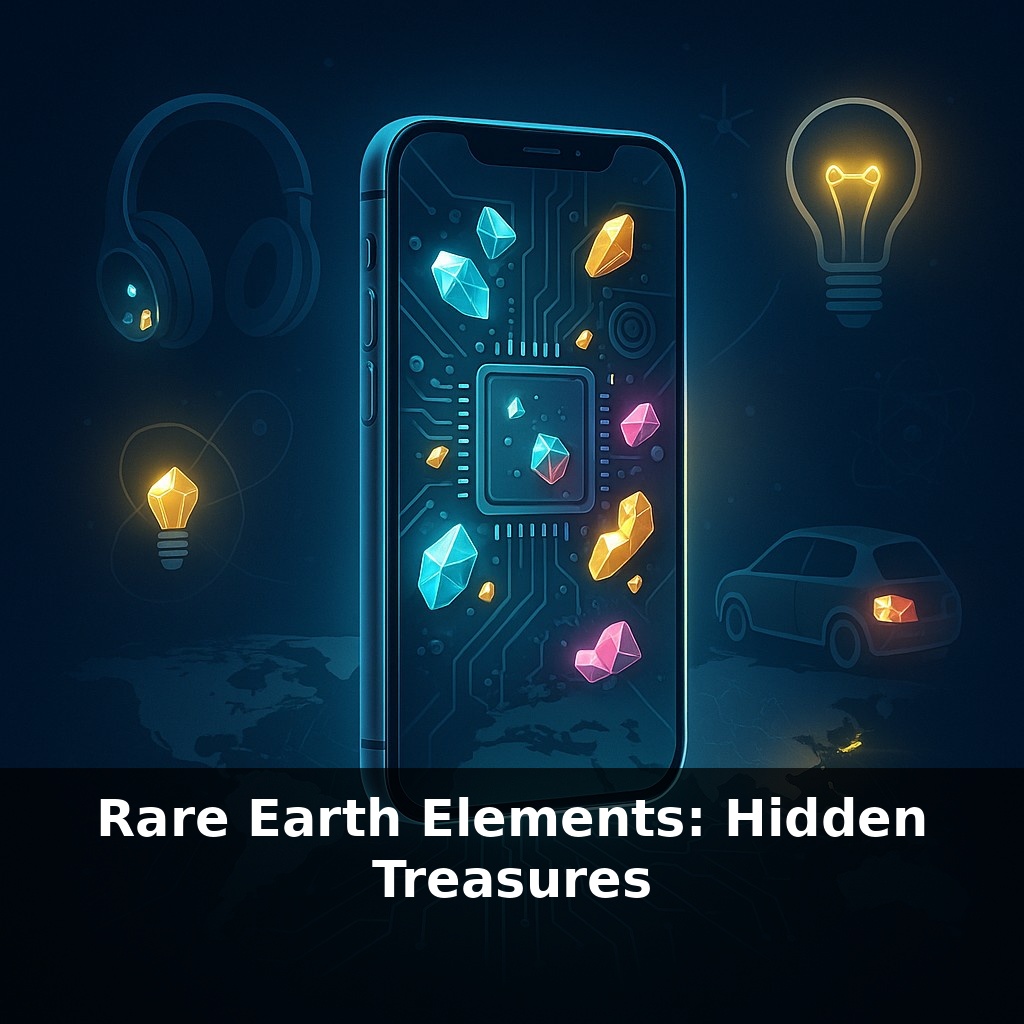
Some of the most important metals in your life are ones you’ve never heard of—and they hide inside your phone, your headphones, even your car. Right now, one country controls most of their journey from rock to finished gadget. So how did these “hidden treasures” become so powerful?
Open your laptop, flick on a light, or brake in a hybrid car, and you’re triggering a quiet performance by rare earth elements. These 17 metals don’t shout their names on spec sheets, yet engineers treat them like secret “cheat codes” for making devices smaller, faster, and more efficient. They tweak colors so screens look vivid instead of washed out; they strengthen magnets so motors can spin harder without bulking up; they help catalysts strip pollutants from exhaust before it hits the air. Behind each of these tricks lies a twist: the world doesn’t just need raw rare earths, it needs them separated, purified, and precisely blended. That’s where the real power—and the real bottleneck—emerges, as a handful of refineries and countries quietly determine which technologies can scale, and how quickly.
Yet for all their influence, these elements stay mostly off-stage in public debates. Climate policy talks obsess over solar panels and EVs, but rarely over the obscure ingredients that let them compete with fossil fuels. Geologists see them in many rocks, but only a few deposits are rich and clean enough to mine profitably. Then there’s the chemistry: long chains of solvent tanks, waste ponds, and strict environmental trade-offs. Add in geopolitics—export controls, strategic stockpiles, new mines in places like Australia and the U.S.—and rare earths start to look less like “materials” and more like levers that can speed up or stall entire energy transitions.
If you cracked open that discreet supply chain, you’d first notice something unintuitive: these elements aren’t actually “rare” in Earth’s crust. The headache is that they usually show up in low concentrations, tangled together with each other and with awkward companions like radioactive thorium. So instead of a single, clean metal vein, most projects face a geochemical jigsaw puzzle.
That’s why new mines keep making headlines. Projects in places like Mountain Pass (U.S.), Mount Weld (Australia), and Kvanefjeld (Greenland) aren’t just about digging; they’re about proving you can solve that puzzle at a competitive price without trashing the local environment. Investors don’t only ask, “How big is the deposit?” but, “Can you separate all 17 efficiently—and sell each into a paying market?”
The economics get stranger the closer you look. Neodymium and praseodymium, key for high-strength magnets, might pay most of the bills. But the same ore also yields “co-products” like europium or terbium that have tiny volumes yet outsized importance. If demand for one element dips, a whole mine can wobble, even if the others are still needed. Producers have to guess future tech trends: more offshore turbines? Fewer fluorescent lamps? Different EV motor designs? Each shift reshuffles which elements are hot or stranded.
Then comes the refining choke point. Even when ore is mined in the U.S. or Australia, it often still travels to Chinese facilities for the final, intricate steps. Those plants benefit from decades of accumulated know‑how, supplier networks, and, historically, looser environmental rules. Policies in Europe, Japan, and North America now push for “mine‑to‑magnet” supply chains at home, but replicating that ecosystem is closer to building a whole new industrial neighborhood than erecting one factory.
Meanwhile, engineers are quietly pruning demand. Some EV makers experiment with motors that skip the most supply‑risk‑heavy elements. Startups develop magnets that shave off dysprosium content without sacrificing performance. Others work on extracting rare earths from coal waste or mine tailings—trying to turn yesterday’s liabilities into tomorrow’s resources.
Recycling sounds like the obvious fix, yet it’s stubbornly small. Those grams scattered across millions of gadgets are hard to retrieve cost‑effectively, especially when glued, soldered, or mixed into complex alloys. Dismantling a retired wind turbine or traction motor is more promising, but those fleets are only now reaching end of life, so a meaningful “urban mine” of magnets won’t peak for years.
Your challenge this week: pick one everyday object you own that likely uses these elements—a phone, an EV, headphones, or a hard drive. Don’t open it; instead, follow its official end‑of‑life path. Where does your local e‑waste actually go? Does your municipal or retailer program specify if motors, drives, or screens are separated for material recovery, or is everything bulk‑shredded? Spend 20 minutes tracing this trail using public info or a quick email to a recycler. By next week, you’ll know whether those hidden elements in your chosen device are headed for a second career—or quietly vanishing into a landfill or low‑grade scrap stream.
Think of three very different scenes: a data center buzzing with servers, a hospital MRI suite, and a satellite factory. In each, these quiet ingredients shape what’s possible. In data centers, high‑performance hard drives and powerful motors rely on tight, compact components that owe their strength to these elements. Hospitals lean on ultra‑precise imaging: the contrast in some scans and the responsiveness of specialized sensors trace back to carefully tuned optical and magnetic behavior. Up in orbit, satellite designers obsess over every gram; lightweight, strong motors for pointing antennas and panels depend on materials that pack intense performance into tiny volumes. The twist is that each sector wants a slightly different “recipe,” so a change in EV motor design or display tech can unexpectedly ripple into medical gear or space hardware. Policy choices, too—like one country subsidizing offshore wind—quietly redirect which applications get the highest‑grade material and who waits in line.
As countries chase climate goals, these ingredients quietly shape geopolitics. Ports, rail lines, and processing hubs start to matter as much as oil pipelines once did. Cities with strong engineering talent could become “magnet foundries,” exporting components instead of crude resources. New rules on tracing material origin may treat every motor like a passport‑stamped traveler, recording mine, refinery, and factory. The open question: who will write the customs rules for this new era?
As exploration pushes deeper—into seabeds, phosphogypsum stacks, even asteroid regolith—we’ll face a choice: repeat the boom‑and‑bust habits of fossil fuels, or design a steadier playbook. Treat each motor, screen, and turbine like a library book on loan, not a disposable gadget, and these quiet ingredients can circulate through generations of technology.
Start with this tiny habit: When you plug in your phone to charge, spend 10 seconds looking at one device nearby (your phone, laptop, or headphones) and say out loud which rare earth element might be inside it—like neodymium in magnets or europium in screens. The next time you buy or click on an ad for electronics, pause for one breath and ask, “Did this come from a place that handles rare earth mining responsibly?” and look for a single word like “recycled,” “conflict-free,” or a known certification. When you toss an old gadget in a drawer, take just one extra second to move it to a “to recycle” spot (a box, bag, or shelf) so it’s ready for an e‑waste drop-off later.