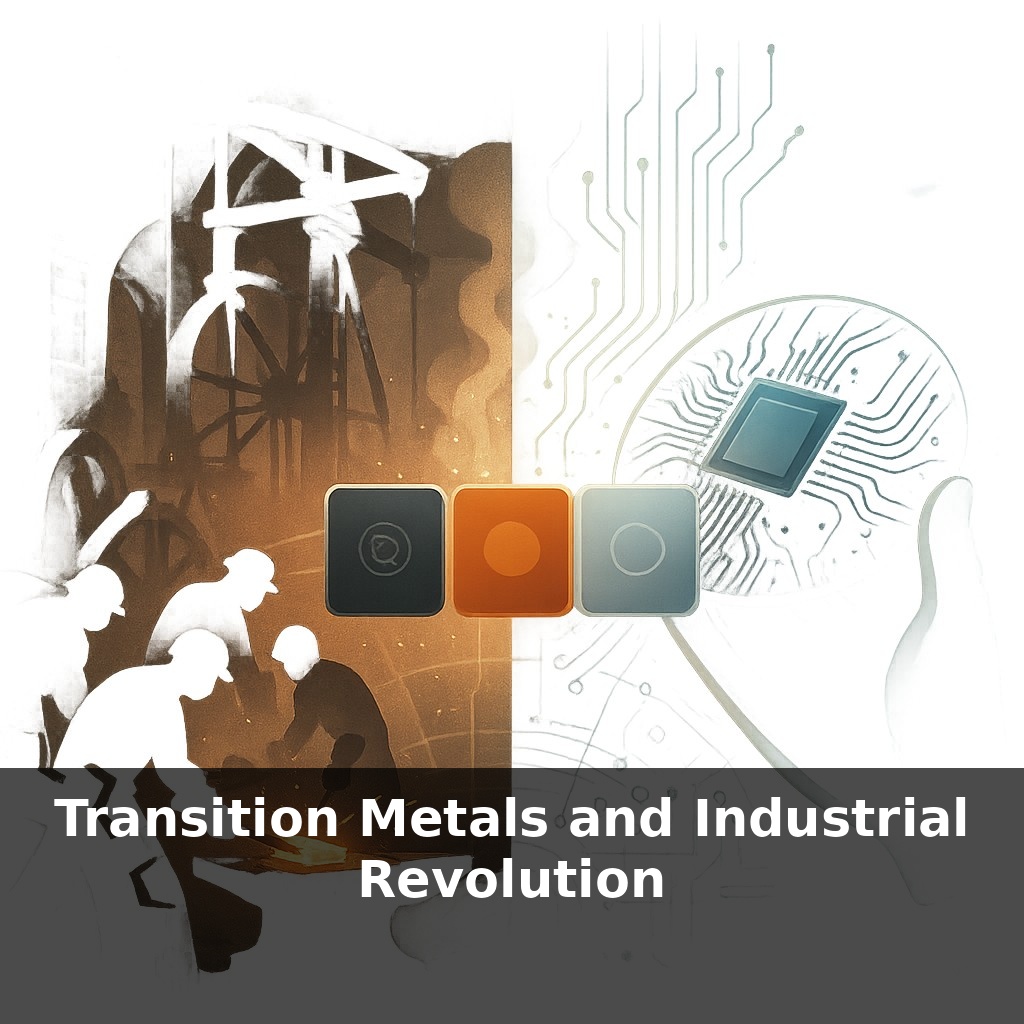
A single family of metals helped launch both the steam engine and the smartphone. In one scene, soot‑covered workers coax iron into early steel. In another, engineers deposit copper and platinum atoms onto chips. Same periodic table row, two industrial revolutions.
By the late 1700s, Britain was running out of easy fuel. Timber forests shrank, shallow coal seams flooded, and early engines gulped money as fast as coal. Yet within a century, railways stitched continents together, city skylines bristled with iron frames, and factories ran day and night. The leap wasn’t just “more machines”—it was a quiet shift in which *elements* humans learned to control.
Focus on one row of the periodic table and a pattern appears: metals there share flexible electron setups that let them switch roles on demand. They can be tough skeletons in bridges, precise gears in engines, or silent partners in chemical plants that turn raw coal tar into dyes, drugs, and fertilizers. It’s less a single invention and more an expanding toolkit: once people cracked how to tune these metals, industry stopped being constrained by wood, stone, and muscle—and started to rewrite what “material limits” even meant.
Factories didn’t just add more of the same stuff; they began swapping one element for another the way a coder swaps modules in a program. Need hotter boilers? Bring in metals that shrug at high temperatures. Want gears that won’t weld together under stress? Choose atoms that slide past each other cleanly instead of tearing. Chemists, meanwhile, learned that tiny traces of certain atoms could steer reactions, turning cheap coal‑derived sludge into vivid dyes or reliable medicines. Step by step, choosing *which* atoms to invite into a process became as strategic as choosing the machine itself.
By 1850, the bottleneck wasn’t “Can we burn fuel?” but “Can we build machines that *survive* what that fuel can do?” Pushing steam pressures higher, spinning shafts faster, and stringing rails farther all hammered on the same weak points: parts cracked, warped, or fused together under heat and stress. To escape that trap, engineers leaned hard on a quirk shared by one narrow band of elements: they rarely commit to a single oxidation state, and their d-electrons are just restless enough to rearrange under different conditions.
That restlessness had two huge payoffs.
First, mechanical. When small amounts of these elements were folded into iron, they didn’t just “mix”; their atoms disrupted how layers of atoms slide, pinning some defects while freeing others. That meant rails that didn’t shatter in winter, boiler plates that tolerated pressure cycles, and cutting tools that stayed hard at red heat. Specific choices mattered: one element might keep strength at high temperature, another might tame brittleness, a third might resist softening during repair. The menu of alloys expanded until designers could pick compositions for springs, turbine blades, or drill bits instead of accepting one generic “metal.”
Second, chemical. Because these elements can flip oxidation states, they can temporarily grab electrons from a reacting molecule and hand them back differently, lowering the energy hill a reaction must climb. In the 19th century that made synthetic dyes predictable enough to industrialize; later it made ammonia synthesis feasible at scale, anchoring fertilizer production and, indirectly, global population growth. In each case, the “helper” atoms emerged unchanged, ready to run the cycle again.
That exposed a deeper pattern: once a reaction or machine step was bottlenecked, chemists would search this same family of elements for something whose d-electrons could buffer the stress—mechanical or electronic. The same logic now runs through hydrogen fuel cells, battery electrodes, and emission-control systems. The toolkit grew, but the core trick stayed: tuning performance by tweaking which d-electrons are allowed to participate, and when.
In the 1860s, one shift in how people handled a single group of atoms crashed steel prices from about £40 a ton to under £7, and suddenly long bridges, tall frames, and mass‑produced rails penciled out economically instead of as vanity projects. Another branch of the same family quietly reshaped color itself: chromium and cobalt compounds made stable, intense pigments, so uniforms, flags, and product labels kept their hues instead of fading to brown. In power plants, nickel‑rich alloys let turbines spin hotter and faster, squeezing more electricity from each shovelful of coal, then later from gas and nuclear heat. Today, the same “tunable” atoms sit in battery cathodes—manganese, nickel, cobalt—controlling how often you can charge your phone before it feels tired. Designing an alloy here is less like picking one “best” metal and more like software architecture: small changes in which modules you include and how they connect can turn a clunky prototype into infrastructure that runs a city.
Soon, “smart” alloys could react to stress like noise‑canceling headphones, subtly rebalancing internal disorder to quiet cracks before they grow. High‑entropy mixtures and atom‑thin films let engineers tune strength, magnetism, and catalysis almost slider‑by‑slider, feeding into lighter aircraft, denser data storage, and quieter reactors. But every new blend raises fresh questions about recycling paths, geopolitical supply, and who controls the recipes that shape tomorrow’s infrastructure.
So the story doesn’t end with old smokestacks; it keeps unfolding in labs where spectrometers glow brighter than any furnace. New alloys for offshore wind, shape‑memory stents that unfurl in arteries, and catalysts tuned for cleaner shipping fuels all hinge on the same row of the chart, now probed like a soundboard for tomorrow’s infrastructure.
Here’s your challenge this week: visit (physically or virtually via a museum website or industrial archive) one historical site or exhibition linked to the Industrial Revolution and make a short, side‑by‑side comparison of how iron, steel, and copper were used then versus now in that same region or industry. Count and list at least five specific objects or machines that relied on each of these metals (e.g., railway tracks, steam engine boilers, telegraph wires, factory tools) and note what modern materials have replaced or complemented them. Then, pick one of those metals and find a current sustainability or recycling initiative involving it (like steel recycling rates or copper recovery from e‑waste) and jot down three concrete stats or facts you could explain to a friend.