Right now, about a quarter of modern medicines owe their power to a tiny, aggressive family of elements. You meet them in your toothpaste, your tap water, and even a hospital X‑ray… often on the same day. Yet, on their own, they’re far too dangerous to touch.
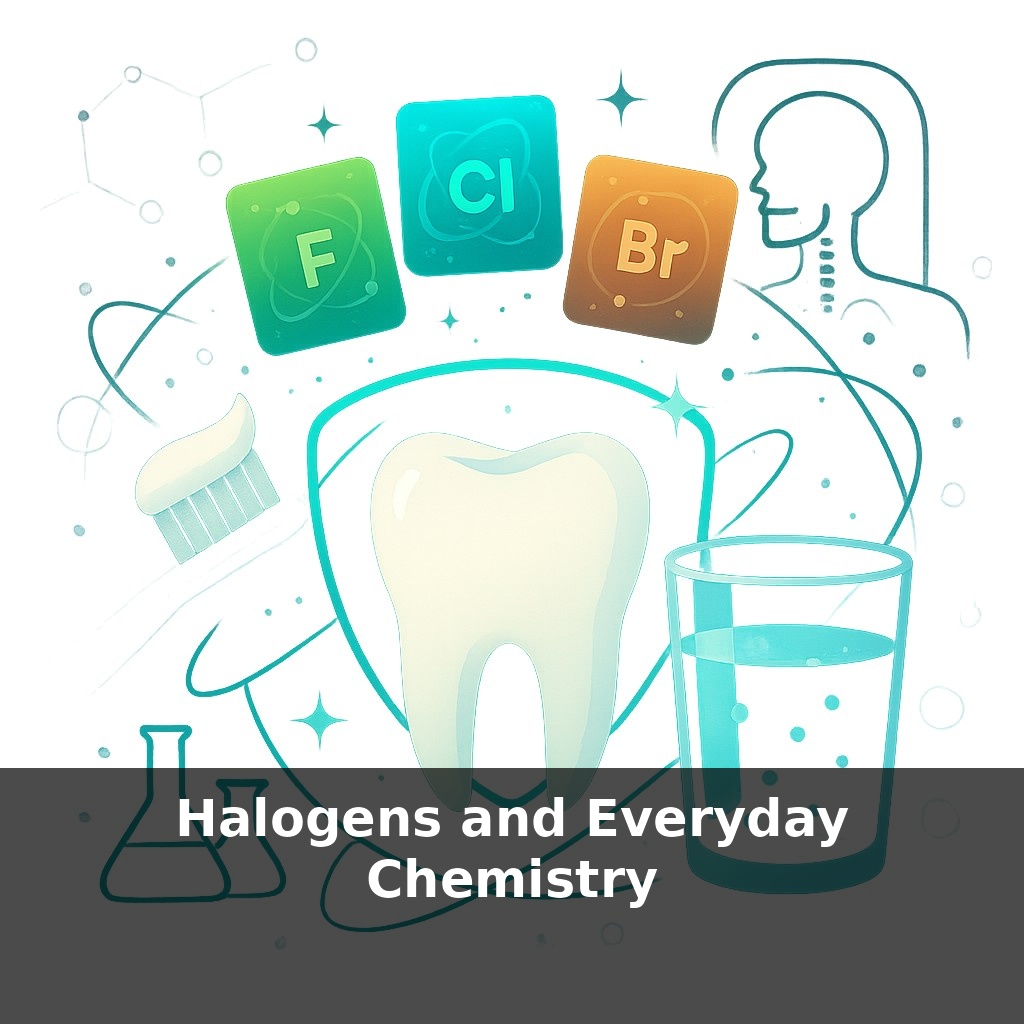
Your morning routine is basically a chemistry lab run by halogens. Fluorine shows up as fluoride in your toothpaste, tweaking the surface of your teeth so acid has a harder time chewing through. Chlorine or chloramine likely rides in with your shower water, quietly shredding bacterial cell walls before they reach you. The same chemical logic turns up in your laundry: that bright “whiteness” from bleach is really broken pigment molecules that no longer absorb visible light. In the kitchen, iodized table salt looks boring, but it’s a global public‑health tool, helping billions avoid thyroid problems with every pinch. Hospitals lean on halogens too: iodine swabs sterilize skin before surgery, and contrast agents laced with iodine make your blood vessels pop into view on scans. All day long, these elements sit behind the scenes, steering reactions that shape what feels clean, safe, and even visible.
Step outside that morning routine and halogens start popping up in places that feel less like a bathroom shelf and more like an engineering catalog. Fluorine chemistry toughens non‑stick coatings so your eggs glide across the pan; chlorine chemistry helps purify swimming pools and manufacture PVC pipes that quietly route water through cities. Bromine hides in some flame‑retardant materials, shaping how electronics and furniture handle heat. Iodine even tracks into agriculture, folded into animal feed and disinfectants that help keep food chains steady, like backstage crew keeping a show from collapsing.
You can trace a surprisingly large slice of modern life just by following where these electron‑hungry elements show up next.
Start with health. Roughly one in four prescription drugs contains at least one halogen atom, often fluorine or chlorine tucked into a carbon framework. That single swap can transform a mild, short‑lived molecule into a long‑lasting, precisely targeted medicine by changing how greasy it is, how it folds, or how stubbornly it clings to a protein. Amiodarone, a heart‑rhythm drug loaded with iodine, is a dramatic case: the heavy atoms help it interact with specific ion channels, but also mean doctors have to monitor the thyroid because the body “notices” all that iodine.
Move to energy and electronics. Many lithium‑ion batteries depend on electrolyte salts built from fluorinated anions, giving high voltage without tearing the system apart. In solar cells and LEDs, carefully chosen bromides and iodides appear in perovskite materials that can harvest or emit light with impressive efficiency. The exact mix of halogens tunes color and stability: tweak the ratio and your device shifts from red to green, or from lab curiosity to something that survives a summer on a rooftop.
Even food security leans on halogen chemistry. Some crop‑protection agents and disinfectants contain chlorine or bromine, designed to knock out pests or microbes quickly, then degrade before they drift too far. Iodine shows up in animal nutrition, folded into feed to keep livestock thyroids functioning and milk production steady. The same reactivity that can shred a cell wall becomes a tool for steering which cells, in which context, are affected.
Of course, history has made the downside impossible to ignore. Chlorofluorocarbons were once hailed as miracle refrigerants: non‑flammable, non‑toxic, wonderfully stable. That stability let them float into the stratosphere, where UV light freed reactive chlorine that chewed through ozone. Brominated flame retardants improved fire safety in furniture and electronics, yet some persist and accumulate in ecosystems, prompting bans and redesigns. In both stories, the problem wasn’t that halogens are “bad,” but that we pushed their chemistry into places our original tests never looked.
Today’s challenge is to keep the benefits—clean water, reliable power, vivid screens, safer surgeries—while designing halogen‑containing molecules that behave more like well‑trained specialists than loose cannons: effective where we use them, forgettable everywhere else.
Think of product designers as software engineers and halogen atoms as a powerful but risky plugin: add the right one, in the right spot, and your “app” (material) gains a new capability, from stain resistance to higher battery voltage. Push it into the wrong file and you get security bugs that show up years later as pollution, bioaccumulation, or unexpected side‑effects.
On the materials side, fluorinated coatings now protect the inside of fuel lines and medical tubing, where they quietly resist corrosion and chemical attack. In imaging, radiologists sometimes rely on short‑lived radioactive iodine or bromine tracers that vanish within hours but briefly light up specific organs for PET scans. Even forensic science leans in: certain bromine‑containing reagents help reveal latent fingerprints on tricky surfaces, trading long‑term persistence for high sensitivity.
Your challenge this week: scan your environment for labels mentioning “iodo‑,” “bromo‑,” or “fluoro‑.” Look up just one and ask: where does this molecule go after it leaves my hands?
Halogen chemistry is now shifting from “does it work?” to “what happens next?”. Researchers are testing catalysts that clip halogens off waste molecules like unscrewing bolts from scrap metal, so the parts can be reused. Others embed bromine or iodine in materials that fall apart on schedule, more like dissolving stitches than permanent implants. Policy is racing to keep up: life‑cycle labels may soon rate products on how gracefully their halogen pieces exit the stage.
We’re only starting to design “exit strategies” for these restless elements: safer coolants, degradable flame retardants, gentler disinfectants that don’t linger downstream. Like city planners rethinking traffic flow, chemists are redrawing routes so each reactive atom does its job, then clears out—leaving cleaner air, water, and bodies behind.
Before next week, ask yourself: Where in my home am I relying on halogen-based products (like bleach, fluoridated toothpaste, non-stick pans, PVC plastics, or chlorinated cleaning sprays), and which one am I most curious—or concerned—about replacing? When you pick just one of those items, what’s a realistic, chemistry-informed swap you could try for a week (for example, switching one chlorinated cleaner for a vinegar-based one, or choosing a fluoride-free toothpaste for a short trial) and what would you want to observe about how well it works? As you experiment, how does knowing the specific chemistry of halogens (like why chlorine disinfects or why fluorine strengthens tooth enamel) change the way you feel about keeping, reducing, or replacing those products in your daily routine?