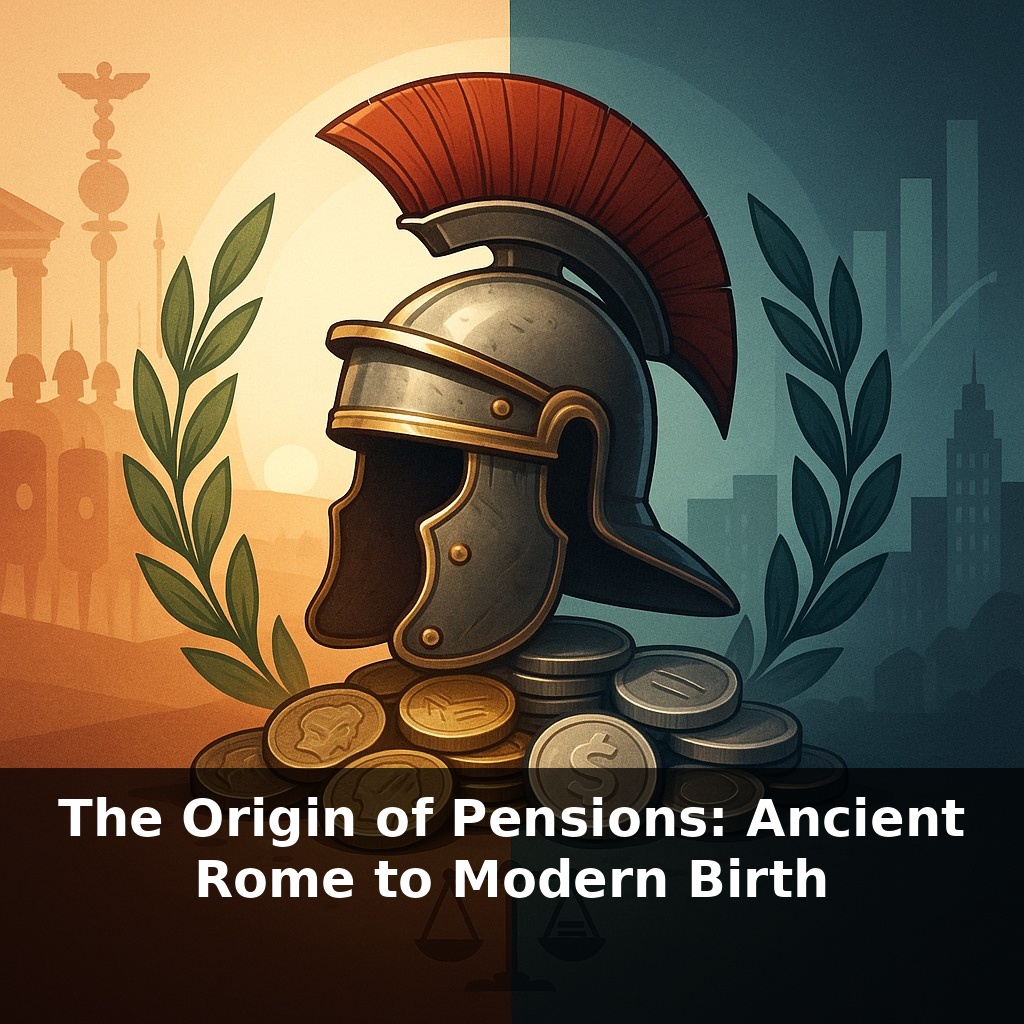
The Origin of Pensions: Ancient Rome to Modern Birth
📝 Transcript
A Roman soldier once retired with a payout worth roughly a decade of wages. Today, billions of people chase a similar promise. In this episode, we’ll step into a world where “old age” was rare—and the idea of a paycheck after work was closer to science fiction.
Retirement, as we know it, didn’t begin with spreadsheets and actuarial tables; it began with power politics and battlefield math. Augustus wasn’t trying to create a social safety net—he was trying to keep a professional army loyal without bankrupting the state every time a legion stood down. The solution was radical for its time: separate money from the day‑to‑day treasury, dedicate it to veterans, and lock in rules about who qualified and when. That single design choice—earmarking resources for tomorrow instead of spending everything today—quietly set a template that would echo for centuries. Over time, guilds copied the idea in miniature, monarchs tweaked it to reward officials, and industrial employers adapted it to keep skilled workers from leaving. In this episode, we’ll trace how a political fix for Roman soldiers slowly morphed into a global system shaping when and how millions step away from work.
As Rome’s veterans began collecting their promised payouts, a new problem surfaced: how do you promise money decades in advance when no one can predict wars, harvests, or tax revenues? Early solutions looked less like finance and more like improvisation. Emperors dipped into war booty, raised special levies, or granted land instead of coin. Later, medieval guilds experimented with pooled dues and strict membership rules, turning shared risk into a kind of financial craft. Each step forced societies to confront the same puzzle: who contributes, who qualifies, and what happens when reality doesn’t match the plan?
Roman pensions didn’t stay a battlefield experiment for long. Once rulers saw that carefully timed payouts could secure loyalty, the idea began quietly migrating into civilian life.
In late Rome and the Byzantine world, imperial officials started receiving stipends once they left office. These were less about kindness and more about control: a former governor with a steady income was less tempted to sell secrets—or raise a rebellion. The pattern hardened: regular service, then a promised stream of support.
Centuries later, medieval craft guilds turned this elite pattern into something more democratic—at least within their own walls. A stonemason’s guild in a German city might collect small, mandatory dues from every member, using the pot to assist those who could no longer work. Rules were blunt: you often had to complete an apprenticeship, pay in for years, and maintain good standing. Step outside the craft or fall behind on obligations, and your claim to help could vanish. The promise was powerful precisely because it was exclusive.
Early poor laws in England added another layer. Instead of a private group taking care of its own, local parishes were told to support those who couldn’t work. That shifted responsibility toward the community—but funding was fragile. Wealthier parishes sometimes tried to push older or disabled residents onto neighboring jurisdictions, a grim reminder that any long-term promise lives or dies on who is compelled to pay.
By the 18th and 19th centuries, a new class of long-serving civil servants emerged. Clerks, postal workers, and railway staff weren’t nobles or guild artisans, yet governments and large employers began offering them formula-based benefits linked to years of service and final pay. This spreadsheet logic—service × wage × factor—turned personal loyalty into something that looked more like a contract.
Across all these settings, one tension kept resurfacing: design the rules narrowly, and many fall through the cracks; make them broad, and the financial strain grows. Like a painter adding layers to a canvas, each era kept the outline—service today, support tomorrow—but altered the colors to match its own politics, institutions, and fears about the future.
A factory in 19th‑century Manchester might offer long‑serving mechanics a future income stream, but only if they stayed loyal to that single employer. Across the Atlantic, American Express in 1875 tied its first pension to 20 years of service and retirement at 60, signaling that “career job” and “eventual payout” were becoming a package deal. These early blueprints quietly shaped worker behavior: switching firms meant forfeiting years of credit, so many simply didn’t. Governments watched and adapted. Bismarck’s Germany set a national age threshold at 70, fully aware that average lifespans meant the system would be cheap at first. That choice wasn’t just actuarial; it was political cover to get the idea accepted. Over a century later, OECD data showing tens of trillions in pension assets reveals how far this logic has scaled. Like migrating birds using the same flyway each year but adjusting altitude and timing, societies now tweak parameters—age, formula, funding—while following a path laid down long ago.
Pension design is now colliding with gig work, longer careers, and patchwork incomes. Instead of one employer, many people juggle platforms and side projects, making single‑firm plans feel like train tracks in a world of bicycles. Some countries test auto‑enrolment and portable “lifetime accounts” that follow the person, not the job. Others explore digital ledgers to track micro‑contributions in real time, hinting at systems that update as fluidly as a navigation app rerouting mid‑journey.
Your challenge this week: Look at one pension or savings scheme you’re in (or eligible for) and map how it would cope if your next 10 years of work looked nothing like your last 10—different employers, locations, or income patterns. Where does the design break, and what would need to change for it to keep up with you?
Today’s pension questions—who pays, who qualifies, who moves the goalposts—sit on the same fault lines as those ancient bargains. The twist now is scale: trillions stored like water behind a dam, feeding millions downstream. As work patterns splinter, the real experiment is whether we can redirect those channels without draining the reservoir mid‑flow.
Try this experiment: Log into your retirement account today and, for one month, “role‑play” as if you were a Roman legionary earning a future pension instead of a modern worker. Pick a specific percentage bump (say +2%) to your current contribution rate and actually change it, then set a calendar reminder to check how your projected retirement income number shifts at the end of the month. While you go through your normal workdays, briefly note (mentally is fine) each time you feel “I earned my future stipend” and see whether imagining your contributions as a guaranteed future payment—like a Roman pension—changes how you feel about both work and saving.
From this course
The Evolution of Pensions: From Past to Future
5 episodesUnlock all episodes
Full access to 5 episodes and everything on OwlUp.
Subscribe — $1.99/monthLess than a coffee ☕ · Cancel anytime