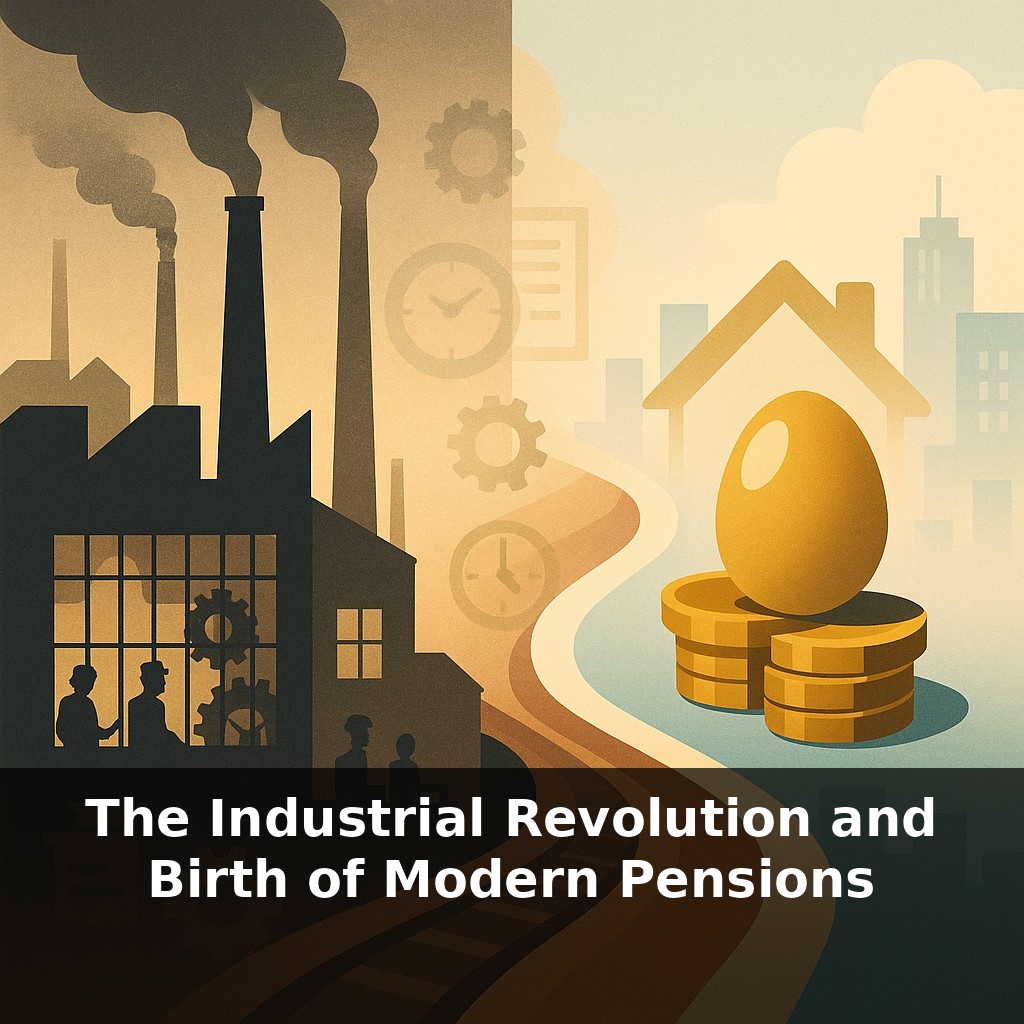
A century and a half ago, most people never expected to stop working—retirement simply wasn’t the plan. Yet factory whistles and coal smoke quietly forced the world to invent pensions. In this episode, we trace how noisy mills and gray city streets birthed your modern retirement.
The twist is that the earliest “retirement plans” weren’t acts of kindness—they were tools to manage a fragile new industrial system.
As factories packed thousands of bodies around clattering machines, owners confronted a problem no village farm had ever faced at scale: what happens when long-serving workers become too slow for the line, but too experienced to simply discard without consequence?
Governments had their own version of this dilemma with aging soldiers and civil servants whose loyalty needed rewarding, but whose salaries strained growing bureaucracies.
Into this tension stepped early pension experiments: railway companies smoothing out payroll risk, Prussian officials tackling social unrest, and worker-run mutual aid clubs quietly filling gaps.
Follow the money, and you see the pattern: retirement income emerged less from generosity, more from a hard-headed need to keep the new industrial city from cracking.
To see why all this mattered, shift your gaze from policy memos to cramped tenements and factory floors. Industrial work compressed lifetimes: children entered mills early, adults endured long shifts, and injury or exhaustion could end earnings overnight. Rural safety nets—extended family, shared land, seasonal side hustles—didn’t translate to soot-covered cities. At the same time, states were arming and expanding bureaucracies, then discovering they had to budget not just for cannons and clerks, but for their futures too. That budgeting mindset is where the architecture of today’s systems quietly began.
Walk through three doors: the state, the firm, and the workers themselves.
First, the state. Long before broad old‑age coverage, governments quietly built promises around people they directly controlled. Prussia’s 1889 law under Bismarck used a striking design: mandatory contributions from workers, employers, and the state, funneled into a national system that only paid out at 70. On paper, many contributors would die before claiming; in practice, those who survived into their 60s often reached 70 and collected. This was less a generous giveaway and more an attempt to lock workers into the new national economy and undercut radical politics. Other European states watched and copied elements: setting a high age, tying eligibility to “loyal service,” and normalizing compulsory contributions.
Second, the firm. Railways, mines, and big manufacturers started asking: how do we move older, slower employees off demanding posts without open conflict or constant ad‑hoc deals? The Great Western Railway’s 1853 plan is a good lens: workers paid a slice of wages each payday, the company matched, and a formula linked years of service and final pay to a predictable benefit. This created a powerful, often intentional side effect: long‑tenured staff became “anchored” to the employer, since leaving meant forfeiting or reducing future payments. Firms gained discipline and stability; workers got a distant but concrete promise.
Third, the workers. In parallel, friendly societies, burial clubs, and trade unions refined their own rules. They set contribution rates democratically, debated who counted as “deserving,” and sometimes negotiated with employers to recognize their funds. Where the state or big firms were weak or absent—think smaller workshops or colonial economies—these grassroots funds became the only structured cushion against old age or disability.
Across these three doors, one principle hardened: obligations were being written down, not left to memory or personal charity. That shift from informal expectation to formal contract is what made later scaling possible.
Your challenge this week: pick one employer in your own family history—a factory, a railroad, a mine, a civil service—and briefly research whether it ever offered a pension or endowment. Notice who was included, who was excluded, and what that reveals about power at the time.
Think of the early systems less as abstract policies and more as a set of very different “routes” an aging worker might follow through late life. A German metalworker in 1890 might spend decades under mandatory deductions, counting on a distant state promise. A British signalman on the Great Western line could trace his own future payment on a table pinned in the depot office, every extra year of service nudging the figure up. A Scottish shipbuilder might rely mostly on his lodge, where fellow members voted on hardship grants case by case. Cross the Atlantic and a clerk at a big U.S. insurer in the 1920s might enjoy a relatively secure corporate promise, while a laborer on the same city’s docks faced nothing written at all. These paths coexisted, overlapped, and sometimes collided—when a worker moved jobs or countries, earlier rights might vanish. The patchwork, not any single model, is what quietly trained societies to expect old-age support as something that could be claimed, contested, and improved.
Factories no longer define every career. Platforms, short contracts, and gig apps scatter people across many paymasters, reviving an old question: who holds responsibility when age or illness cuts earning power? Some cities now test “benefit wallets” that follow workers like a passport stamp, while others debate automatic savings that switch on with any income, however small. The tension ahead: flexibility people want versus the stability their future selves will need.
Today’s systems now hold trillions, yet they rest on quiet choices: which jobs earn security, which lives count as “full service,” whose risks are pooled. As work splinters, those old lines blur. The next redesign may look less like a single grand law and more like a mosaic—small tiles of policy, tech, and habit slowly laid, generation by generation.
Before next week, ask yourself: 1) “If I suddenly had to rely on my ‘old age income’ the way 19th‑century factory workers relied on early pensions, what specific sources (employer plan, state pension, personal savings) would actually be there for me—and how much would each likely provide?” 2) “Given how the Industrial Revolution shifted responsibility from family and church support to employer and state pensions, what’s one concrete step I can take today (e.g., logging into my pension/401(k) portal, checking my contribution rate, or reading my plan’s vesting rules) to understand where my own security really comes from?” 3) “If my current job disappeared like some of those early industrial roles, would my pension or retirement savings follow me, and what exact action can I take today to make them more portable or diversified?”