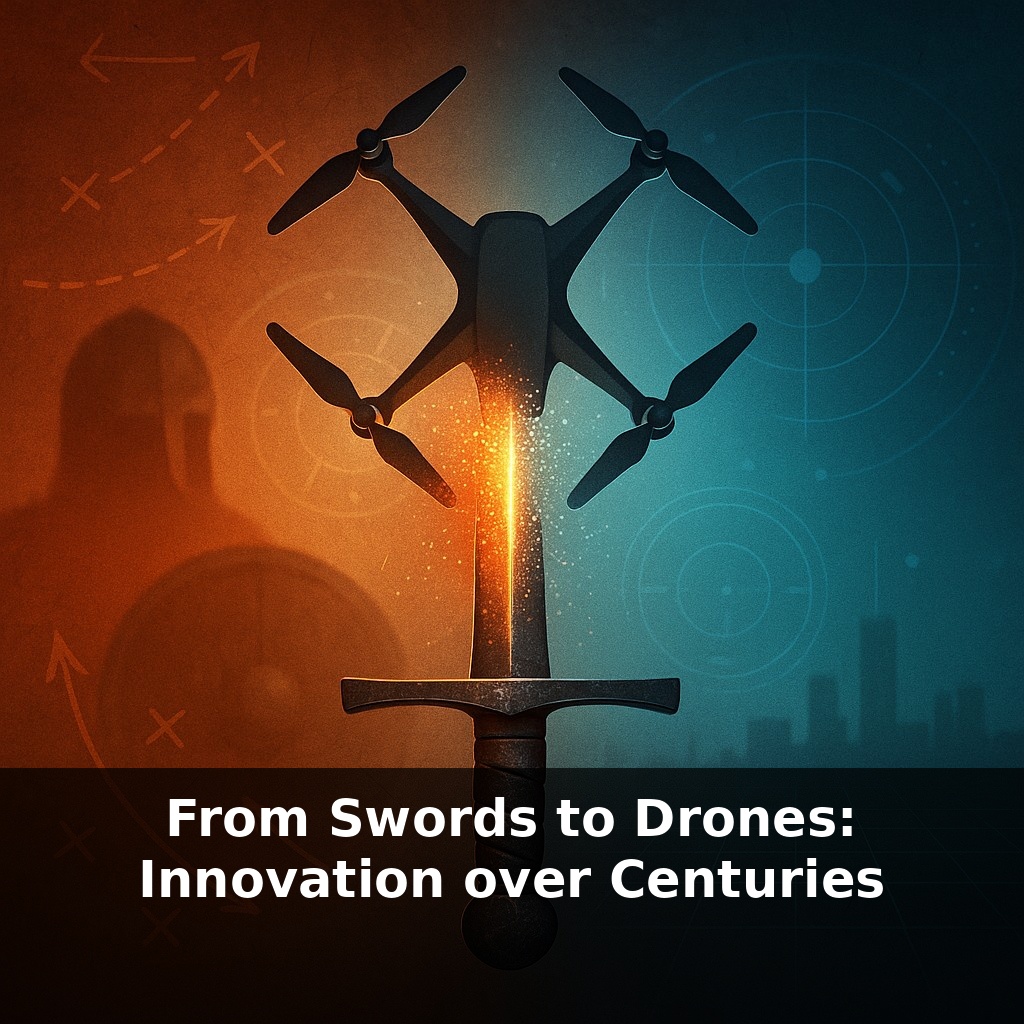
From Swords to Drones: Innovation over Centuries
📝 Transcript
A swordsmith once needed fire hot enough to glow steel before it could hold an edge. Today, a plastic-bodied drone can redirect itself hundreds of times each second. Same goal, though: out-think the opponent. The real mystery is how those leaps quietly reshape everyday life.
Centuries ago, the best “high tech” on a battlefield might have been a strip of sharpened metal and a shield of layered wood. Victory depended on muscle, discipline, and a craftsman’s feel for when the metal was ready. Now, code written on a laptop can decide, in milliseconds, whether a drone banks left or right, climbs or dives, engages or aborts.
What links those two worlds is not just better gadgets, but a shifting mindset: from honoring individual bravery up close to valuing information, distance, and timing. As materials changed—from charcoal-fired iron to alloy steels to carbon fiber and silicon—so did the kinds of risks societies were willing to take, the industries they built, and the skills they rewarded.
In this episode, we’ll trace how each “upgrade” in warfare quietly rewired economies, cities, and even what people believed counted as courage.
Stand on a medieval wall and you’d measure power by how many trained fighters lined the field. Stand in a modern command center and a map of supply chains, satellites, and software updates tells the real story. The through‑line is organization: who can coordinate people, tools, and knowledge fastest. Steel that once demanded days of careful heating now comes from global mills; drones rely on chips whose production spans continents. Warfare turns into a stress test for an entire society’s ability to learn, adapt, and integrate new tools, much like an ecosystem adjusting to a sudden change in climate.
Look closely at a well‑made medieval sword and you’re seeing the edge of a whole industrial system. To turn raw ore into steel that could survive real combat, you needed reliable charcoal supplies, access to iron deposits, people who understood when steel had hit that crucial austenitizing zone above about 750 °C, and trade routes to move finished blades. A kingdom with better furnaces and more consistent fuel didn’t just win duels; it organized forests, mines, and workshops differently. Technological advantage meant bureaucrats counting cartloads of wood and ore long before anyone drafted a blueprint.
Gunpowder shifted the balance again. Suddenly, fortification design mattered as much as personal technique. Star‑shaped forts, sloped walls, standardized cannon calibers—all of that demanded surveyors, mathematicians, and centralized foundries. Warfare pushed societies to measure more precisely: distance, angle, timing of volleys. States that could collect taxes in coin, pay standing armies, and run coastal foundries tended to outlast those relying on part‑time warriors and village smiths.
Fast‑forward to the first aircraft and tanks. Now, victory depended on internal combustion engines, refineries, ball bearings, and rubber plantations. You couldn’t field tanks without railways to deliver them, oil to feed them, and factories tolerating tiny defects in steel. War planners became, in effect, logistics designers. The battlefield spread backward into supply depots, ports, and assembly lines.
Drones extend that spread into invisible layers. A single Bayraktar‑class system leans on satellite networks, encrypted links, weather forecasting, chip fabrication, and data analysts far from the front. With a flight controller making hundreds of tiny attitude adjustments each second, the “weapon” increasingly lives in software and sensors. The projected US$30 billion drone market by 2030 isn’t just about airframes; it’s a proxy for investment in AI, communications, and electronics.
Like a shifting weather pattern that rearranges whole ecosystems, each major weapon change forces societies to reconfigure education, trade, and governance. The story from blades to drones is less about machines replacing humans than about which human skills and institutions rise to the surface each time the tools change.
Think of a coastline in a storm: the waterline looks stable for years, then one season of unusual waves redraws the map. Military breakthroughs act like those storms. When cannons arrived, city walls weren’t just thickened—they were reshaped into low, angular bastions. Engineers who once focused on cathedrals learned to calculate lines of fire. When radar appeared, entire towns grew around listening stations and airfields, with new jobs in electronics, signal analysis, and maintenance.
Today’s AI‑guided drones quietly demand their own “coastlines.” Cloud infrastructure, spectrum management, export controls, and training pipelines for operators become as strategic as fuel once was. Tech startups that might have built phone apps now compete for defense contracts, and civil aviation agencies wrestle with sky corridors that never mattered before.
Across centuries, each wave of tools drags unexpected flotsam ashore: new laws, habits, and business models that stay long after the shooting stops.
Laws, norms, and expectations will have to sprint to keep up. When a cheap quadcopter can “see” like a reconnaissance plane, privacy starts to feel porous, and small states gain leverage once reserved for empires. Black‑market code may become as destabilizing as smuggled weapons. Think of cities rewriting their “sky traffic rules” the way they once rewrote street laws for cars—zoning, insurance, and even etiquette will quietly absorb the logic of remote conflict.
As tools keep leaping ahead, the real frontier may be how calmly we redesign ourselves around them. Like a city adjusting its rhythm to new seasons, we’ll decide which jobs become rare crafts, which skills get automated, and which choices we refuse to outsource. Your challenge this week: spot one old habit each new tool quietly makes obsolete.
From this course
The Evolution of Warfare and Personal Innovation
5 episodesUnlock all episodes
Full access to 5 episodes and everything on OwlUp.
Subscribe — $1.99/monthLess than a coffee ☕ · Cancel anytime