A war once turned on rubber tanks and actors reading fake radio scripts. Another hinged on a jet so fast that, when missiles launched, pilots simply…sped up. In this episode, we’ll explore how staying unseen doesn’t just win battles—it quietly rewrites the rules of innovation.
The quiet arms race in warfare has never really been about who shouts the loudest—it’s about who disappears first. When the F‑117’s radar signature shrank to the size of a marble, it didn’t just change air combat; it changed what engineers believed was mathematically possible. When planners filled fields with inflatable tanks and scripted thousands of fake radio calls, they weren’t just tricking an enemy; they were prototyping large‑scale theater with real consequences. The same shadow thinking now drives cyber deception, a market racing toward billions as companies plant digital decoys and phantom servers. In each case, the breakthrough isn’t merely a new tool—it’s the decision to treat concealment, misdirection, and surprise as core design principles, not last‑minute add‑ons. That mindset is where the real innovation starts.
Militaries didn’t stumble into this mindset by accident; they built it through constraints. When enemies improved radar, engineers weren’t asked for “better planes” but for aircraft that looked, electronically, like almost nothing at all. When satellites made massing troops risky, planners shifted to scattering forces and amplifying illusions. These pressures forged a habit of thinking in layers: what must be seen, what should never be seen, and what is shown only to mislead. That layered thinking is now creeping into boardrooms and product labs, quietly reshaping how bold ideas are tested, protected, and revealed.
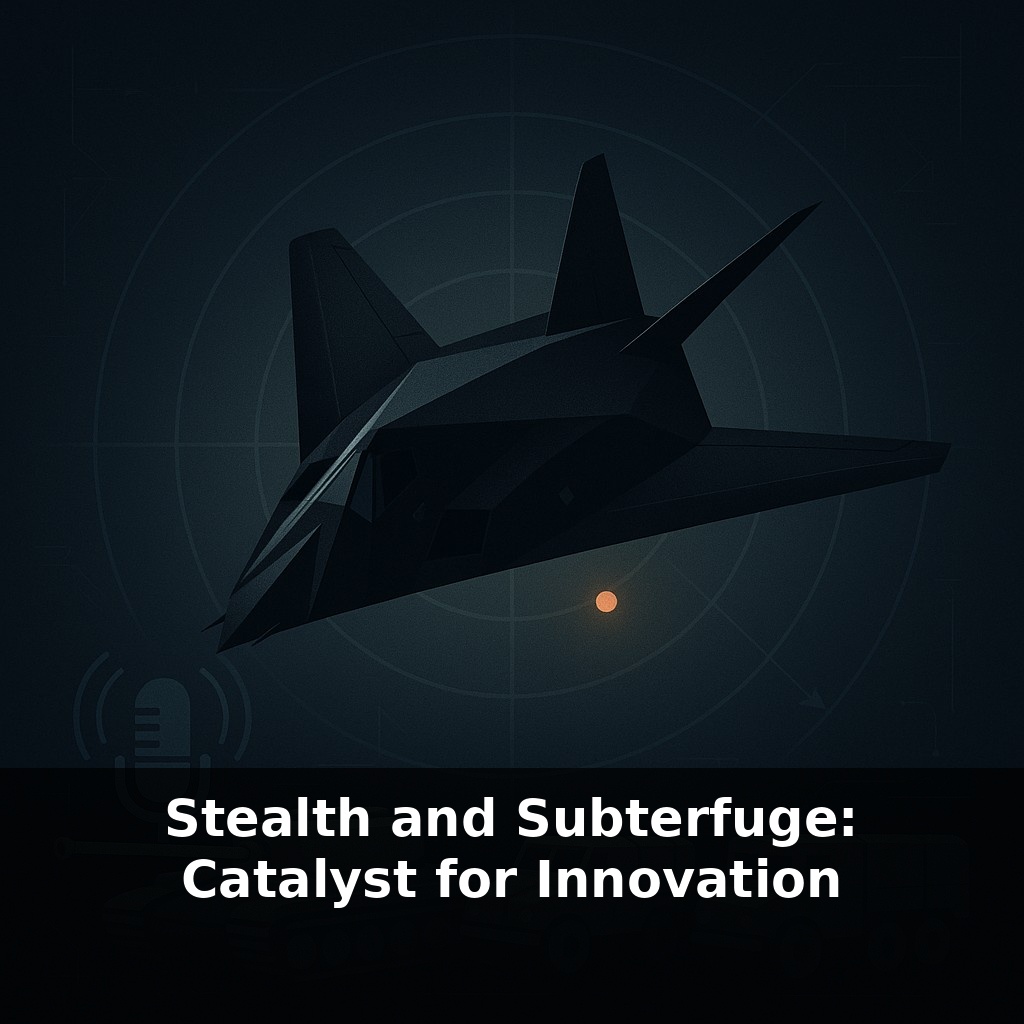
Stealth has always been less about vanishing and more about quietly rewriting the rules of what “counts” as power. In the gunpowder age, strength meant massed ranks and roaring cannons. By the late 20th century, it meant something much stranger: a 20‑ton jet that, to radar, looked smaller than a bird. That shift didn’t just demand exotic materials; it forced planners to value absence—of signal, of pattern, of predictability—as much as firepower.
The SR‑71 program is a textbook case. Flying above 85,000 feet at over Mach 3, it operated in a realm where interception became practically impossible. No SR‑71 was lost to enemy fire not because defenses didn’t try, but because the entire engagement geometry broke. Traditional timelines—detect, track, engage—collapsed when the target was already past you before your system finished its checklist. The innovation wasn’t speed alone; it was designing an aircraft around the idea that the best defense is to live in a slice of time the enemy can’t use.
Operation Fortitude pushed this logic onto the ground. Those 500 inflatable tanks and thousands of scripted radio messages did more than confuse German intelligence; they weaponized expectation. German analysts “saw” what their doctrine told them to expect: a massive force pointed at Calais. The Allies didn’t need to be omnipresent. They just needed the enemy to confidently look in the wrong direction at the decisive moment.
Today’s cyber‑deception industry is essentially industrialized misdirection. Gartner’s projection of US$3.4 billion by 2027 isn’t about prettier firewalls; it’s about companies filling networks with believable lies—decoy databases, fake credentials, trap servers that only an attacker would touch. Security teams aren’t merely building walls; they’re curating a stage where any unscripted movement becomes a tell.
For businesses and individuals, the pattern is the same: define where you want to be underestimated, where you’re content to look ordinary, and where you’ll suddenly reveal unexpected capability. Like a jazz musician who hides a complex motif inside an apparently simple melody, the real skill lies in deciding which notes to play loudly—and which to let almost disappear.
A practical way to see this in your own life is to look at how top creators and companies manage their “quiet work.” Apple rarely shows prototypes; by the time a device appears on stage, years of dead‑end experiments are already buried. The reveal feels sudden not because the work was fast, but because the struggle stayed offscreen. Netflix tests multiple thumbnails and feature ideas silently on small user slices before deciding what looks “obvious” to roll out. The visible product is just the final layer of a long, hidden rehearsal.
On a personal level, many standout careers are built the same way. Someone might look like an overnight success after a single breakout project, while the real engine was a decade of low‑profile trial runs, side gigs, and skills developed out of sight of their main job. Their “public roadmap” stays simple and predictable; the real experimentation happens in carefully chosen corners where failure doesn’t stick to their reputation.
As quantum sensing, AI surveillance and biometric tracking spread, “going dark” will be less about vanishing and more about controlling which traces you leave. Think of your data trails like footprints after fresh snow: you can’t avoid leaving them, but you can choose the direction, spacing and which ones you later cover. Future innovators will design products and careers so that the most legible signals point where scrutiny is welcome—and the real experiments stay just outside the brightest beams.
Your challenge this week: pick one ongoing project and create a small “hidden layer” for it—a draft, prototype, or experiment no one else sees. Protect that space like a secret garden plot. Notice how ideas change when they’re sheltered from instant feedback, and which ones feel sharper when you finally bring them back into the daylight.