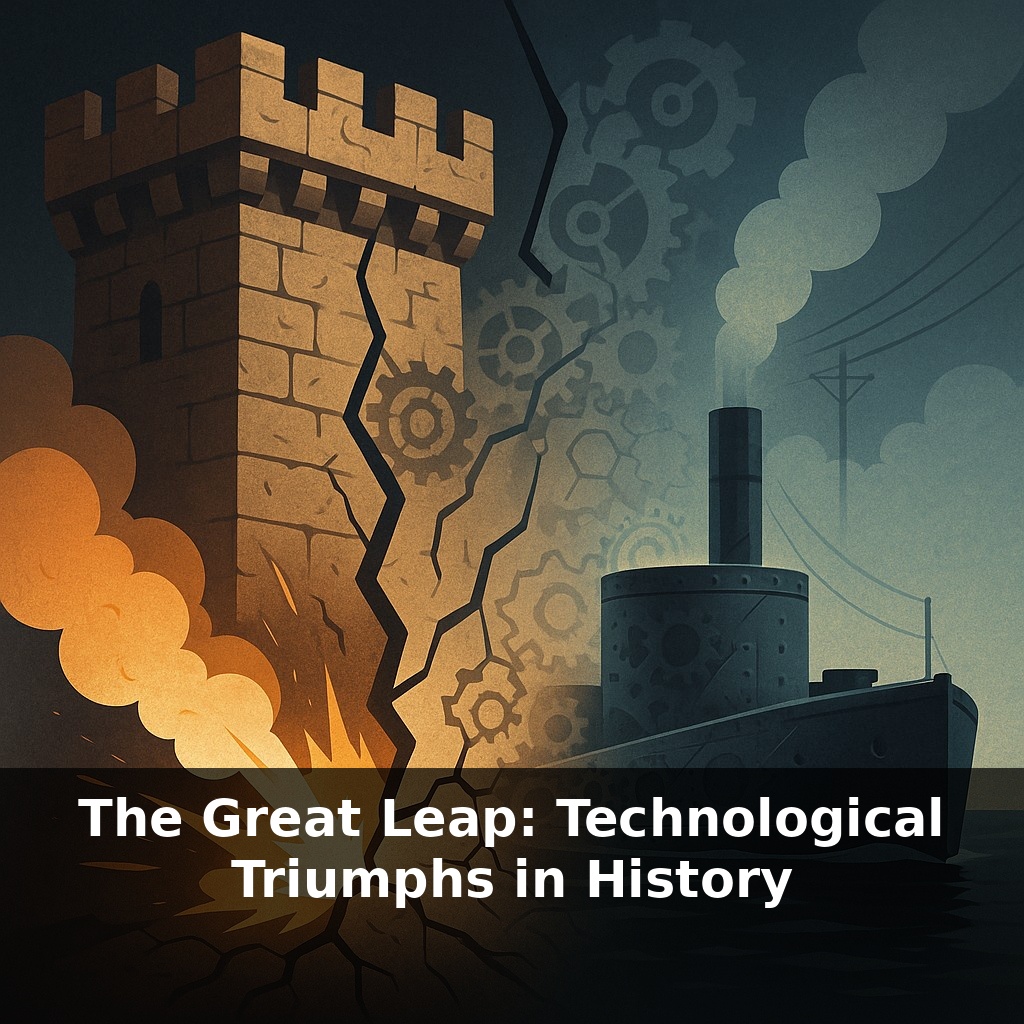
Gunpowder once turned towering stone castles into temporary scenery—obsolete in a single generation. In this episode, we dive into moments like that: when a new weapon doesn’t just win a war, it quietly rewrites how the whole world works.
By the 19th century, the battlefield was no longer just soil and smoke; it was steel, steam, and signals. When the ironclad Monitor met the CSS Virginia, it wasn’t simply a duel of ships—it was an early sign that industrial workshops and shipyards might matter as much as generals and admirals. Soon after, wireless sets, rangefinders, and early fire-control computers began turning guesswork into geometry.
These shifts mattered far beyond the front. Precision at sea encouraged precise engineering in factories. The need to coordinate fleets across oceans sped up global telegraphy and, later, radio networks. As states poured money into solving military problems—seeing farther, moving faster, coordinating better—they accidentally laid tracks for civilian revolutions in transport, communication, and mass production, the way a river quietly carves out the valley a city will one day fill.
Governments didn’t just buy equipment; they built ecosystems. To make ironclads viable, they needed coal logistics, standardized parts, repair docks on distant coasts. To coordinate fleets, they codified time zones and created trained technical corps. Each “military” fix quietly hardened into everyday infrastructure—rails, ports, power stations, engineering schools. Over time, the map of conflict and the map of commerce began to overlap: shipping lanes followed naval coaling stations, trade clustered where war planners had once drawn arrows, and cities grew along these enforced lines of connection.
The pattern repeats across centuries: a government faces a specific fear, spends heavily to reduce uncertainty, and unintentionally funds an entire scientific and social leap.
Take fortifications. Once high walls were enough. Then artillery improved, and planners confronted a grim equation: stone versus steel, static versus mobile. They responded with angular bastion forts, buried magazines, layered defenses—essentially, early systems engineering. Surveyors, mathematicians, and materials specialists were pulled into what had been a mason’s trade. Their methods—standardized measurements, stress calculations, contour mapping—spilled into civilian bridge-building, city planning, and civil engineering as a profession.
At sea, armor and heavy guns forced navies to think in networks instead of individual ships. Coal depots, later oil terminals, created global supply chains that merchants quickly exploited. Shipping insurance, freight timetables, and refrigerated cargo followed from guarantees originally designed to keep fleets fighting at distant stations. Financial instruments used today to hedge fuel or shipping costs echo risk models once drawn up in admiralty offices.
The 20th century pushed this further. Funding to understand blast waves, shock, and high-speed flight produced supersonic wind tunnels and refined fluid dynamics. Those same equations now shape passenger jets and even the curves of efficient cars. Efforts to harden communications against jamming fostered error-correcting codes and information theory—foundations of digital storage, streaming, and mobile networks.
Nuclear research forced scientists to quantify risk at planetary scale. Fallout models, radiation medicine, and long-term environmental monitoring all emerged from trying to understand what a weapon might do to both a city and a climate. That mindset—projecting consequences decades ahead—influences how we study climate change and pandemic spread.
More recently, the drive to coordinate fast-moving units and sensors accelerated satellite navigation and miniaturized electronics. Precision-guided munitions required cheap, rugged chips; the same manufacturing breakthroughs made smartphones possible. Uncrewed systems pushed advances in lightweight materials, lithium batteries, and computer vision that now guide warehouse robots and agricultural surveying.
Think about three moments where war’s urgency quietly rehearsed the future.
First, early weather stations: navies needed to avoid storms as much as enemy shells, so states funded systematic ocean measurements. Over decades, that data morphed into modern forecasting, airline routing, and even the apps that warn you before a cloudburst hits your street.
Second, medical triage in mass battles forced surgeons to prioritize by survivability, not rank. That brutal arithmetic later shaped civilian emergency rooms and disaster response protocols, influencing how ambulances, trauma centers, and blood banks are organized today.
Third, efforts to track fast-moving aircraft pushed governments to invest in centralized command posts and standardized reporting formats. Those same ideas later underpinned air-traffic control and, eventually, the logistics software that lets delivery companies choreograph millions of parcels with near-military timing. Radar is like turning the lights on in a dark room—once you can see reliably, you start arranging everything differently.
War’s tech leaps also rewrite expectations. Citizens start to assume that maps update live, that distant voices are instant, that crises can be modeled before they hit. As quantum tools, AI swarms, and space-based sensors mature, the line between “frontline” and “front door” blurs. Supply chains, hospitals, even city traffic systems begin to act like quiet command centers, constantly scanning, predicting, adjusting—less about winning battles, more about shrinking surprise in everyday life.
Your challenge this week: watch for “hidden spin-offs” of defense tech in daily life. That weather alert on your phone, the satellite map in your car, the surgical robot in a hospital—trace one back to its funding roots. As we’ll see next time, the same labs designing tomorrow’s weapons may be sketching everyday tools we don’t yet recognize.