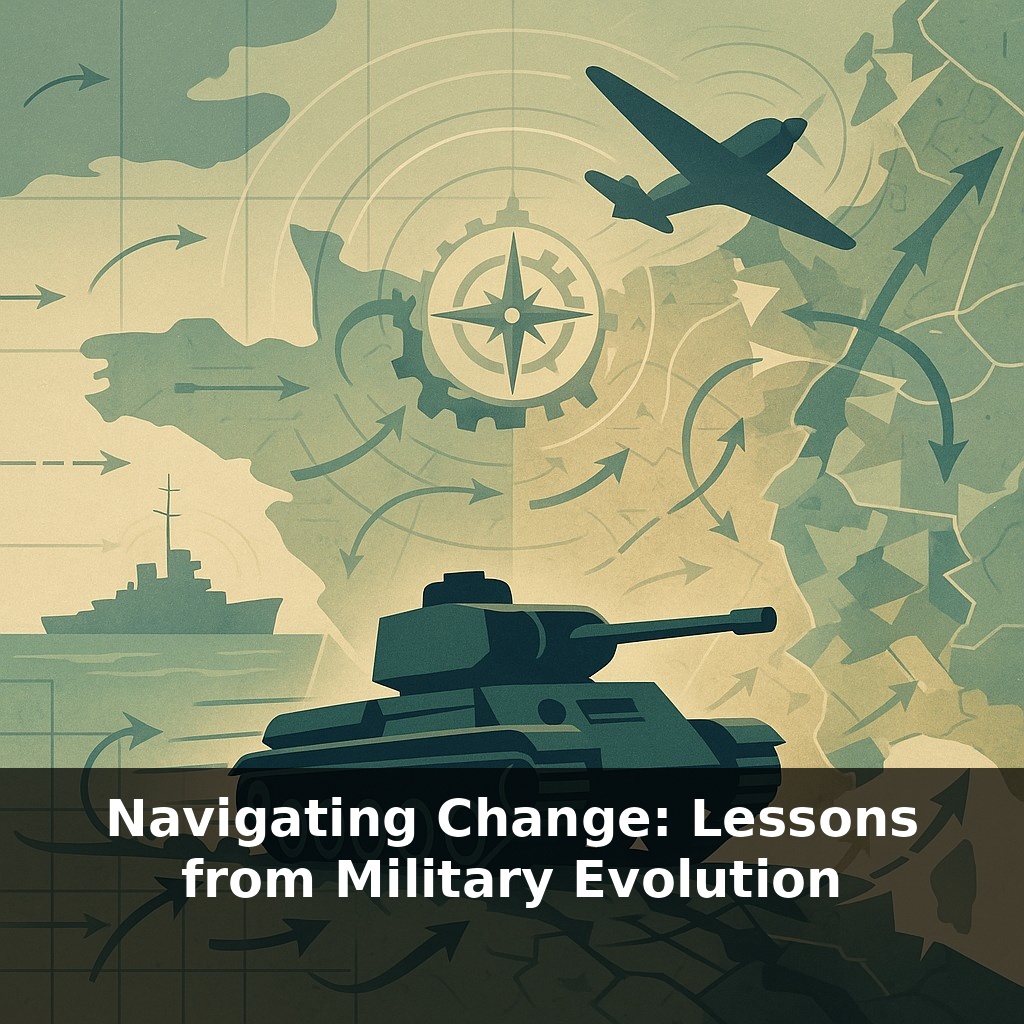
German tanks once crossed France so fast that the maps couldn’t keep up. In another war, American battleships sat silent while aircraft decided the outcome. How do entire systems pivot that quickly—while others freeze—and what does that say about how *we* handle sudden change?
For centuries, armies treated their doctrines like sacred texts—fixed battle plans, rigid hierarchies, carefully polished equipment cycles. Then the world stopped cooperating. Radios scrambled chains of command, aircraft leapt over defensive lines, and suddenly the units that clung tightest to “how we’ve always done it” were the first to be outmaneuvered. What changed wasn’t just technology; it was the speed at which reality invalidated old assumptions. Today, your market, career, or community can shift just as abruptly as a front line once did. A small startup updates its product weekly; a neighborhood group reorganizes overnight around a new threat or opportunity. Those that thrive don’t just react—they quietly build habits of sensing, discarding, and reallocating long before the crisis arrives. In this episode, we’ll mine those military turning points for practical ways to rewire how you adapt.
Modern militaries quietly rewired how they learn. Instead of treating plans as finished products, they treat them as drafts—constantly red-lined by new intel, field reports, and unexpected failures. After-action reviews, war games, and small experimental units act like living laboratories, feeding lessons back into the larger force. You see echoes of this in elite companies that spin up “tiger teams” or limited beta launches before committing. Adaptation stops being a heroic, last-minute rescue and becomes a background process—less about dramatic pivots, more about steady course-corrections that keep you off the rocks.
When armies truly change, it usually starts with something quiet and unglamorous: logistics, information flow, and who’s allowed to say “this isn’t working.” That’s why German armored units in 1940 mattered less for their tanks and more for how they were organized around radios, decentralized decisions, and fast resupply. The hardware looked impressive, but the real advantage was a system designed to learn faster than opponents could react.
You see the same pattern at sea. At Midway, the decisive difference wasn’t that aircraft existed—Japan had plenty—but that the U.S. Navy had begun treating the aircraft carrier as the organizing center of a battle, not an accessory to battleships. That meant new routines: flight deck choreography, specialized command teams, intelligence units fusing code-breaking with reconnaissance. The “weapon” was really an ecosystem of roles, processes, and feedback loops wrapped around a ship.
Modern organizations quietly repeat that script. Amazon’s move to micro-services wasn’t just a technical refactor; it decomposed a monolith into small, semi-autonomous teams that could deploy, fail, and fix on their own cadence. That’s suspiciously close to how mission-type orders work in flexible military units: leaders set intent, small teams experiment at the edges, and useful discoveries spread.
Notice what all of these shifts have in common:
- **They redefined the basic unit of action.** From single tank to combined-arms group; from ship to carrier task force; from giant codebase to tiny service. - **They pushed authority closer to information.** Tank commanders on radios; pilots and intelligence officers shaping plans; engineers owning services end-to-end. - **They treated structure as a variable.** Units were reorganized, merged, or retired when they stopped fitting the environment.
For individuals and teams outside the military, the question becomes less “What tool should I learn next?” and more “How easy is it for me to rewire how I work when the environment shifts?” A tree that can flex in the wind doesn’t survive because any single branch is strong, but because the whole structure is built to bend, redistribute stress, and grow in new directions after the storm.
A useful test is this: when conditions shift, what’s the smallest thing you can change quickly without asking ten layers of permission? Some modern militaries run “red teams” whose entire job is to probe for weak spots in plans and structures; when they find one, leaders don’t defend the old setup, they adjust around it. Netflix created its famous chaos engineering practice for the same reason: by deliberately breaking parts of its own system, it exposes where flexibility is fake and where it’s real.
On a personal level, you can borrow this by treating your calendar, tools, and routines as modular—not sacred. Instead of one massive workflow that collapses if disrupted, build interchangeable pieces: a way to learn fast, a way to share what you’ve learned, a way to test it safely. Think of it like a jazz group rehearsing not just full songs, but tiny improv patterns they can recombine when the tune changes. The players stay the same; the configuration shifts to fit the room, the audience, the moment.
Future adaptations may hinge less on tools and more on how smoothly humans and algorithms negotiate decisions. As AI shrinks reaction times, leaders may shift from “commanding” to curating boundaries, values, and escalation rules. Careers, too, may look more like rotating “tours” across domains than one long posting. Your real edge becomes meta-skills: learning how you learn, debugging your own biases, and updating your mental maps before reality forces the issue.
Adapting well is less about predicting the next disruption and more about rehearsing how you’ll respond when one lands. Treat each small change—new tool at work, shifting role, unexpected constraint—as a low-stakes drill. Over time, you’re not just surviving turbulence; you’re quietly training to navigate when the air gets truly thin.
Try this experiment: For the next seven days, run your team like a small platoon on deployment facing a new threat. On day one, pick one active project and brief your team using a 10-minute “intel update”: what’s changed in your market, tools, or constraints (your version of shifting terrain or new tech on the battlefield). Then, every 24 hours, hold a 5-minute “after-action review” where each person must share one thing that went wrong, one thing that went right, and one adjustment for the next day—no blame, just learning, like a military debrief. At the end of the week, compare your original plan to what you’re actually doing now and note exactly which daily adjustments created the biggest performance or clarity gains.