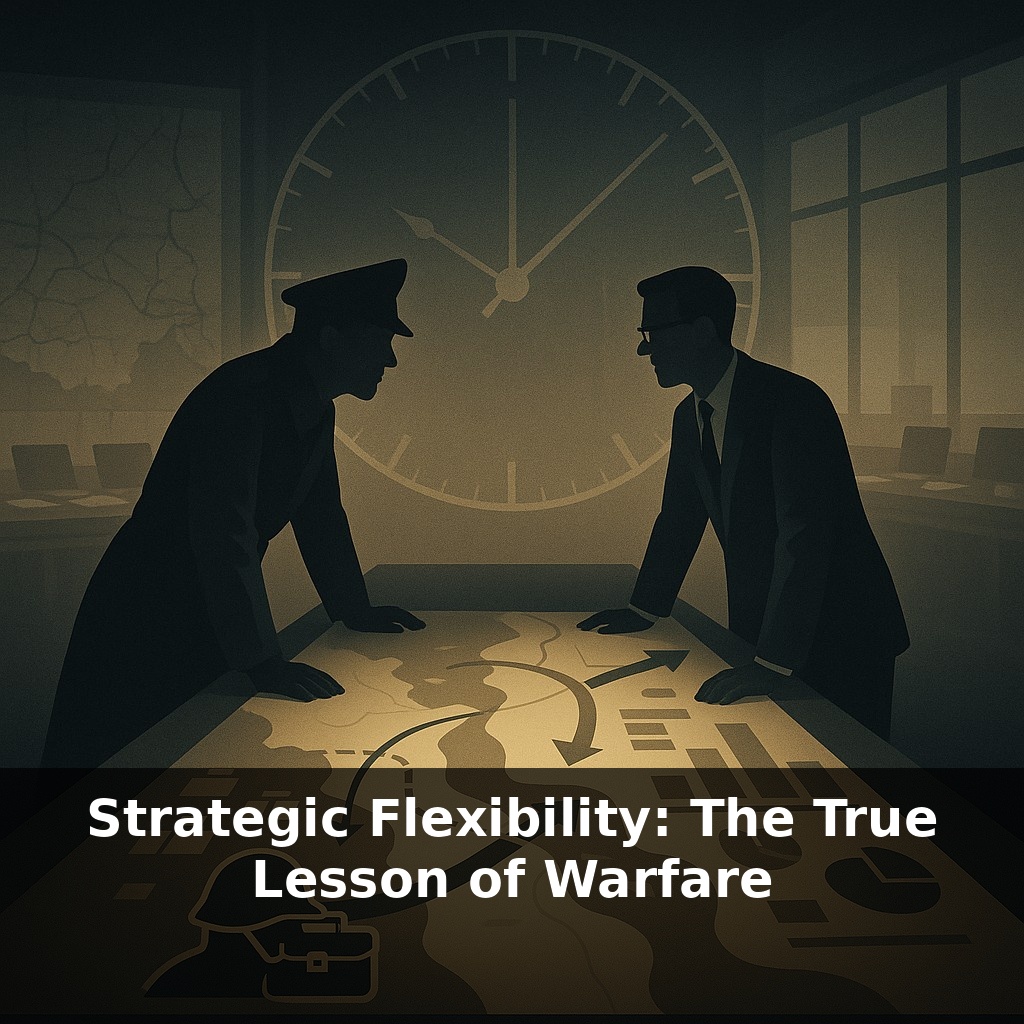
Armies that start weaker win more often than you’d expect. Not by luck—but by learning faster. A panicked general in a war room, a nervous CEO in a board meeting, and you facing a sudden life curveball all share one hidden test: how quickly can you rewrite the plan?
Armies don’t just fight the enemy in front of them—they fight the clock. Every hour that passes without adjustment quietly shifts the odds. In 1940, French commanders often waited for full reports before authorizing moves; German Panzer leaders were empowered to exploit an opening the moment they saw it. Same battlefield, different relationship to time.
That’s the core of strategic flexibility: treating changing conditions as standard, not exceptional. In war, that meant radios in every tank, standing orders that trusted junior officers, and logistics built to move fuel and ammo along new routes at short notice. In your world, it might look like projects that can be reshuffled mid-week, savings you can redirect within a day, or a career path designed with deliberate exit ramps rather than a single fragile ladder. The advantage goes to whoever can turn “this wasn’t the plan” into “this is now the plan” fastest.
On real battlefields, this isn’t abstract theory; it’s a race between two clocks. In France 1940, Panzer columns that outran their maps weren’t just moving fast—they were forcing Allied headquarters into permanent catch‑up mode. In the Gulf War, rewriting the air plan every 24 hours didn’t just squeeze in more sorties; it kept Iraqi defenses preparing for yesterday’s threats. Those same dynamics show up when markets crash faster than budgets update, or when personal crises move quicker than our habits. The side that treats surprise as input, not insult, quietly captures the initiative.
Speed alone isn’t enough. What wins modern campaigns is how quickly awareness, authority, and resources can be re‑wired when reality shifts.
Start with sensing. Every army collects information; flexible ones shorten the distance between frontline observation and meaningful signal. German Panzer crews in 1940 didn’t just report obstacles—they constantly updated higher command about where resistance was thin, allowing thrust lines to bend toward opportunity. In the 1991 Gulf War, surveillance aircraft and satellites streamed target data so frequently that the air plan could be rebuilt daily without going blind. In both cases, the point wasn’t more data; it was faster discrimination between noise and pattern.
Then comes decision. Centralized commanders can feel safer, but they move slower. John Boyd’s work on fighter combat showed that even fractions of a second in the OODA loop could tilt kill ratios dramatically; scale that logic up to armies or companies and you see why rigid hierarchies lose initiative. German doctrine of Auftragstaktik, and later U.S. “mission command,” pushed choice down the ladder: clarify intent, then let subordinates improvise. By the time an opponent has escalated your report up and back down their chain, you’ve already acted twice.
Finally, re‑allocation. Plans crumble if fuel, money, and people can’t follow decisions. The U.S. Navy’s carrier strike groups are a textbook case: ships, aircraft, and submarines can be recombined into different task forces without rewriting the entire institution. That modularity is the opposite of chaos; it depends on standard interfaces, shared procedures, and a culture that treats re‑mixing as normal work, not emergency surgery.
The same three levers show up far from battlefields. Firms that scored high on strategic flexibility in that 2021 Strategic Management Journal study didn’t simply cut costs faster during shocks; they shifted capital and talent into new lines while rivals were still defending old ones, producing that higher ROA gap. Personally, the parallel is stark: you either detect small shifts in your health, relationships, or industry early—or you wait until they become crises that force clumsy, all‑or‑nothing moves.
Your resilience, like a well‑tuned orchestra, depends less on any single virtuoso part than on how quickly the whole can change tempo together when the conductor raises the baton in a new rhythm.
A practical way to see all this is to zoom in on small, concrete moves. At a company level, sensing might start with a product team quietly watching which features users gravitate to after a minor release. When they notice an unexpected spike—say, customers obsess over a simple export button—they don’t wait for a quarterly review. They spin up a tiny “export experience” squad by mid‑week, borrowing two engineers and a designer from less time‑sensitive work. Authority shifts with them: that squad gets clear outcomes to hit, then freedom to test versions without begging for approvals.
Individually, the same pattern shows up when you treat your calendar, skills, and relationships as movable parts instead of fixed pieces. A marketer who spots early signals that privacy rules are tightening can start shadowing the legal team now, take one targeted course, and volunteer for the next compliance‑heavy project. No drama, no big announcement—just small, reversible bets that make it easier to slide into a new lane later rather than slam on the brakes when rules finally change.
Victories will hinge less on brute force and more on how gracefully humans share control with algorithms. As autonomous tools compress those already-tight cycles, the real edge will be leaders who can question machine outputs instead of rubber‑stamping them. At home, families may treat backup power, remote income streams, and support networks like layered defenses—quietly rehearsed before crises. Careers, too, may feel like coastal paths: always scanning the horizon, ready to step inland when the tide shifts.
In the end, this isn’t about being restless; it’s about being ready. The best commanders and the most resilient people keep a light grip on their plans and a firm grip on their direction. Treat each small adjustment—swapping a meeting, learning one new tool, calling one different person—as rehearsal for bigger pivots you can’t yet see.
Try this experiment: Pick one ongoing “battle” in your life this week (like a tough project at work or a recurring conflict) and, for 24 hours, forbid yourself from using your default “strategy” for dealing with it. Instead, create two radically different “campaign plans” inspired by warfare: one where you attack the problem head-on with speed and over-communication, and one where you “retreat and flank” by pausing, gathering intel (asking questions, observing), and then acting in a smaller, unexpected way. Run the first plan in the morning, the second in the afternoon, and keep score: which one produced more movement with less friction? Tomorrow, double down on the winning approach—but tweak one variable (timing, allies involved, or tools used) to practice staying flexible, not fixed.