By the time you finish this episode, someone on a middle-class salary will have inched closer to retiring decades early. Not through lottery wins, but by quietly saving most of each paycheck, living on purpose, and letting simple index funds do the heavy lifting.
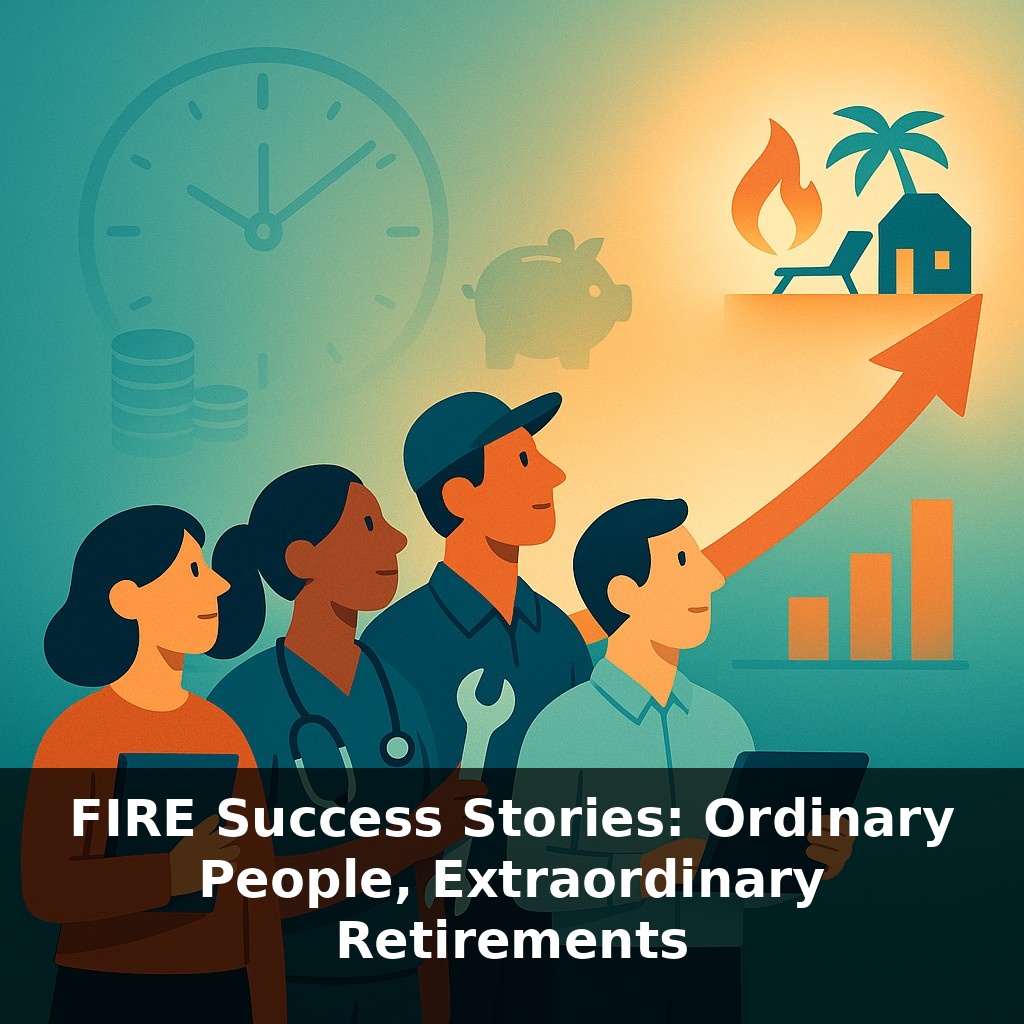
Some of the most compelling FIRE stories don’t start with six-figure bonuses or tech stock windfalls; they start with teachers, nurses, mechanics, and office admins who simply refused to accept “work until 67” as the only script. While social media loves to highlight overnight success, the real magic tends to look more like slow-cooked stew than a microwave meal—small, deliberate choices that get richer over time.
In this episode, we’ll zoom in on how ordinary earners rewrote their timelines: couples who used modest pay raises to ramp up savings, renters who became small-scale landlords with one carefully chosen duplex, and solo savers who stacked tax-advantaged accounts year after year. We’ll explore the patterns they shared, the trade-offs they embraced, and the unexpected freedoms they gained long before their peers even thought about retirement.
Some of the most striking FIRE stories begin the same way: with someone staring at a bank statement or a dusty old 401(k) and thinking, “There has to be a smarter way to use this.” From that moment, they stop treating money as something that just “comes in and goes out” and start treating it like a tool that can be arranged, stacked, and redirected. Debt payoffs become priority projects, side income turns from “extra” into “fuel,” and spending starts getting sorted into two buckets: what genuinely lights them up, and what they’ve been buying on autopilot for years. The gap between those two becomes the engine that pulls their retirement forward.
Many of the most memorable FIRE stories begin with a very unglamorous move: someone decides what “enough” actually looks like for them. Not a vague “someday I’ll be rich,” but a specific number and a clear picture of a Tuesday in their ideal life. That clarity quietly changes thousands of tiny decisions that follow.
On r/financialindependence, where membership has climbed into the 1.5–2 million range, you’ll see the same pattern repeat. A single parent on $55k figures out that their “lean FIRE” number is $500k because they’re happy in a low-cost town and plan to pick up occasional shifts they enjoy. A couple on a combined $80k targets $900k because they want more travel and a generous buffer. The dollar amounts differ, but the process is similar: define the destination, then reverse-engineer the path.
This is where math stops being abstract and starts shaping behavior. With tools like the Networthify calculator, people plug in a savings rate—say, 50 %, 60 %, 70 %—and see how many working years that translates into. That 70 % savings rate leading to financial independence in under a decade isn’t a motivational slogan; it’s an output of simple compounding math at a 5 % real return. Many case studies don’t start anywhere near that number. They work up to it, often in 5–10 % jumps: a roommate here, a cheaper car there, a serious audit of subscriptions and “default” spending.
On the investing side, one of the quiet heroes in these stories is low cost. People who choose something like Vanguard over higher-fee alternatives aren’t chasing secret strategies; they’re avoiding slow leaks. An average expense ratio of 0.08 % versus 0.40 % doesn’t sound dramatic, but over a 30-year horizon, that gap can preserve six figures that stay in your column instead of the fund company’s. Many FIRE journeys accelerate not because of higher risk, but because of lower drag.
Withdrawal strategy is another place where real-world stories get interesting. The Trinity Study’s 4 % inflation-adjusted rule shows up often as a starting point, not a finish line. Some early retirees aim lower—3–3.5 %—especially if markets feel expensive or they want more margin of safety. Others add dynamic rules: cut spending slightly after bad market years, dial it up after strong runs, or layer in flexible income like part-time work or short-term contracts to take pressure off their portfolio.
One relatable metaphor that comes up is “versioning” your retirement, the way software companies release updates. Version 1.0 might be semi-retired at 45 with some consulting. Version 2.0 could be fully work-optional at 50 with paid-off housing. Version 3.0 might add more travel or generosity once you’ve seen how the plan behaves in the wild. That mindset lets people treat FIRE as an evolving project rather than a single leap.
Crucially, the most grounded success stories don’t present FIRE as an escape hatch from a miserable life. They treat it as a platform. Some use it to switch from corporate roles to community-focused jobs that pay less but matter more to them. Others take multi-month sabbaticals, test out new cities, or dive into creative work without obsessing over whether it “monetizes” immediately. The common thread is agency: work becomes something they choose, not something they endure by default.
If there’s a quiet paradox running through these journeys, it’s this: the people who appear to “give up” the most in their 20s and 30s—fancy cars, newest phones, prestige apartments—often end up with the most options later. By aligning their spending tightly with what they actually care about, they compress the timeline between “have to” and “want to,” and discover that an extraordinary retirement is less about luck and more about a series of ordinary, well-aimed choices.
One couple in Ohio treated each promotion like “found money” and never let their lifestyle catch up. Over 12 years, their combined income rose from $70k to $120k, yet their monthly spending barely moved. Every raise went straight to buying back years of future freedom; they hit their “work-optional” number while still in their 40s and kept their 15-year-old hatchback because it still did its job.
A public librarian in Texas mapped her ideal week—mornings for gardening, afternoons for part-time shifts she enjoyed—then reverse-engineered the smallest portfolio that could support it. Instead of chasing a seven-figure net worth, she focused on shrinking her fixed costs: a paid-off duplex, bike commuting, shared tools with neighbors. The lower her baseline, the less her portfolio had to do.
Think of it like debugging a bloated software app: every unnecessary background process you shut down (unused memberships, impulse upgrades, default upgrades) frees up processing power for what actually matters—your time and attention.
As more people quietly reach FI, workplaces may shift too. Employers could see mid-career staff treating jobs like “tours of duty,” stepping in and out as their money picture stabilizes. That might push companies to offer project-based roles, sabbaticals, or phased exits instead of one big retirement cliff. FIRE becomes less a fringe movement and more like meal-prepping your life: front-loading effort so future you isn’t scrambling, stressed, and stuck with whatever’s left in the fridge.
FIRE doesn’t have to mean quitting forever; many people “retire” into work they’d gladly do for free—seasonal gigs, creative projects, mission-driven roles. Think of each experiment as taste-testing your future menu: part-time here, a sabbatical there, maybe a mini-retirement abroad, until you’ve sampled enough options to design a life that actually fits.
Before next week, ask yourself: 1) “If I copied just one tactic from the teacher who hit FIRE on a modest salary—like house-hacking, maxing out a Roth IRA, or picking up a weekend side hustle—which one actually fits my life right now, and what real dollar amount could I commit to it this month?” 2) “Looking at my last 30 days of spending, which 2–3 recurring expenses would the couple who geo‑arbitraged to Portugal say are quietly stealing my freedom, and how willing am I—on a scale of 1–10—to cut or shrink each one starting this week?” 3) “If I defined my own version of ‘enough’ the way the engineer in the episode did before walking away from his job, what specific annual spending number would let me feel secure and excited, and how does that compare to what I’m on track for today?”