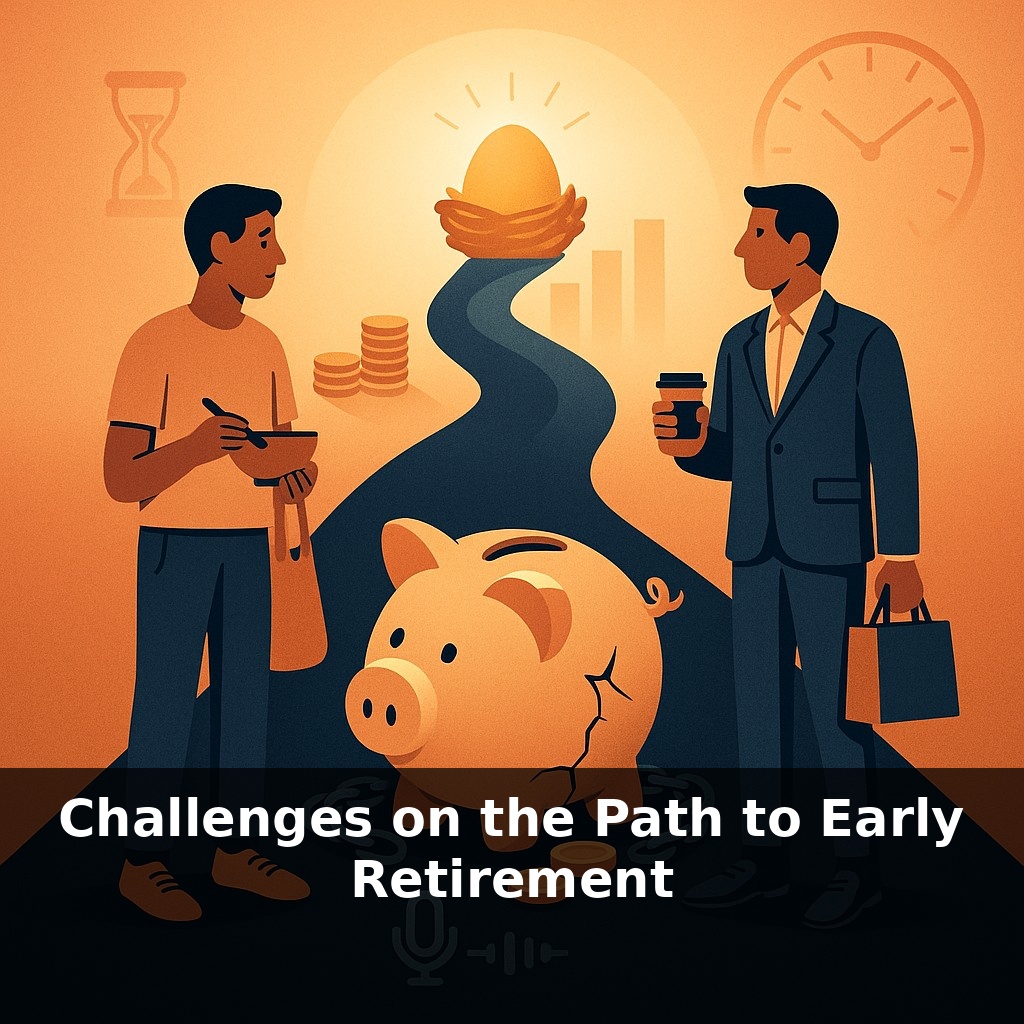
About half of Americans have less than a thousand dollars easily available—yet some plan to stop working decades early. One person eats rice and beans to save; another earns a high salary but spends freely. Both want FIRE. The twist is, their biggest obstacles aren’t where most people think.
Most people think the hardest part of early retirement is “just saving more.” Yet the data tells a harsher story: the average American saves barely a sliver of their income, while successful early retirees often save half or more for years. That’s not just skipping lattes; it’s reshaping an entire life. On top of that, markets don’t move in straight lines, medical costs keep rising, and tax rules shift like traffic patterns at rush hour. Your plan has to work not just on a spreadsheet, but in the messy real world where recessions hit, kids arrive, parents need help, and motivation fades. In this episode, we’ll unpack the specific bottlenecks that most often derail early-retirement plans—portfolio size, market risk, healthcare, lifestyle strain, and identity shifts—and we’ll look at how real people have adapted when their perfectly crafted plans met reality.
So where do people actually get stuck? Not usually on the dream itself, but in the friction between numbers and real life. A spreadsheet assumes you’ll save the same amount every month, earn tidy returns, and glide into a low-cost future. Real life throws layoffs, sick kids, surprise relocations, and aging parents into the mix. The math is still essential, but it becomes more like GPS than a strict script: you set a destination, then keep rerouting as traffic, roadblocks, and new shortcuts appear. In the next sections, we’ll zoom into those bottlenecks and how to navigate them in motion.
“Save half your income and you’re set” sounds clean—until you realize you also need to build an engine that keeps running through recessions, policy changes, and your own shifting priorities.
The first choke point is sheer portfolio size. With more conservative withdrawal assumptions (3–3.5 % for long horizons), a $40,000 annual spending target implies something closer to $1.2–1.4 million, not $1 million. Many people discover that “their number” quietly inflates as they add kids, housing goals, or geographic preferences. The practical shift is from aiming at one static target to aiming at ranges: a “lean” number, a “comfortable” number, and a “luxury” number, each tied to concrete spending levels and trade-offs.
Then comes the problem of *when* returns show up. A portfolio that averages 7 % over 40 years can still fail if the ugly years cluster right after you quit. That’s why experienced planners obsess over the first decade of withdrawals. Common defenses: holding 2–5 years of essential expenses in safer assets; building flexible expenses you can trim 10–20 % in bad markets; and lining up at least one income stream that isn’t tightly linked to stocks—such as a rental, royalties, or part-time work you can scale up temporarily.
Healthcare adds another moving part. Between 45 and 64, insurance costs can rival a small mortgage. People who succeed here usually design a specific bridge strategy instead of “I’ll figure it out later”: deliberately keeping taxable income low to maximize ACA subsidies, choosing locations with strong insurance markets, or structuring work so an employer plan covers the riskiest years.
The emotional grind is quieter but just as real. A 60 % savings rate can feel heroic at first and suffocating three years in. People who stick with it rarely rely on raw willpower. They redesign their environment: smaller homes closer to work, social circles that normalize frugality, hobbies that are cheap by default. They also pre-plan “relief valves”: modest upgrades or mini-sabbaticals triggered when key milestones are hit, so the journey doesn’t become an all-or-nothing slog.
Finally, there’s the transition from earning to autonomy. Many early retirees underestimate how much structure and social contact their job provided. The more thoughtful ones prototype their post-work life well before their financial date—blocking “pretend” free days, testing projects, and noticing what actually feels energizing rather than idealized on paper.
Your challenge this week: pick one bottleneck that feels most threatening—portfolio size, early bad markets, healthcare between 45–64, motivation during high-savings years, or post-work purpose. Then design a *stress test* around it. For example: - Portfolio size: model your plan with a 3 % withdrawal rate instead of 4 %. - Early bad markets: cut your assumed first-10-years returns by half and see what breaks. - Healthcare: pull quotes for an ACA silver plan at your target retirement age. - Motivation: try a “mini-FIRE month” with your ideal future budget and track what feels tight. - Purpose: schedule one full “unstructured Saturday” and observe how you actually spend it.
By next episode, you’ll know which part of your plan is most fragile—and therefore where the biggest upside lies if you shore it up.
A useful way to explore these bottlenecks is to run “what if” micro-scenarios, the way a chef tests a recipe by altering one ingredient at a time. Take someone like Maya, 38, who wants to leave her tech job at 48. Instead of obsessing over a single “number,” she drafts three menus of her future life: a bare-bones version with house-hacking and public libraries as her main “luxuries,” a middle path with one big trip a year, and a splurge tier with frequent travel and boutique fitness. Each menu gets a price tag, then she reverse-engineers how much she’d need to invest for each.
Or consider Julian, who’s nervous about sequence risk but doesn’t want to hoard cash forever. He sets a rule: when stocks fall 20 %, he automatically offers more consulting hours, like turning on a backup generator during a brownout. When markets recover, he dials that work back down.
You can run similar experiments now, at small scale: one quarter on a “lean” budget, one quarter where you test a passion project as income, one quarter focused on building social structure outside work.
Longer lives and shakier careers mean “done working at 45” may morph into several phases: intense earning, semi-retirement, sabbaticals, and late-career reinvention. Think of it less as an exit date and more as a series of checkpoints where you can renegotiate how much you work, what you earn, and how you live. AI may compress some careers but also spawn niche, part-time roles that fit a flexible plan, like side quests that refill your health bar when markets or health waver.
Treat this path as ongoing R&D, not a single launch. Your plan will get patched like software: new features (kids, passions), surprise bugs (policy shifts), and version upgrades as you grow. The skill that matters most isn’t predicting every risk—it’s staying curious enough to keep iterating, even when the roadmap keeps changing.
Try this experiment: For the next 7 days, live on your actual target early-retirement budget by only spending what you *would* allow yourself once you’ve left your job (same housing, but adjust eating out, subscriptions, travel, and “treat” spending to your future target). Each day, log exactly what felt easy to cut, what felt painful, and any social or emotional friction (like saying no to invites or skipping convenience purchases). At the end of the week, compare your real spending to your target and decide on one permanent “friction fix” (e.g., canceling a subscription, batching social plans at home, or meal-prepping twice a week) that makes the early-retirement budget feel more natural instead of like deprivation.