The Faces of Inequality: A Day in the Life
📝 Transcript
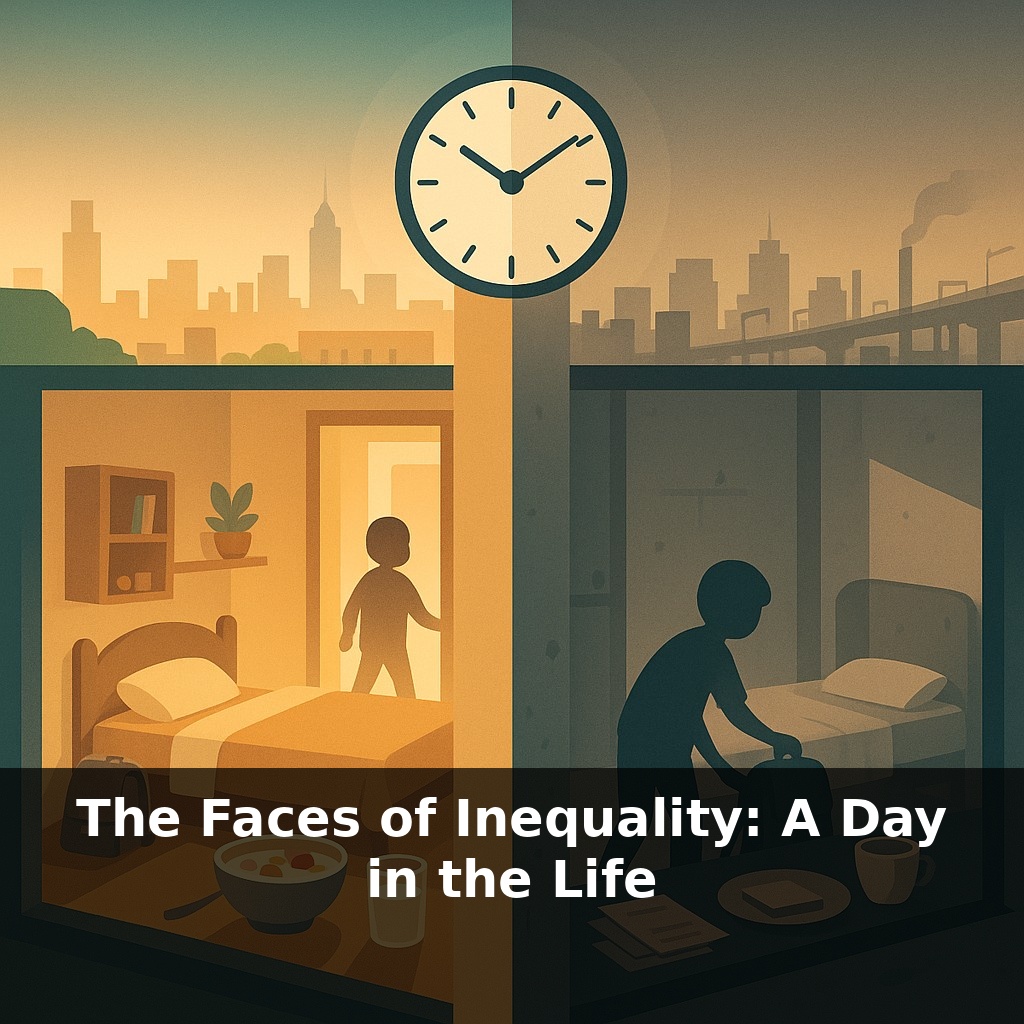
A child’s life expectancy can drop by nearly 20 years just by crossing an invisible line between neighborhoods. This episode steps into one morning routine—same city, same hour, wildly different lives—to ask: when the clock strikes 7 a.m., whose day truly has a chance?
By noon, those invisible lines have already shaped hours of someone’s day: the air they’ve breathed, the food they’ve skipped or eaten, the stress simmering in the background. Inequality shows up not just in paychecks, but in how long a bus ride steals from homework time, how many jobs a parent must juggle, and whether the school nurse is there five days a week or only on Tuesdays. It’s in the cracked sidewalks that slow a wheelchair, the grocery store that moved away years ago, and the constant calculation of “can we afford this?” while others ask only “do we want this?” Think of a city as a patchwork quilt: some squares thick and warm, others threadbare and full of holes. In this episode, we’ll walk through one ordinary weekday, hour by hour, to see how those stitches hold some people—and let others slip through.
As our weekday unfolds, those quiet gaps scale up into something massive. The richest 10% now hold about three-quarters of global wealth, and that concentration doesn’t just sit in bank accounts; it decides who lives near a factory fence and who lives near a park, whose school cuts art and whose builds a robotics lab. Some kids grow up counting bus transfers, others count frequent-flyer miles. One family’s “emergency fund” is another family’s overdue bill notice. A bit like software updates rolling out unevenly, advantages install early for some, while others are stuck running an old version the world no longer supports.
By mid-morning, the gap in two people’s days often shows up as something deceptively simple: time. One parent is stuck on a bus that stops every few blocks; another taps a key fob and drives a 15‑minute route with reserved parking. That extra 40 minutes, every weekday, quietly adds up to weeks each year—weeks that can be spent on test prep, sleep, exercise, or a second job. Time, in that sense, works like compound interest: small differences, relentlessly repeated, grow into chasms.
Inside schools, the contrasts layer on. In one building, students switch on aging desktops and share tattered textbooks; in another, each child has a tablet, coding club, and a college counselor who knows their name. The numbers behind this are stark but often invisible in the hallway chatter: per‑student spending, class sizes, how many advanced courses are even offered. A child’s curiosity might be the same in both classrooms; what differs is how far that curiosity is allowed to travel.
Lunchtime draws another line. Some teens choose between sushi and salad; others stretch a free meal to cover what might be their most substantial food of the day. Nutrition shows up years later as diabetes rates, attention spans, and absences marked “sick.” For a student worrying about whether there’ll be dinner, homework competes with hunger and stress for mental bandwidth.
Step outside and the air itself can be part of the story. Proximity to highways, factories, or ports tracks closely with lower incomes and, often, with race. One child grows up under flight paths and beside diesel trucks, another beside tree‑lined bike lanes. Asthma inhalers in tiny backpacks are not random; they’re receipts from decades of planning decisions.
Access to the digital world splits the afternoon again. With only 54% of rural households online compared with 84% in urban areas, a simple homework assignment that assumes high‑speed internet becomes a sorting mechanism. One teenager logs onto a video lecture at home; another leans against the wall of a fast‑food restaurant for Wi‑Fi, hoping the battery—and the manager’s patience—lasts.
Layer in gender, and unpaid care work quietly rearranges the clock. Women and girls patch together cooking, cleaning, and caregiving around paid work or school. A brother might head to after‑school sports while his sister rushes home to watch younger siblings, her extracurriculars permanently “postponed.”
By late afternoon, the gap shows up in bodies: whose back aches from warehouse shifts, who sits all day at a screen, who can afford a physio when the pain starts. The same twinge in a knee leads one person to a specialist appointment and another to a search bar and a discount pharmacy line. In the U.S., your job type strongly predicts not only your income, but your rate of workplace injury and even how often someone checks the fire alarms where you work.
Even rest follows those invisible lines. One teenager falls asleep in a quiet bedroom, devices charged, homework done on a steady connection. Another dozes off on a couch in a shared room, phone battery dead, setting an alarm early to finish assignments at school before the bell. Sleep isn’t just about discipline; it’s about how many people share your space, how loud your street is, and whether stress lets your mind ever fully power down. Over years, those nights trace different futures in health charts and report cards long before anyone calls it “unfair.”
Algorithms, hiring software, even map apps can quietly freeze these daily gaps into tomorrow’s reality. If search results for “jobs near me” never show certain neighborhoods, or internships circulate only in private group chats, whole paths stay invisible. Like a navigation system that defaults to toll roads, our tools can steer advantage along the same narrow corridors—unless we choose to rewrite the routes, widen the roads, and question who sets the destination.
Each choice we make about bus routes, clinic hours, data plans, or park benches quietly redraws those invisible lines. Change rarely arrives as a grand speech; it’s closer to updates in a city’s operating system—small code tweaks in policy, budgets, and habits that, over time, shift who gets error messages and who finally runs without crashing.
Try this experiment: Tomorrow, shadow your own day the way the podcast shadowed Amina’s and Jorge’s—set a timer for three moments: your commute, your lunch break, and your evening errand (like grocery shopping). At each moment, deliberately choose the most “inequality-exposing” option available: take the bus instead of driving, eat where the cafeteria workers or cleaners eat, and shop at the lowest-cost store in your area. While you’re there, quietly count and compare: How long are people waiting? Who’s doing what kind of work? What choices are available or missing? By the end of the day, you’ll have your own “faces of inequality” map of your city—and a clearer sense of where your voice, money, or time could actually shift something.
From this course
The Lives Behind Numbers: Human Stories of Inequality
5 episodesUnlock all episodes
Full access to 5 episodes and everything on OwlUp.
Subscribe — $1.99/monthLess than a coffee ☕ · Cancel anytime