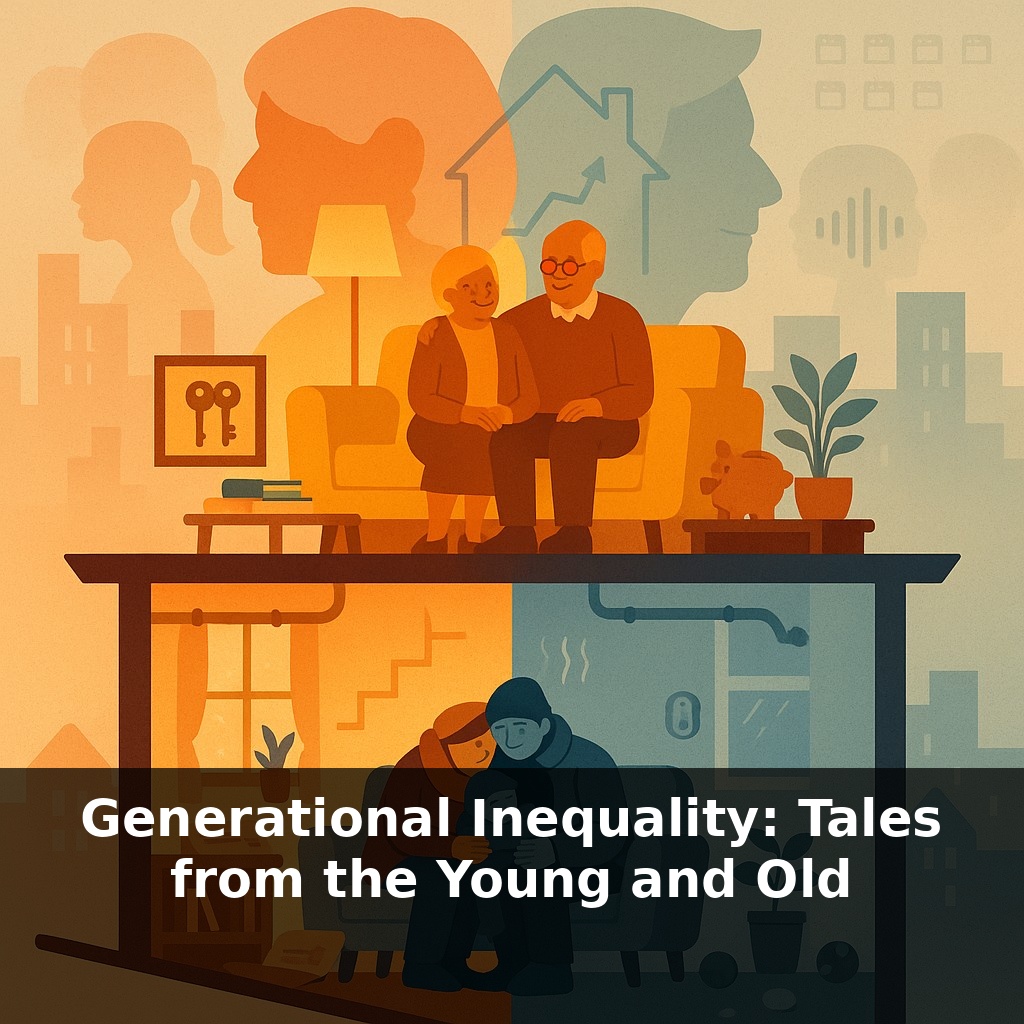
A couple in their seventies pays off their home, plans cruises, and helps with grandkids’ tuition. Two floors below, a young family skips the heating bill to cover childcare and rent. Both work hard. Here’s the puzzle: how can effort be constant, but security so uneven by age?
The numbers behind that puzzle tell a quieter, stranger story than simple “hard work pays off.” Over the last four decades, rules have been rewritten mid-game. Housing shifted from being a place to live into a primary investment vehicle. Degrees that once opened stable careers now often come bundled with decades of debt. Meanwhile, people live longer, but many jobs still behave as if careers stop at 60, shunting older workers aside just as savings need to last further. Tax codes reward some forms of wealth more gently than others; pension promises tighten for newcomers while remaining generous for those already inside. The outcome isn’t a single villain or a single bad choice, but a stack of small policy levers quietly nudging different age groups onto diverging tracks, even when they share the same street, family name, or office corridor.
Step back and the pattern widens. Age isn’t a destiny, but it increasingly behaves like a postcode for opportunity: it predicts who rents from whom, who pays interest and who earns it, whose taxes fund promises they’ll never receive on the same terms. Two people born in different decades can share a workplace yet inhabit different financial worlds: one stacking assets, another juggling obligations. And it’s not only about money. Expectations diverge too—around when it’s “normal” to move out, to retire, to start a family, to take risks. Policy sets the stage, but culture quietly scripts who feels late, lucky, or left behind.
Listen closely in mixed-age groups and you’ll hear the gap in the verbs people use. Many in their sixties and seventies talk about “preserving” or “managing” what they have. People in their twenties and thirties talk about “catching up” or “getting a foothold.” That difference in language traces back to concrete shifts in how life stages line up with money, risk, and time.
For those who started work in the 1970s and 80s, the typical path ran in a relatively straight line: leave school, find a job that trained you up, watch wages and seniority grow, buy a modest home at a low multiple of your salary, then let inflation quietly erode your mortgage while boosting the value of what you owned. Even when incomes weren’t high, the sequence itself was predictable enough that many could plan around it.
Today, the sequence is scrambled. Education stretches further into the twenties; earnings often zigzag through internships, contracts, and side gigs; relationships and families start later; home-buying can slip into the forties, if it happens at all. Instead of moving along one long escalator, younger workers hop between short staircases, each with a different slope and different rules. Any pause—illness, caring for parents, a failed business—costs more when there’s no steady platform beneath you.
At the other end of the age spectrum, longer lives should be a dividend, but they arrive with arithmetic that doesn’t quite add up. Retiring at 65 with savings built for 15–20 years looks very different if you live to 90 and spend long stretches outside the labour market. People who fell through earlier cracks—informal work, career breaks, low wages—see those gaps magnified when every missing contribution compounds over decades.
Policy and markets then sort people within each generation. A millennial who entered finance in 2010 and bought an apartment with parental help lives in another universe from a peer who started in hospitality the same year and rents in a city with weak tenant protections. Among older adults, a retired teacher with a defined benefit pension enjoys a stability that a self-employed cleaner of the same age, in the same town, never touches.
These are not just snapshots of who is “ahead” or “behind.” They’re stories about how shock-absorbers are distributed: who has buffers—family wealth, stable benefits, forgiving institutions—and who meets each bump with bare suspension.
Take a single apartment block. On the top floor, a retired nurse in her late sixties rents out the spare room on a short‑stay platform. The income tops up a modest pension and pays for a new boiler. On the ground floor, a 27‑year‑old delivery driver lives three to a flat, cycling late shifts to cover rising rents and an auto‑enrolment pension that feels too abstract to matter. Neither person is “the system”; both are adapting to rules they didn’t write.
Or look at a family business where the founder bought the shop outright decades ago. Their daughter, now in her thirties, keeps the business alive by adding online sales and juggling childcare costs. When profits dip, the parent can fall back on a paid‑off property; the daughter falls back on a credit card.
Across countries, these micro‑stories rhyme: seniors renting rooms to students whose loans fund the very rooms, grandparents gifting deposits in markets their own children could never enter alone, early retirees consulting part‑time while graduates rotate through unpaid “experience.”
Some effects arrive sideways. Rising rents reshape dating choices; delayed parenthood alters school rolls; heavier support for parents squeezes time for friendships. Workplaces mix interns using food banks with managers planning second homes, shifting office politics. Politically, parties quietly track who turns out to vote: if older voices stay louder at the ballot box, budgets may tilt further their way, nudging young adults to view institutions less as ladders and more as locked doors.
Across countries, small experiments are emerging: youth councils with real budget power, citizen assemblies mixing retirees and students, apprenticeships that pair older workers’ tacit know‑how with younger workers’ digital fluency. Your challenge this week: ask one person at least 25 years older or younger how today’s rules feel from their side.