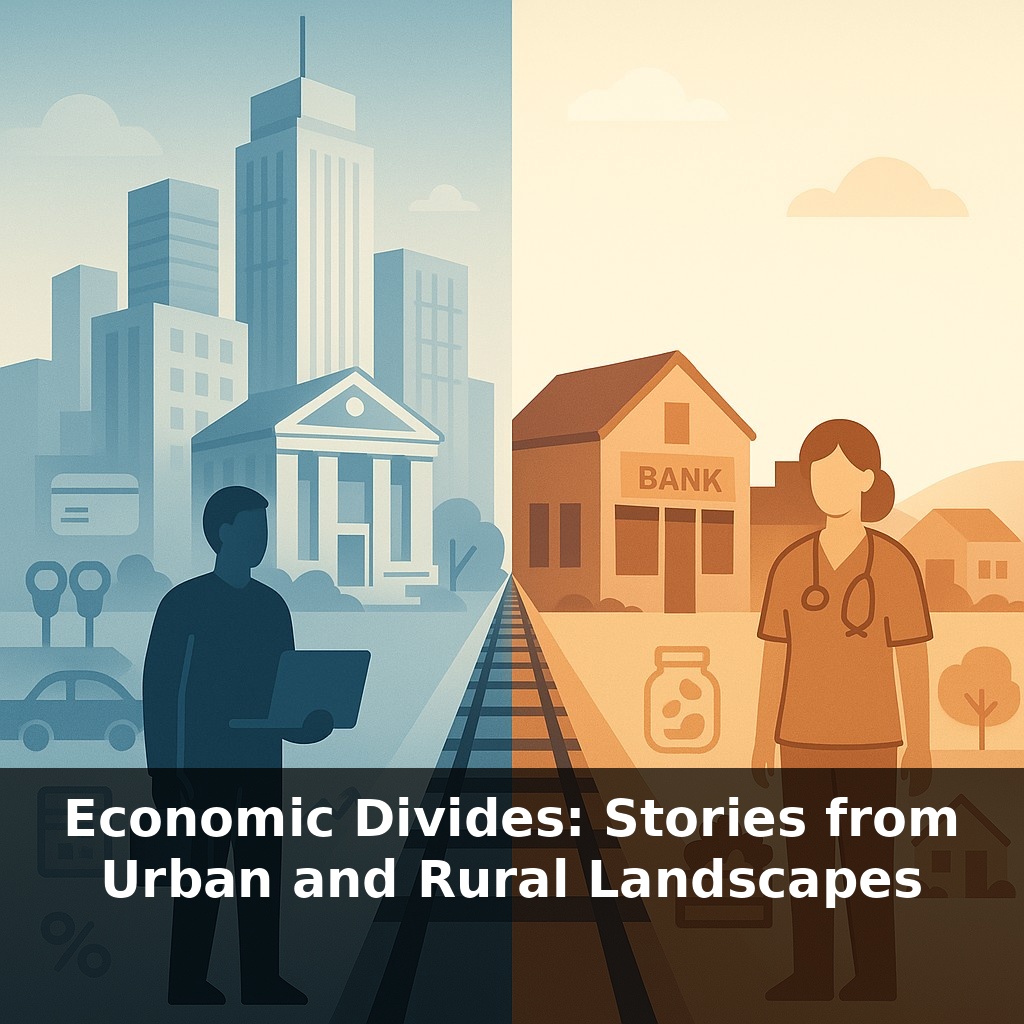
Right now, in the same country, one worker spends more on parking than another spends on rent. A short train ride separates a skyline of glass towers from a town where the only bank just closed. Both places drive the economy—yet they barely speak the same financial language.
The numbers say “urban rich, rural poor,” but lived reality scrambles that script. A nurse in a shrinking farm town might own her home outright while a software engineer downtown counts every paycheck to survive the rent. A rural mechanic may trade skills like favors, while a city freelancer juggles three apps just to find the next gig.
What rarely shows up in charts is how place decides the *texture* of a life: whether the nearest hospital is two blocks or two hours away; whether a layoff means three new openings across town or a one-way ticket out; whether slow internet is an annoyance or a locked door to higher-paying work.
As we follow stories across highways and cornfields, subways and cul-de-sacs, we’ll trace not just who has more—but who has options, buffers, and ways back when things go wrong.
A single statistic hides a lot of crossed wires: urban counties generate most of the nation’s output, yet some of the lowest “on-paper” incomes sit in rural zip codes where debt is rare and food comes from next door. To understand that, we have to zoom in on the systems wrapped around people: the bus lines that decide who can take a night shift, the school budget that shapes which math class even exists, the cell tower that makes or breaks remote work. Think of these as invisible scaffolding—quiet structures that either hold people up or quietly limit how high they can climb.
Walk down a downtown block at 8 a.m. and you can *hear* agglomeration economics at work: coffee shops rushing orders to office workers, delivery vans double-parked, construction crews wedged between towers. Each business feeds off the others’ presence—shorter distances, faster deals, more chances to bump into opportunity. That density draws in investors, transit lines, even experimental clinics and schools. When policymakers talk about “growth hubs,” this is what they’re quietly betting on: stack enough activity in one place, and the whole pile becomes more than the sum of its parts.
Now trace a two-lane highway into a town where the tallest building is the grain elevator. The work here might center on a single plant, a regional hospital, a mine, or the seasonal rhythm of harvests. When one employer trims shifts, it’s not just lost wages; it’s fewer lunches at the diner, fewer donations to the high school, fewer customers for the mechanic. The economic web is thinner, so every cut travels further. That’s part of why a rural hospital closure doesn’t only change medical access; it rewires the whole local job market and confidence about the future.
Technology can stretch these worlds closer together—but only if several pieces click at once. A stable broadband line might let a rural accountant serve clients three states away, or a city-based therapist offer telehealth to farming communities. Yet without affordable devices, quiet space, childcare, and the skills to navigate online platforms, that same connection becomes another source of frustration: a loading bar that never quite finishes.
Policy choices layer on top of all this. Tax breaks that reward building in already-thriving districts, transit budgets tilted toward commuter rail instead of regional buses, university extensions located just beyond the reach of a rural student’s car—all nudge talent and capital along familiar grooves. Over years, those grooves harden into expectations: “real careers are in the city,” “small towns are just for starting out or winding down.” Breaking that pattern requires more than a single new factory or co-working space; it means rewriting the map of where it feels realistic to build a life.
A grocery chain planning new stores captures the gap in miniature. In a dense neighborhood, one location can draw walkers, bus riders, and office workers grabbing lunch. The same chain eyeing a county with one stoplight has to bet on whether enough customers will drive forty minutes each way. If they say no, prices at the lone independent shop stay high, and residents quietly pay a “distance tax” in time and fuel.
On the flip side, a rural metalworker selling custom parts online may skip the storefront entirely, shipping to cities they’ll never visit. Their workshop might sit beside a barn, but their customer base looks like an airport departures board.
Think of opportunity like cell phone signal strength: strong in dense cores, flickering at the edges unless someone installs boosters—broadband, shared work hubs, mobile clinics. Those boosters don’t just raise incomes; they change daily decisions, like whether a teenager believes an advanced class, or a remote job, is meant for someone “from here.”
Remote work, green energy, and AI services won’t land on an empty map; they’ll redraw it. A wind farm deal can turn a quiet ridgeline into a negotiation table where locals, investors, and schools haggle over whose future gets funded. Tele-education might let a kid in a one-stoplight town join a robotics team across the country. The real test won’t be the tech itself, but who gets to steer it—and whether staying put can finally mean moving up.
Conclusion The next chapter in this divide may be written less by skylines and cornfields, and more by unlikely partnerships: city coders testing apps with farm co‑ops, small‑town nurses training via urban teaching hospitals, local libraries doubling as Zoom offices and loaner‑laptop banks. The map doesn’t vanish—but its borders can blur in ways the numbers still can’t see.
Try this experiment: This week, spend $20 you’d normally use at a national chain on two different purchases—one from a locally owned urban business (like a corner grocer, repair shop, or café) and one from a rural producer (like a farm stand, CSA box, or online co-op from a nearby town). Before you buy, ask each seller one question about how big-box or online retailers affect their income or hiring. Then, track exactly what you got for that $20 (quality, service, and how many people you interacted with) and compare the experiences. By the end of the week, decide one concrete way you’ll permanently shift at least $10/month toward whichever purchase felt like it more directly supported real people in your wider region.