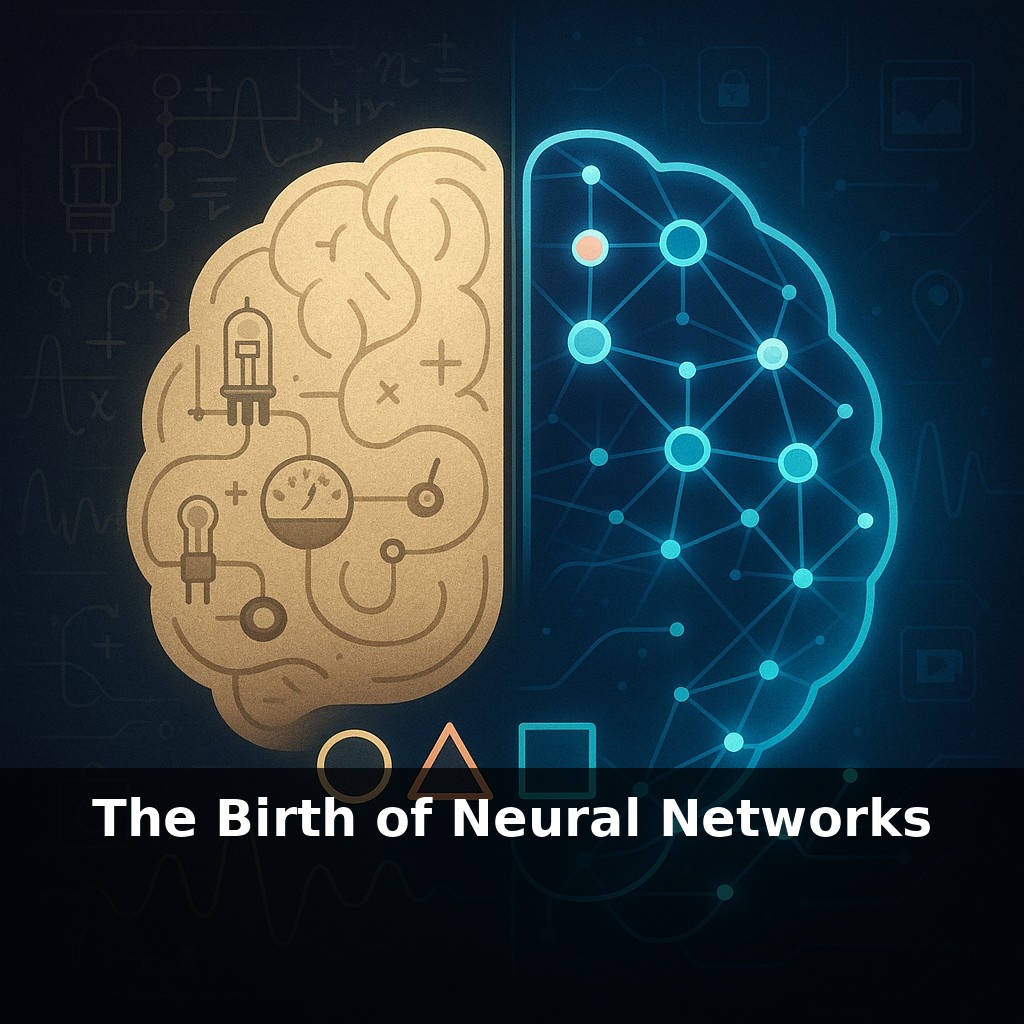
The Birth of Neural Networks
📝 Transcript
The first “artificial brain” cost more than a luxury car and could barely recognize simple shapes. Today, similar ideas quietly sort your photos, route your deliveries, even unlock your phone. How did a clunky, overhyped gadget become the engine of modern AI?
In the 1940s, a psychiatrist and a logician sketched a strange kind of “electrical algebra” on paper: tiny on/off units wired together that, in theory, could reason. This wasn’t a lab demo or a product pitch; it was closer to a thought experiment that escaped into engineering. Over the next two decades, those equations hardened into hardware—metal racks, whirring motors, banks of sensors—clumsy but ambitious attempts to make circuits behave less like calculators and more like nervous systems.
At first, funding agencies and the press treated these projects the way investors treat a hot new startup: bold promises, loose money, and very little patience. When early machines failed to deliver, support vanished, and the whole idea was written off as a dead end. Yet a handful of researchers kept tinkering in the background, quietly upgrading the original blueprint until it was ready to re-enter the spotlight.
Early prototypes were impressive mostly on paper. The real drama began when researchers tried to teach these systems to spot patterns in the messy outside world—letters on index cards, shapes on spinning drums, crude “eyes” squinting at the environment. Results were erratic: one day they’d recognize a triangle, the next day they’d fail on the same shape slightly tilted. Supporters saw growing pains; critics saw a flop. Meanwhile, other branches of AI were chasing crisp logic and hand-coded rules, more like writing legal contracts than nurturing something that could gradually learn from experience. The stage was set for a clash of philosophies.
The shift from clever diagrams to working machines began with a deceptively simple question: could a device *learn* from examples instead of explicit instructions?
Frank Rosenblatt’s answer in 1958 was the Perceptron—a machine that watched light patterns on 400 photocells and adjusted internal settings each time it made a mistake. Those settings were just numbers, but they could be nudged up or down after every training example. With enough nudging, the Perceptron could separate “yes” from “no” cases on its own, like drawing a line on a scatter plot to divide dots into two camps.
This was radical because it promised automation of something programmers were struggling with: hand-crafting rules for every situation. Instead of writing “if it’s curved like this, and bright like that, then it’s a letter A,” you could show the machine many A’s and many not-A’s and let it discover its own internal rule. For a while, that felt like magic—and funders behaved accordingly. The U.S. Navy poured money into Perceptron Mark I, a room-filling device whose price tag rivaled high-end lab equipment.
But that straight-line trick hid a weakness. Some problems can’t be cleanly split by any single boundary, no matter how you tilt it. The classic example is XOR, a tiny logical puzzle that refuses to be sorted by one neat divide. Marvin Minsky and Seymour Papert didn’t just point this out; they formalized the limits. A single Perceptron, they showed, was fundamentally incapable of handling whole classes of realistic tasks.
Their critique landed hard. If the flagship “learning machine” couldn’t tackle such basic cases, why keep pouring money into the approach? Funding agencies pivoted to safer bets, and neural models slid from center stage to the margins. Hardware aged in basements; careers shifted direction.
Yet a stubborn question lingered: what if you stacked many simple units in layers, instead of relying on just one? On paper, multi-layer networks could, in principle, represent far more complicated boundaries, bending and folding the input space instead of slicing it once. The catch was brutal: nobody knew an efficient way to *train* all those layers together. Adjusting one layer at a time failed; error signals got lost or scrambled as they tried to flow backward through the stack.
For a while, that training problem looked like a brick wall, and neural networks were treated as an intriguing but impractical detour—a beautiful idea missing a crucial piece of machinery.
Think of the early researchers like ambitious chefs who’d inherited a mysterious recipe card: “Combine many tiny elements. Adjust after every taste. Eventually it will ‘know’ the flavor you want.” They had a list of ingredients—those simple units and tunable numbers—but no reliable method to season a *deep* stack of layers without ruining the dish halfway down.
Some tried hand-tuning: tweak a few parameters here, a few there, taste again. It was slow, unstable, and almost impossible to reproduce. Others simplified the menu, sticking to “shallow” networks they could actually train, even if it meant giving up on richer behaviors. Meanwhile, scattered hints appeared: algorithms in control theory that pushed errors backward through time, physicists studying how small adjustments ripple through large systems, cognitive scientists wondering whether the brain might be performing a similar kind of credit assignment.
These threads didn’t look connected—different fields, different jargon, different goals. But they were quietly circling the same missing tool.
Funding, fashion, and physics will likely keep reshaping neural networks. As chips shrink and data piles up, researchers are already testing brain-inspired hardware that sips power instead of gulping it, more like a solar calculator than a gaming rig. Others are stitching learning systems to symbolic tools, hoping for models that can both sense patterns and follow rules. The open question is not just what these hybrids can do, but who will control them—and to whose benefit.
Neural nets are still early in their story, more garage band than polished orchestra. Today’s systems can label photos or draft emails, but they still fumble at common sense and long-term planning. The next breakthroughs may look less like smarter gadgets and more like collaborations—models as lab partners, copilots, or editors that reshape how we think and work.
Start with this tiny habit: When you unlock your phone for the first time each day, whisper to yourself, “Perceptron, hidden layer, output,” and picture three dots in a row. Then, before you open any app, tap your screen three times—once for each “neuron”—as a reminder that even deep neural networks started from this simple layered idea. This tiny ritual will keep the core structure of neural networks fresh in your mind and make the history from the episode feel real and usable.
From this course
The Neural Network Mysteries: Under the Hood of AI
8 episodesUnlock all episodes
Full access to 8 episodes and everything on OwlUp.
Subscribe — $1.99/monthLess than a coffee ☕ · Cancel anytime

