Right now, an AI system can spot signs of breast cancer weeks before a human doctor—and another can predict the shape of nearly every known protein on Earth. Yet most of us walk past these neural networks every day, never realizing they’re quietly steering our lives.
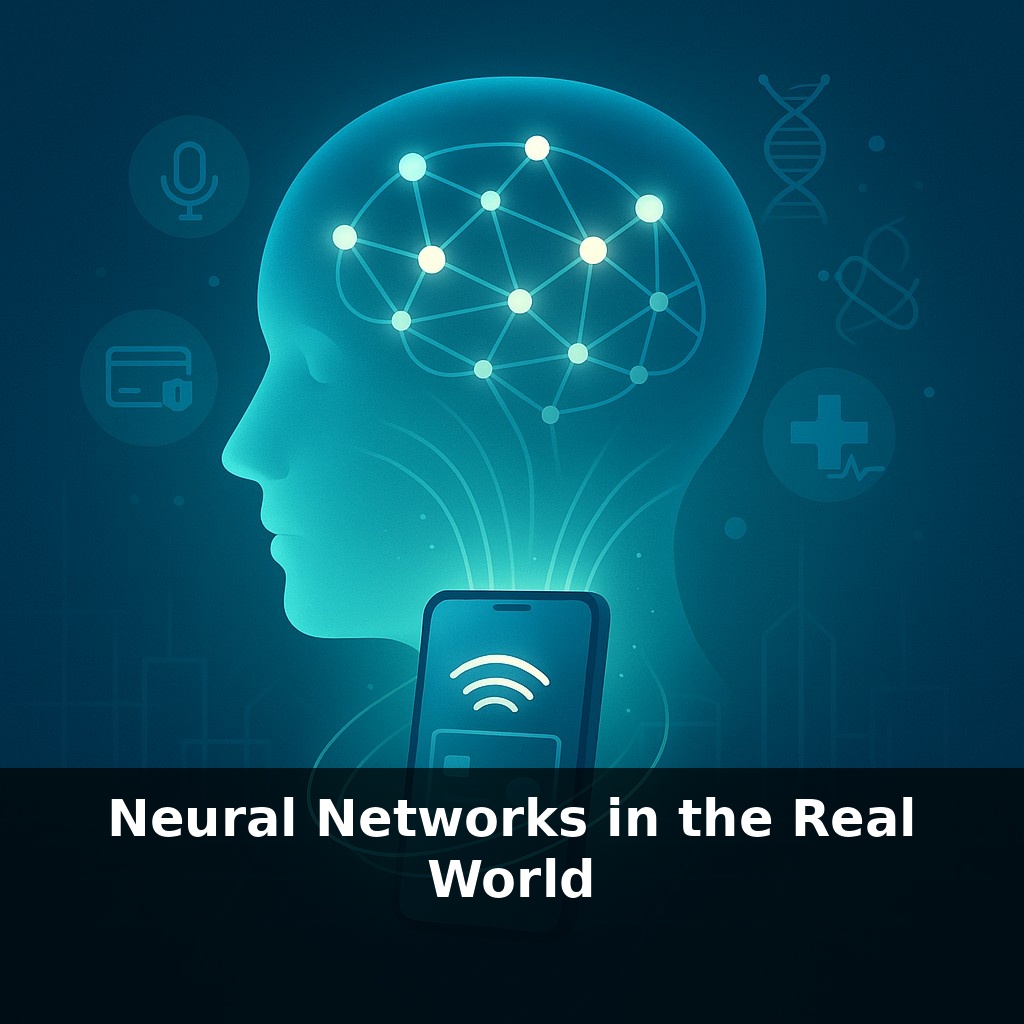
Every time you tap your phone to pay, ask a voice assistant for directions, or get a fraud alert from your bank before you even know your card is missing, there’s a good chance a neural network is working behind the scenes. These systems now sift through billions of transactions, medical images, and sensor readings in real time, ranking risks and recommending actions faster than any human team could manage. In hospitals, they quietly flag subtle patterns in scans; in cars, they fuse camera feeds and radar to keep lanes and avoid collisions; in research labs, they help chemists narrow millions of drug candidates to a promising handful. Training a neural network is like teaching a chef multiple recipes: with each batch of data, it refines its “taste” for patterns, until its split-second judgments start to reshape how entire industries operate.
Step back for a moment and widen the lens: those medical, financial, and automotive breakthroughs are just a sliver of where these models are showing up. Logistics companies lean on them to route delivery trucks like a perfectly choreographed dance, shaving minutes off millions of trips. Streaming platforms quietly reshuffle your home screen, nudging hidden gems to the surface. Even in agriculture, cameras on drones scan fields leaf by leaf, spotting stress before it becomes visible. What ties all this together is that once data exists in large enough volume, these systems start turning messy history into surprisingly useful foresight.
In medicine, those same pattern-hungry systems are starting to act less like sharp-eyed interns and more like tireless collaborators. Beyond radiology, hospitals use them to sift through vital signs, lab results, and notes to spot patients at risk of sepsis or sudden deterioration hours before the crash. In pathology labs, models analyze whole-slide images of tissue, flagging suspicious regions so specialists can focus on the hardest cases instead of getting buried under routine work.
Drug discovery is shifting, too. AlphaFold’s protein structures didn’t just solve an academic puzzle; they gave pharmaceutical teams a searchable atlas. Now, neural networks screen virtual molecules against those structures, scoring which ones might bind well enough to justify the costly jump into real-world experiments. That cuts months from the “guess and check” loop that once dominated early-stage research.
On the streets, automotive networks are growing from lane-keepers into full driving teammates. One set of models interprets the raw sensor feeds; another predicts what other road users will likely do next; yet another decides when to brake, swerve, or glide through a yellow light. Crucially, automakers retrain these systems not just on everyday driving but on the rare “long tail” events: odd construction patterns, half-faded road markings, or that cyclist who signals and then changes their mind.
In finance, card networks and banks lean on layered models: some watch for transaction-level anomalies (“why is this card buying luxury handbags three continents away?”), while others track relationships between accounts to spot fraud rings that no single suspicious purchase would reveal. The trick isn’t only catching more bad actors—it’s reducing the number of legitimate customers whose payments get blocked for no good reason.
Even your phone’s keyboard and voice assistant rely on constantly refreshed language models, tuned to new slang, products, and local quirks. Together, these systems form a kind of quiet, distributed infrastructure: always learning, rarely seen, but increasingly woven into how decisions—big and small—get made.
Walk through a modern airport and you’re passing a showcase of these systems at work. Security cameras don’t just record; they feed face-blur tools, passenger-flow analyzers, even models that spot abandoned bags faster than a human scanning a crowded monitor wall. At the gate, overbooking decisions increasingly come from models that juggle historic no‑show rates, weather patterns, and connecting flights to decide how many stand‑by passengers to clear without stranding anyone.
Retailers follow a similar playbook. Instead of simply counting how many jackets sold last winter, their models juggle online searches, social media buzz, and local weather forecasts to decide what to ship, where, and when. That same forecasting lets power grids guess when millions of EVs will plug in, or when solar output will dip behind a storm front, so they can spin up backup generation with fewer last‑minute scrambles.
Behind the scenes, even software development is changing: neural tools read through millions of code snippets to suggest fixes or tests, nudging teams toward cleaner, safer releases.
As these models spread, they start to feel less like tools and more like a kind of invisible public infrastructure. City planners already test traffic, zoning, and transit ideas in neural “sandboxes” before pouring a dollar of concrete. Climate teams mix satellite streams with decades of weather to pinpoint which neighborhoods will overheat first. In classrooms, adaptive tutors quietly reshape exercises, so each student’s path through algebra is as individual as a fingerprint.
As these models seep into daily routines, the real question shifts from “what can they do?” to “who decides where they point?” A network tuning traffic lights could just as easily tune loan approvals. Like a city’s zoning map, the choices about data, oversight, and access will quietly shape which futures get built—and which never leave the sketch.
To go deeper, here are 3 next steps: 1) Open a free Google Colab notebook and implement a tiny feedforward network using PyTorch on the UCI “Wine Quality” dataset, following along with the first two chapters of *Dive into Deep Learning* (d2l.ai). 2) Watch Andrej Karpathy’s “Neural Networks: Zero to Hero – Micrograd” video and literally clone the GitHub repo, step through the backprop code, and tweak one thing (e.g., number of layers) to see how it changes training curves. 3) Sign up for a free Hugging Face account, fork a simple vision or text model from the Hub (e.g., a small CNN for MNIST), and redeploy it using Hugging Face Spaces so you experience the full “model-in-the-real-world” pipeline the episode talked about.