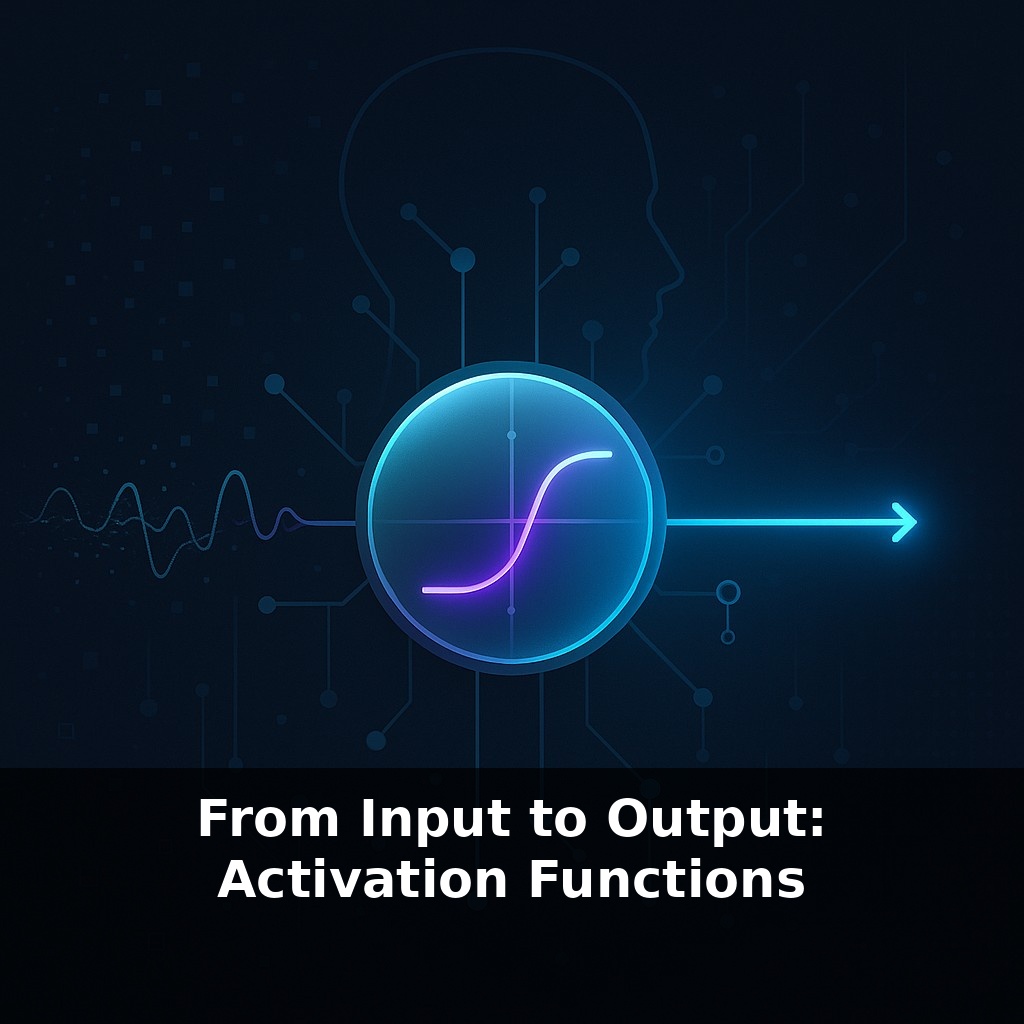
Your phone can recognize your face in under a second, yet the math inside each neuron is almost embarrassingly simple. Here’s the twist: the real magic isn’t in the calculation—it’s in a tiny decision at the end that says, “Does this signal matter enough to pass on?”
That tiny “does this signal matter?” moment is controlled by something deceptively humble: the activation function. Change it, and the *same* network can go from stuck and clueless to fast and accurate. In early neural nets, people favored smooth, biology‑inspired choices like sigmoid because they “looked right.” But the models were slow to train and often got lost in the math, unable to adjust their internal knobs in deep layers.
Modern systems take a more ruthless, engineering‑driven approach. Functions like ReLU simply zero‑out negative inputs, letting only the strongest evidence flow forward, which dramatically speeds up learning in deep vision models. Others, like GELU and Swish, add a subtle curve that helps large language models capture fine‑grained patterns in text. Swap one function for another, and you’re effectively changing how the entire network interprets every intermediate signal.
In real models, that “tiny decision” isn’t one-size-fits-all. A vision network might rely heavily on ReLU‑style behavior in early layers to quickly filter edges and textures, while later layers or language models lean on smoother choices like GELU to preserve subtler signals. Softmax sits at the very end, turning raw scores into a probability distribution so the network can “commit” to a class or a word. As architectures deepened, researchers discovered that some functions make gradients evaporate, while others keep learning alive even hundreds of layers down. That’s why newer designs often *mix* activations across different blocks.
Think of activation choices as a kind of “network personality test”: the math of the layers may be identical, but the way those layers *respond* to evidence can turn the same architecture into a cautious skeptic, a sharp minimalist, or a smooth negotiator.
Start with the older, smoother camp. Sigmoid and tanh didn’t just fall out of fashion because they’re slow; they quietly sabotage depth. Their derivatives shrink near the extremes, so by the time a corrective signal travels back through many layers, it can be so tiny that early weights barely move. Stack enough of these layers and the front of your model becomes almost frozen—technically trainable, practically inert.
Piece‑wise and learned activations attacked that problem head‑on. ReLU’s brutal “cut it off” attitude massively simplified the landscape that optimization algorithms navigate. But its hard zero created a new pathology: units that never revive once their inputs slip negative too often. Leaky variants, with their small negative slope, statistically rescue a big chunk of those units while keeping most of ReLU’s speed and simplicity. In large vision models, that small tweak alone has translated into more active features, better utilization of capacity, and measurable accuracy bumps.
In sequence models and transformers, the stakes are different. You’re not just detecting a cat; you’re juggling syntax, semantics, and long‑range dependencies. That’s where smoother activations like GELU shine. They don’t slam the door on weaker signals; they down‑weight them in a way that plays nicely with residual connections and layer normalization. Empirically, that subtlety shows up as higher benchmark scores and more stable training at scale.
The choice isn’t purely empirical, though. It also interacts with initialization, depth, and even hardware. Functions with simple formulas can be fused and vectorized aggressively on GPUs and TPUs, shaving milliseconds off each step—multiplying into hours saved on large runs. Others, like Swish or GELU, are slightly more expensive per call but can reduce the number of steps needed to reach the same loss.
Your challenge this week: open one open‑source model you use or care about—maybe a vision backbone, a transformer, or a small classifier. Scan its config or code and list every activation it uses, layer by layer. Then, for exactly one of them, run a tiny experiment: swap it for a plausible alternative (ReLU → Leaky‑ReLU, ReLU → GELU, or GELU → ReLU in a non‑NLP setting) and train on a *small* subset of data. Compare three things only: training speed per epoch, validation accuracy after a fixed number of epochs, and how spiky or smooth the loss curve looks. Don’t chase the best score; you’re probing the network’s personality shift.
Consider three concrete “activation personalities” in the wild. In AlexNet‑style vision models, you’ll often see pure ReLU packed after almost every convolution; in practice, that choice helped early CNNs jump from “toy demo” to ImageNet‑scale workhorses by making training feasible on 2012‑era GPUs. In contrast, modern recommendation systems at large streaming platforms sometimes favor leaky variants or even parametric ReLUs in their dense towers, because user‑behavior features can be noisy and skewed—preserving a trickle of negative evidence turns out to stabilize ranking scores and reduce bizarre edge‑case suggestions.
In large language models, GELU tends to appear inside feed‑forward blocks while the output head leans on a familiar final transform. That split lets the middle of the network stay nuanced about token interactions, while the last layer focuses on making a sharp, usable choice that downstream systems—search, chat, or code completion—can treat as a clear signal rather than a vague hunch.
Soon, picking an activation may feel less like choosing a formula and more like tuning a soundboard. AutoML systems are starting to search over entire *families* of shapes, nudging curves to match each layer’s role—like a mastering engineer sculpting bass, mids, and treble. On-device models will push this further: phone chips might favor functions that minimize energy spikes, while datacenter accelerators co-design custom activations that squeeze every FLOP, reshaping what “efficient” even means.
In the next decade, expect “off‑the‑shelf” activations to give way to layer‑specific, data‑aware ones that evolve during training—more like adaptive noise‑cancelling headphones than fixed presets. As hardware, search, and theory co‑design these shapes, choosing an activation will feel less like a guess and more like dialing in a house style for your models.
Start with this tiny habit: When you open your laptop to code or study, whisper to yourself, “What’s my activation function?” and pick *one* (sigmoid, ReLU, or tanh) to focus on for just 2 minutes. In those 2 minutes, look at a single neuron in your notes or code and quickly say out loud what that activation does: “ReLU: zero for negatives, linear for positives,” or “Sigmoid: squashes to 0–1.” If you’re already in code, change the activation of just *one* layer (e.g., swap sigmoid for ReLU) and save it as a separate file—no need to run or train anything yet.