Right now, as you listen, your attention is jumping around several times a second—fast enough that you never notice the gaps. Yet a single notification, a stray thought, can hijack that system. In this episode, we’ll explore who’s really steering your focus—and how much control you have.
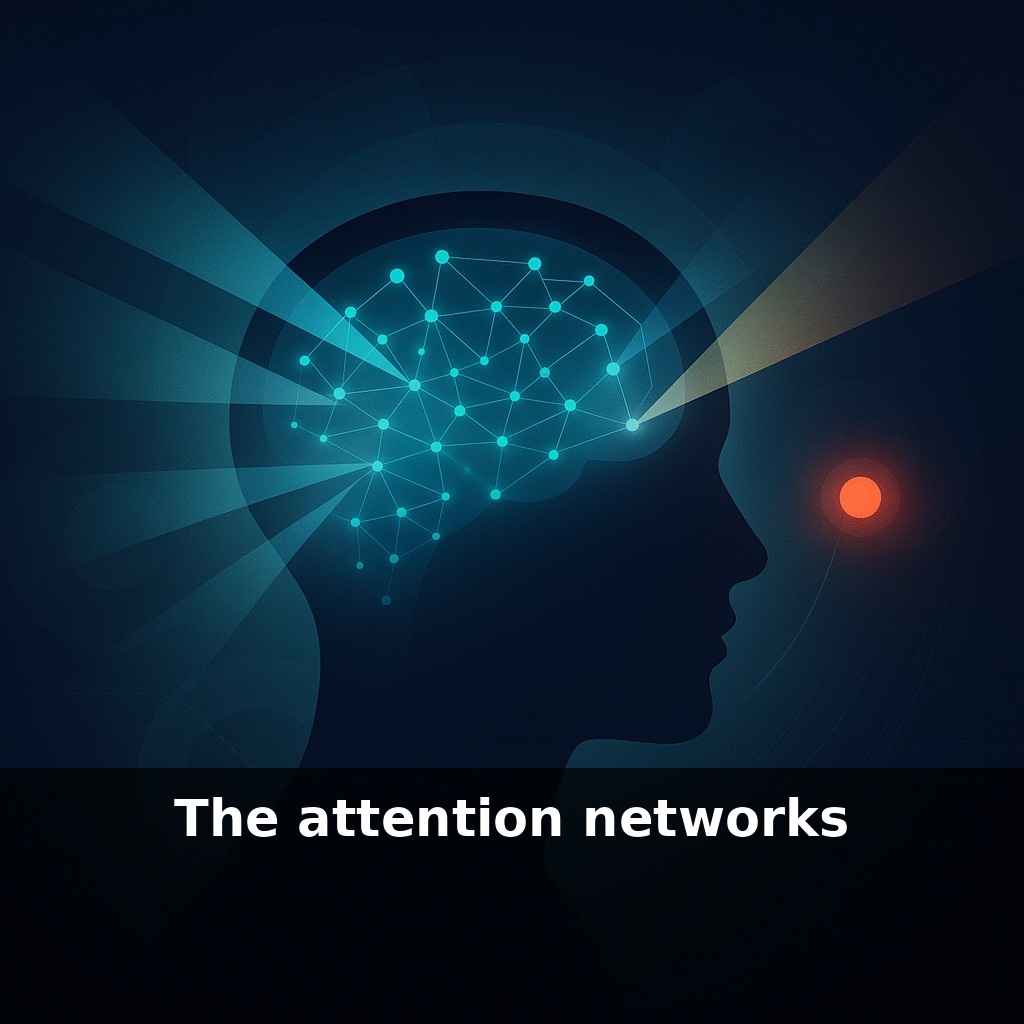
Your brain isn’t running one single “concentration mode”; it’s juggling a small cast of specialized systems that keep taking turns in charge. One ramps up your overall readiness so you don’t miss something crucial on the edge of awareness. Another quietly redirects your sensory resources when a faint sound, a change in brightness, or your name in a noisy room appears. A third steps in when there’s a clash—between a long‑term goal and a tempting shortcut, between what you meant to do and what grabbed you.
These systems aren’t polite; they interrupt, override, and negotiate with each other in milliseconds. That constant tug‑of‑war shapes what you notice, what you ignore, and which plans survive contact with real life. In this episode, we’ll zoom in on those networks, look at how small changes in routine or technology can tilt the balance between them, and ask: which ones are you unconsciously training every day?
Those networks don’t just react to the world; they’re constantly being tuned by what you do, what you feel, and even what you expect will happen next. Open your inbox and your brain quickly learns that stray pings might be “urgent,” nudging the alerting system to sit on a hair‑trigger. Scroll a fast social feed and you reward rapid shifts, not depth. Over time, your setup of apps, sounds, and habits becomes a kind of personalized training ground, biasing which signals get promoted and which never make it past the first filter. Technology isn’t just using your attention—it’s helping wire how it operates.
The alerting, orienting and executive systems don’t live in single “attention centers”; they’re spread across hubs that talk in fast loops. In EEG, researchers see the average person’s focus configuration flip 4–6 times per second—like rapid scene cuts in a film. Most of the time, you only notice the rare “glitch”: blanking on a word, opening a tab and forgetting why, missing a turn you’ve taken a hundred times.
One key player you almost never feel directly is the locus coeruleus, a tiny brainstem nucleus that sprays norepinephrine across the cortex. When it fires a brief burst—often under 300 milliseconds—it temporarily boosts the signal‑to‑noise ratio of whatever’s already active. That means your current goal, or the sound you’re half‑listening for, suddenly gets more bandwidth than the background. A single notification, a subtle anxiety spike, or the thrill of “something new” can all trigger that same chemistry.
The executive side leans heavily on regions like the anterior cingulate cortex (ACC). In conflict-heavy situations—resisting a clickbait headline while trying to finish a report, for instance—the ACC ramps up. In one study, just five days of brief mindfulness practice made this region about 27% more efficient on fMRI: less metabolic cost for the same level of control. That suggests you’re not stuck with a fixed attention profile; you’re running a system that can be conditioned, for better or worse, in surprisingly short windows.
Now layer in individual differences. In ADHD, roughly 5% of children worldwide show reliable under‑activation in parts of this control network. It’s not simply “low willpower”; it’s a different baseline architecture for handling conflict and staying on script. High-stimulation apps, constant novelty, and chaotic notification streams don’t just feel distracting here—they align almost perfectly with the brain’s bias toward quick shifts and immediate rewards.
Technology choices plug into all of this. A quiet, sparse interface gently favors sustained executive control. A screen filled with motion, badges, and alerts repeatedly recruits the alerting system and tugs the orienting system toward whatever is most salient, not most meaningful. Over weeks and months, your devices become a rehearsal space where certain patterns—rapid switching, shallow sampling, or deep, single‑threaded engagement—get repeatedly practiced and reinforced.
Think of how different tools “pull” on your daily setup. A fast‑paced group chat that lives on your lock screen keeps your system in a state of light vigilance, ready to catch fragments of conversation. A longform reading app with no badges quietly rewards staying with one thread until the end. Over time, the first setup nudges you toward scanning; the second, toward dwelling.
You can see this in workplaces that default to open‑plan plus always‑on chat. People start checking messages between every micro‑task, treating depth as the exception. Compare that to a team that batches communication into scheduled check‑ins and uses “focus blocks” with shared calendars. Same projects, same brains, but the day teaches very different habits.
One useful lens is to ask of any app or workflow: does this design make rapid shifts easier than staying put, or the other way around? The answer is often more about interface choices than about your personal “discipline”.
Tech is becoming less like a passive tool and more like a live collaborator with your brain. Future apps may read subtle attention signals—pupil shifts, tiny pauses in scrolling—and adapt in real time, stretching deep work or easing off when fatigue hits. Classrooms could assign “attention workouts” the way gyms assign strength plans. Your challenge this week: notice which apps leave you mentally “out of breath” and which leave you clearer than before you opened them.
As you start spotting which tools leave your mind feeling like a crowded subway and which feel more like a quiet side street, you’re sketching a personal “attention map.” That map can guide small design choices—layout, sounds, timing—that steadily shift how your day unfolds. In later episodes, we’ll turn that map into concrete, testable experiments.
Before next week, ask yourself: “When during my day does my orienting network get hijacked most—scrolling my phone in bed, jumping between tabs at work, or reacting to notifications—and what’s one specific cue I can remove or redesign to protect that window?” “In the next 24 hours, where will I deliberately train my executive attention—like doing a 15‑minute, single‑task ‘deep focus’ block without switching—and how will I notice when my mind wanders and gently bring it back?” “Looking at the last time I felt really stressed or overwhelmed, how was my alerting network running the show, and what concrete reset (a slow breathing pattern, a 3‑minute body scan, or a short walk without my phone) can I experiment with instead of just pushing through?”