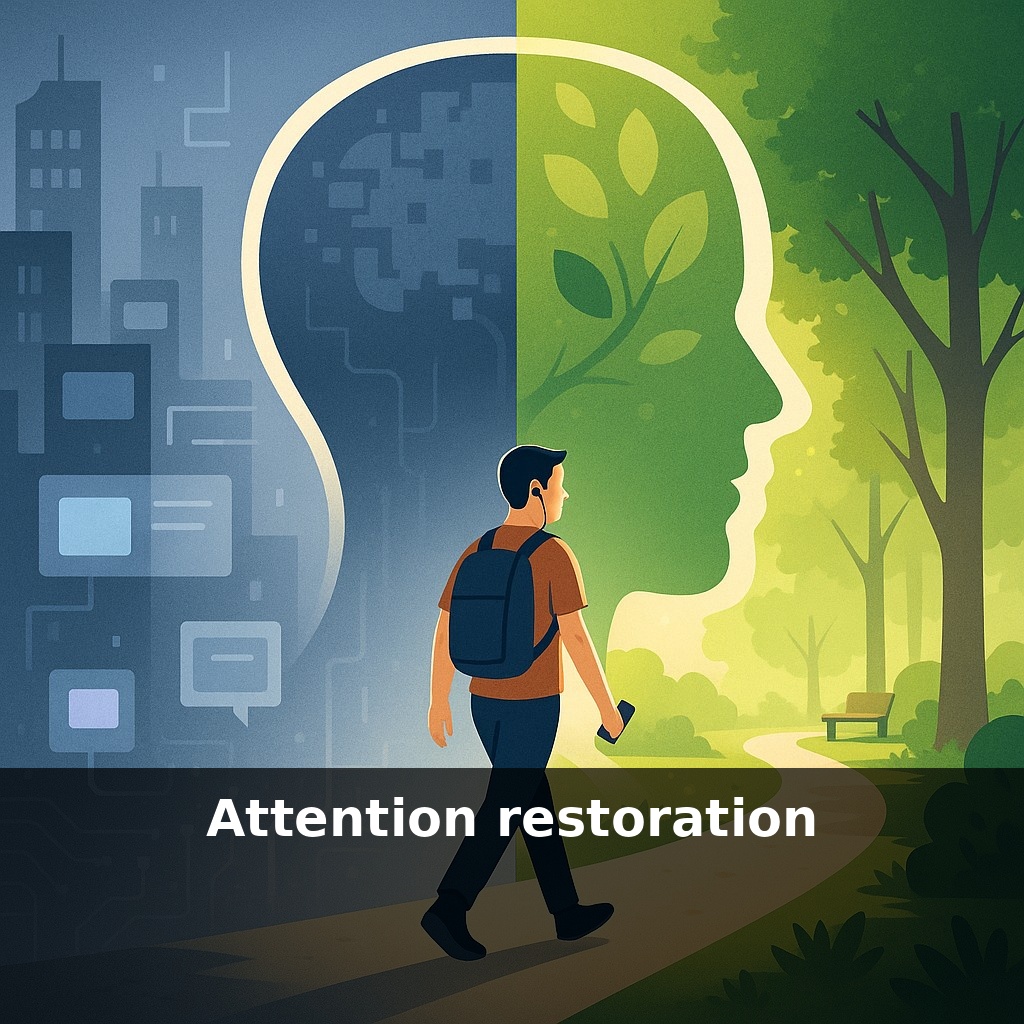
Right now, a short walk under real trees can sharpen your focus more than another cup of coffee. A student leaving a noisy street for a leafy path, a nurse stepping onto a hospital rooftop garden—each returns thinking more clearly. Why does “green” reboot attention so quickly?
A 20-minute nature walk can boost working memory in students by around 20 %, yet most of us still try to “push through” mental fatigue at a desk. In this episode, we move from the idea of a green reboot to what the data actually say about how fast and how much your focus recovers. Researchers have tracked test scores, reaction times, even hospital recovery, and the pattern is striking: when real trees enter the picture, attention measurably improves.
This isn’t just for healthy undergrads. Children with ADHD concentrate better after time in parks than after the same play indoors. Patients who can see a tree from bed need less pain medication and leave hospital sooner. Even screen-based nature—like VR forests—helps a bit, though not as much as the real thing.
We’ll unpack what this means for your workday: how short, deliberate doses of nature can be scheduled like meetings to restore focus before it crashes.
Across labs, one pattern keeps showing up: it’s not only *where* you are, but *how* your mind engages with that place. ART argues that effortless “soft fascination” is the secret ingredient—settings that gently hold your interest without demanding it. Think of strolling through a quiet park, noticing shifting light, distant birds, patchy clouds: there’s enough novelty to keep your mind from ruminating, but no urgent decisions to make. Cities, in contrast, pelt you with micro-choices—traffic, ads, alerts—taxing the same control systems you rely on for deep work.
That distinction matters because it’s actionable. You don’t need a mountain retreat; you need more moments where your surroundings invite curiosity without insisting on it. For some, that might mean a tree-lined side street instead of the main road; for others, a courtyard with plants rather than a busy café. Even within urban environments, there are gradients of cognitive demand. Researchers call these “micro-restorative opportunities”: small pockets in your routine where your mind can idle productively rather than grind.
We’ll look at how to redesign tiny pieces of your day—walks, windows, breaks—so that they tilt toward this softer, more generous kind of attention.
Walk through the evidence and a pattern emerges: certain features of environments keep showing up whenever attention bounces back reliably. ART groups them into four ingredients—being away, extent, fascination, and compatibility—but they’re easier to think of as design rules for your brain.
First, “being away” is less about distance and more about mental distance. It’s the psychological shift when your surroundings stop cueing work, messages, or performance. A leafy courtyard outside your office can do this if, for a few minutes, your brain stops anticipating the next demand. That’s why even a balcony with plants, or a different floor of the same building with a view, can help: the cues change, so the habits of thought tied to your usual desk quiet down.
Second, extent: the sense that what you’re looking at “goes on.” Long, continuous lines of trees, layered views of branches and sky, winding paths that disappear from sight—these give your attention room to stretch without effort. In experiments, photos with depth and coherence tend to restore attention more than isolated potted plants or a single patch of lawn.
Third, fascination. Here, the quality matters more than the quantity. Soft, slow variation—moving water, rustling leaves, shifting clouds, bird movement—nudges your mind just enough to stay gently engaged. In contrast, hard fascination (scrolling social feeds, flashing ads) occupies you fully but doesn’t let the control systems that handle prioritising and resisting distraction rest.
Finally, compatibility: how well a setting fits what you’re trying to do. A dense forest trail might be beautiful, but if you’re anxious about tripping or getting lost, it won’t restore much. Studies find the best outcomes when people feel safe, unhurried, and free to drift: a quiet park bench, a rooftop garden, even a window seat overlooking trees where you can safely let your mind wander.
One helpful way to see this is like a well-designed musical interlude between intense movements in a symphony: it’s not silence, and it’s not another crescendo; it’s structured gentleness that lets core motifs settle so the next peak can land with full force.
Critically, these ingredients scale down. A single tree framed by a window, a planter-filled balcony with some sky and motion, or a short detour along a river path can all contain “enough” being away, extent, fascination, and compatibility to make a measurable difference, especially when they’re woven into your habits instead of treated as rare treats.
Think of how people in different roles secretly “hack” their surroundings. A UX designer in a dense city chooses a second-floor café purely because its window overlooks a canopy instead of traffic; she reviews complex wireframes there and reserves her desk for execution. A startup team in a warehouse district redraws its floor plan so the most cognitively demanding tasks happen at desks that face a planted courtyard, while email and status updates live in an interior room with no view. They aren’t chasing vibes; they’re matching task difficulty to environmental support.
On a smaller scale, a long-haul programmer times code reviews to coincide with a short loop around the block that passes a single line of street trees, noticing that tough bugs often feel less “stuck” right after. A teacher in a windowless school brings in rotating nature posters and a desk plant near where students queue to ask questions, creating a tiny corridor where kids can exhale between classes. Each example shows the same move: pairing your highest-precision mental work with your most forgiving slice of the day’s landscape.
A city built with this science in mind starts to look different: bus stops shaded by trees become tiny mental layovers, schoolyards double as open-air “processing space” between classes, and office rooftops feel less like perks and more like shared tools. Over time, zoning rules, leasing decisions, even real-estate prices could quietly factor in “cognitive yield per square meter,” the way we once optimised only for parking spots and Wi‑Fi coverage.
Your challenge this week: treat nearby nature like a quiet collaborator. Before decisions that feel “high stakes”—a tough email, a key line of code, a tricky conversation—step outside or to a window with real sky for five unhurried breaths. Notice if choices feel less like tight knots and more like pages you can calmly turn and rewrite.