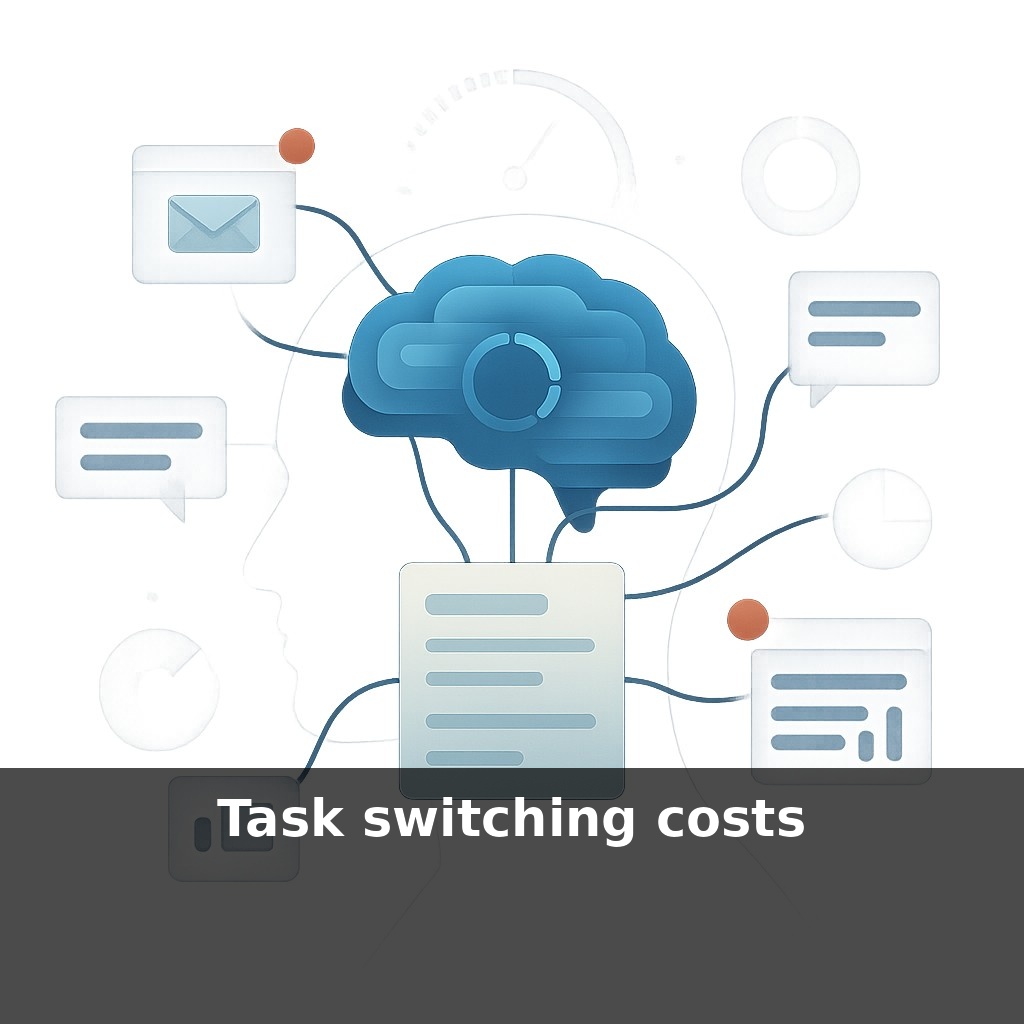
Your brain can lose nearly half its effective focus time the moment you glance at a notification. Now you’re answering a “quick” message, reopening a document, and trying to recall where you were—while your mind quietly burns extra fuel just to switch gears.
Up to 40% of your productive time can vanish in a day—not because you’re lazy, but because your brain is paying a “switching tax” every time you jump between tasks. Email, chat, docs, dashboards: each one quietly asks your mind to load a different rulebook. Answering a colleague’s DM? Prioritizing social nuance and speed. Drafting a report? Precision, structure, and long chains of reasoning. Your executive control system must shut one mode down before the next can fully come online, and that restart isn’t free. Tiny delays—often just 50–100 milliseconds at a time—stack across hours into noticeable drag. Add the hormonal ripple of cortisol and adrenaline from feeling “behind,” and the cost isn’t just lost minutes; it’s a background stress hum that reshapes how clearly you think and how calm you feel while working.
That “tax” doesn’t hit every task equally. Your brain can hop between low‑stakes actions—like skimming headlines and deleting spam—without much friction. The real damage appears when you alternate deep, structured thinking with reactive, shallow work: writing strategy, then checking chat; debugging code, then scanning social feeds. Each mode relies on partly different neural circuits and working‑memory demands, so rapid alternation scatters your mental resources. Over time, your inner sense of momentum erodes: progress feels slower, effort feels higher, and simple decisions start to feel surprisingly heavy.
Open a bug tracker, then glance at Slack, then half‑scan a calendar invite: in lab terms, you’ve just run three different “task sets” through your brain’s control system. Each one has its own rules—what matters, what to ignore, how fast to respond—and your mind has to load and unload those rulebooks with every shift. That loading is where much of the hidden cost lives.
Researchers talk about three layers to this cost. First is the mechanical layer: your working memory must clear out the old instructions (who was I coding this for, what constraint was I respecting?) before it can reliably apply new ones. The more complex or unfamiliar a task’s rules, the longer this clearance takes. That’s why swapping between writing marketing copy and refactoring a legacy system feels heavier than bouncing between two similar tickets.
Second is the decision layer. When several possible actions are active—reply to the ping, tweak the slide, check the metric—your brain has to inhibit all but one. Heavy media multitaskers show weaker filtering here: irrelevant stimuli sneak in more often, so they waste cycles deciding what not to do. It’s not that they’re better at juggling; their filters are leakier, so noise competes harder with the signal.
Third is the emotional layer. Every unfinished thread your mind is tracking behaves like an “open loop,” tugging periodically on attention. Switching while loops are open doesn’t just slow you; it subtly changes what you choose to do next. Under load, people gravitate toward tasks that offer quick closure or social reassurance—answering messages, clearing small items—even when those aren’t the most valuable moves.
In real teams, these layers collide. A product manager splitting an hour between roadmap strategy, stakeholder pings, and live metrics will usually underestimate the cost of fragmentation. On paper it’s “20 minutes each.” In practice, the constant reconfiguration can compress true high‑quality thinking into only a few scattered minutes.
Your challenge this week: choose a single 60‑minute block per day and ruthlessly protect it from switches between unrelated rule sets. You can stay within one domain (e.g., all coding, or all writing), but no hopping to chat, email, or dashboards that demand different rules. Notice not just what you get done, but how your sense of effort and clarity changes across the week.
A designer shifting between Figma, a brand brief, and a fast‑moving Slack thread isn’t just “busy”—they’re repeatedly asking their brain to honor different rules for what “good” looks like. In the mockup, tiny spacing flaws matter; in the brief, narrative cohesion matters; in chat, timing and tone matter. The friction shows up in oddly specific ways: re‑reading the same sentence three times, missing a subtle visual misalignment, or overreacting to a short message because your mind is still primed for visual detail, not social nuance.
Teams feel this collectively. A standup that drifts into live debugging, then status updates, then roadmap debate forces everyone’s minds through multiple rule shifts in 15 minutes. Contrast that with a company like Basecamp, which batches topics into separate, written threads and time‑boxed calls; by narrowing what “mode” people must be in, they reduce those silent reconfiguration costs and create cleaner decisions with less hidden fatigue.
As hybrid work normalizes, expect tools to behave more like considerate colleagues than loudspeakers. Calendar systems may negotiate with inboxes, delaying non‑urgent messages until your mental “rhythm” is least disrupted. Classrooms could train students to treat context shifts like changing musical keys, done deliberately rather than randomly. At a policy level, roles may be redesigned around fewer concurrent streams, making “focus‑preserving” workflows a measurable productivity metric.
Treat your day like arranging songs in a setlist: group similar “tracks” so your mind doesn’t constantly change tempo. As you notice which combos feel smooth or jarring, you’re mapping your personal switching limits. That map is power—you can redesign your tools, meetings, and habits to match how your attention actually works, not how apps demand it.
Before next week, ask yourself: 1) “Looking at yesterday’s work, which specific moments did I jump from email/Slack to ‘just quickly check’ something else, and what exactly did that interruption cost me in lost momentum or rework?” 2) “If I had to protect one 60–90 minute ‘no-switching’ block tomorrow for my most cognitively demanding task (e.g., deep writing, coding, strategy thinking), when would it realistically fit, and what distractions would I need to turn off or postpone to make it stick?” 3) “When I feel the urge to switch tasks mid-stream, what story am I telling myself (e.g., ‘I might miss something important’), and how true is that really compared to the measurable benefits of finishing what I’m doing first?”