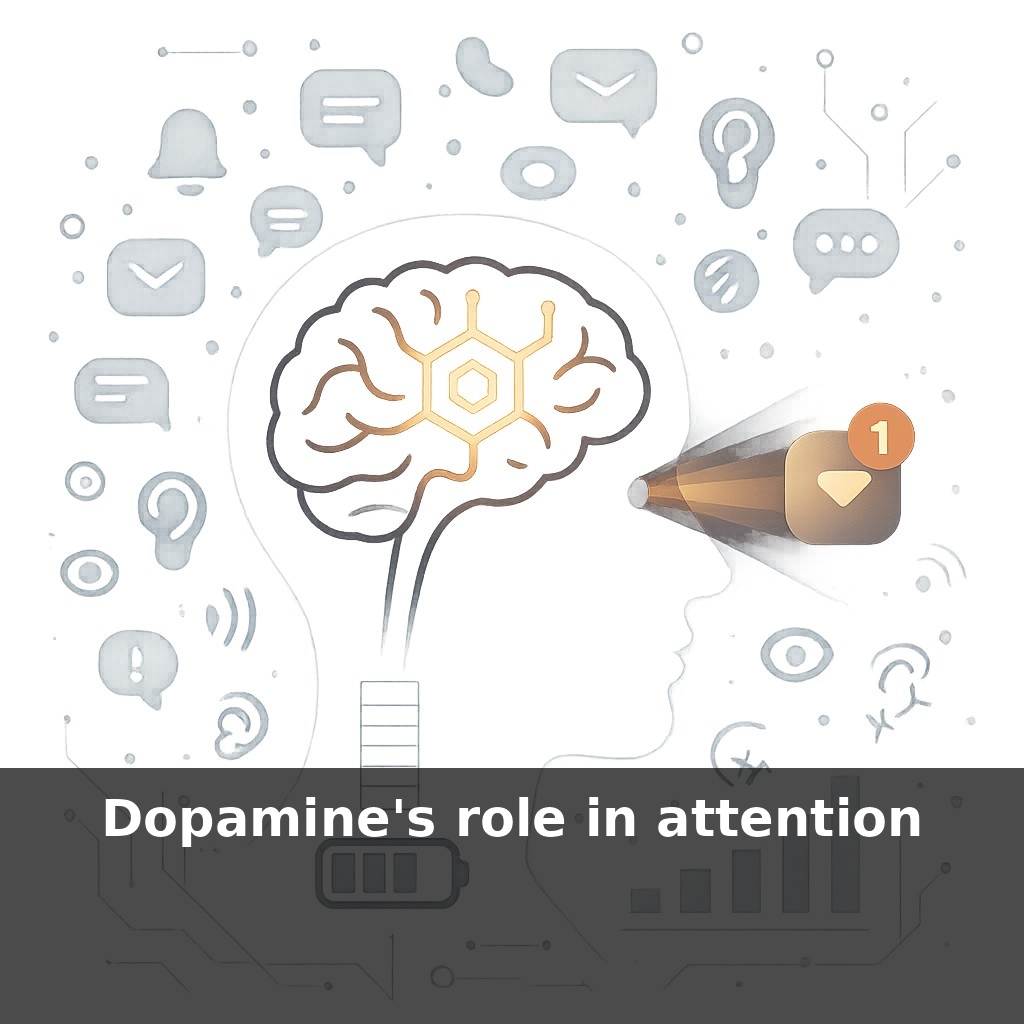
Right now, as you listen, your brain is quietly bidding on thousands of possible distractions—and only a tiny handful win. One notification, one memory, one itch on your arm. Why those, and not the others? That mystery lives inside a single brain chemical: dopamine.
Every time you lock onto a task—or fail to—your brain is doing something closer to “budgeting” than “drifting.” It has limited metabolic resources, so it can’t afford to treat every email, thought, and sensation as equally important. This is where dopamine quietly shifts from abstract chemistry to something you feel as “I care about this” or “my mind keeps slipping away.”
In your prefrontal cortex, tiny changes in dopamine can tilt this budget one way or another: a little boost, and the spreadsheet you’ve been avoiding suddenly feels compelling; a slight dip, and even finishing a short message feels weirdly effortful. Meanwhile, deeper reward circuits tag certain cues—your phone lighting up, a colleague’s voice, a half-remembered song—as “priority items.”
Across a day, these micro-adjustments create your personal rhythm of sharp work, dull slog, and restless scroll.
Across hours and days, those tiny dopamine shifts don’t just change how “on task” you feel—they reshuffle what even counts as worth your effort. A message from your boss, a half-finished design, the pull of a news feed: they’re all competing bids, but the “exchange rate” keeps changing with sleep, stress, food, and even time of day. That’s why a problem that felt impossible at 10 a.m. can seem trivial after lunch, or why late-night scrolling feels magnetic while your long-term goals fade into the background. Your brain’s priorities aren’t fixed; they’re constantly being repriced.
Here’s the twist most productivity advice ignores: attention doesn’t fail in one single way. It breaks down through different dopamine “profiles,” and they feel very different from the inside. If you misread which one you’re in, you’ll often choose the exact wrong fix.
One pattern is low *tonic* dopamine in the background. Subjectively, this feels like “everything is gray.” Tasks look flat on the horizon; you know what to do, but there’s no internal “oomph” to start. People in this state often blame themselves for laziness, but the more accurate description is: the system isn’t flagging *anything* as worth the energy cost. You’ll notice lots of aimless tab-switching, rereading the same sentence, or drifting to mildly pleasant, low-effort activities.
Another pattern is high but *scattered* dopamine signaling. This doesn’t feel flat at all—it feels jumpy. Everything looks a bit important, so your focus keeps being yanked from one “urgent” cue to the next. Here you might fire off half-replies, open new docs without finishing old ones, or compulsively check dashboards and chats. From the outside it can look productive—lots of motion—but your completion rate quietly drops.
Then there’s distorted *phasic* bursts: big spikes for fast, variable rewards (messages, feeds, notifications) and weak responses for slow, single-channel work. This is the classic “I can doomscroll for an hour but can’t write for five minutes” pattern. The brain has been trained, often unintentionally, to expect quick novelty hits, so long, quiet tasks feel strangely airless.
These profiles also interact with biology you didn’t choose. That lower transporter density in human cortex means a small pharmacological nudge—or a strong coffee for a sensitive person—can flip you from flat to edgy. Genetic variants like the DAT1 10-repeat can tilt some people toward faster dopamine clearance and chronic “low-tonic” days, even with good intentions and discipline.
What makes this practically useful is noticing the *signature* of your breakdown, not just the fact that you’re “distracted.” The interventions that help a flat profile—strong external structure, a salient deadline, a short burst of stimulating collaboration—can backfire badly in the scattered profile, where the real medicine is constraint: fewer inputs, narrower goals, slower switching. Understanding which mode you’re in is the first step toward choosing strategies that actually fit your brain, instead of fighting it.
Think of a busy product team mid-sprint: they don’t just “work harder,” they decide which tickets make it into the next release. Your brain does something similar with tasks across your day, but its backlog grooming is driven heavily by *how* those dopamine patterns line up with what’s in front of you.
Concrete example: a software engineer with the DAT1 10-repeat variant might feel oddly blank during morning standup—no story card feels compelling—yet later that afternoon, when their natural dopamine curve rises, they slip into two hours of deep debugging without forcing it. Same brain, same tasks, different internal weighting.
Or consider a founder who stacks back-to-back pitch meetings at their personal dopamine peak. They’re not “more disciplined” then; their brain is simply more willing to treat long-term investor relationships as worth the metabolic cost, instead of defaulting to inbox triage. Over weeks, these small timing choices snowball into a visible gap in output between people who accidentally “surf” their biology and those who constantly swim against it.
Whole industries now prototype experiences to latch onto those dopamine profiles with A/B-tested precision. Think of feeds, alerts, even “productivity” tools as rival street vendors calling to your attention as you walk past. Future regulation may treat cognitive load like sugar: not banned, but labeled, taxed, and nudged. Expect apps that disclose “attentional intensity” scores and workplaces that schedule key decisions for each person’s most stable window of focus.
Treat this less like fixing a flaw and more like tuning an instrument: across your day, certain tasks “resonate” better with your current dopamine pattern. You can experiment with matching deep work to your most stable hours and lighter, social, or exploratory work to wobblier times, quietly redesigning your schedule around when your brain is most willing to care.
Before next week, ask yourself: “Looking at when I mindlessly check my phone or social media, can I spot the exact cues (time of day, emotion, app) that are hijacking my dopamine and attention most often?” Then ask: “If I turned just one of those high-dopamine, low-value behaviors (like scrolling Reels at night) into a ‘dopamine bridge’ toward something I care about (like reading 5 pages or finishing one focused work block), what would that look like in practice for me today?” Finally: “What is one simple way I can make my highest-value, attention-heavy task more rewarding right now—such as pairing it with a favorite playlist, a timer-based sprint, or a specific ‘win’ I’ll celebrate when I finish 20 minutes of deep focus?”